
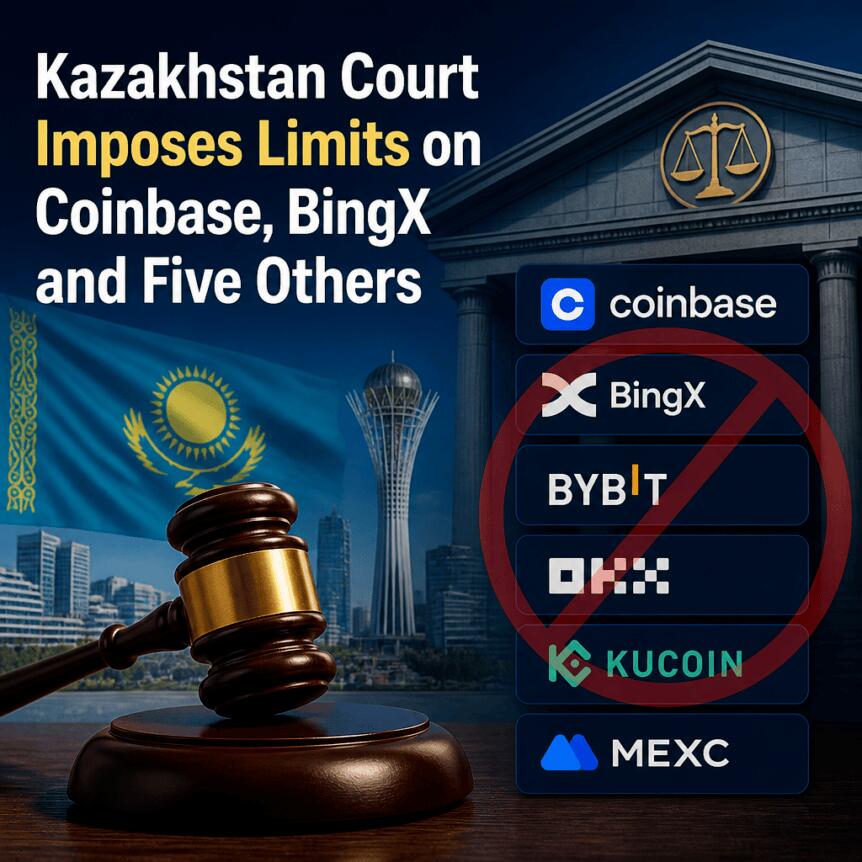
Kazakhstan’s Astana International Financial Centre (AIFC) court has issued injunctions against six crypto platforms for providing digital-asset services without the required authorization in the AIFC jurisdiction and has broadened app-access restrictions to cover major app stores. The move underscores the AIFC’s push to enforce its licensing framework and increase compliance standards for firms operating in the country’s financial hub.
According to the Astana Financial Services Authority (AFSA), the regulator pursued legal action after identifying platforms advertising and offering digital-asset-related services in Kazakhstan without permission. AFSA said the court’s orders are intended to protect users by ensuring that only licensed providers can offer services under the AIFC’s rules.
Key takeaways
- The AIFC court issued injunctions targeting six unlicensed platforms: BingX, Bitcoin.com, Huobi Global (HTX), BitMart, Coinbase, LBank, and WEEX, with LBank later removed after its operator blocked access in Kazakhstan.
- AFSA extended the restrictions to app-store operators, including Google and Apple, to limit access to the affected platforms within the jurisdiction.
- AFSA argues that users of unlicensed services miss safeguards required of licensed firms, including asset protection and complaint/dispute handling.
- Kazakhstan’s broader regulatory split remains: the National Bank oversees digital-asset providers outside the AIFC, while AFSA enforces rules within the AIFC.
- AFSA says it previously warned more than 20 platforms about AIFC requirements in 2025, with some voluntarily restricting app access or seeking licenses.
Injunctions ordered under AIFC licensing rules
AFSA said the court issued the injunctions after AFSA sued operators of crypto platforms for offering digital-asset services without authorization. In its announcement, AFSA stated that the Sept. 15 order listed multiple entities, and an amendment three days later removed LBank from the injunction list after its operator took steps to block access in Kazakhstan.
The regulator also indicated that app-store operators were included in the scope of the restrictions. In addition to the named platform operators, AFSA’s statement said Google and Apple are covered, with geographic restrictions applied for access to the remaining platforms.
AFSA did not cite any changes in the underlying licensing standards; instead, the emphasis is on enforcement—specifically that the platforms were advertising and operating without the AIFC permission required for digital-asset-related services.
Why AFSA says unlicensed platforms are a problem
AFSA framed the decision as part of its supervisory and enforcement strategy targeting firms that operate outside the licensing regime. The authority said users of unlicensed platforms do not receive safeguards that licensed firms are expected to provide.
AFSA listed several requirements it associates with licensed operators, including asset protection measures, disclosure obligations, complaint handling procedures, and dispute resolution mechanisms. The implication for users is straightforward: without licensure, there is no assurance that service providers follow the AIFC’s consumer and risk-management rules.
AFSA also highlighted the regulatory division within Kazakhstan. It noted that Kazakhstan’s National Bank oversees digital-asset service providers outside the AIFC, while AFSA enforces the AIFC’s framework within the financial centre. That distinction matters because platforms may face different regulatory expectations depending on where they are authorized to operate.
Previous warnings and a partial outcome from earlier outreach
AFSA said it began warning platforms about AIFC rules in 2025, notifying more than 20 firms about compliance requirements. The regulator reported that nine platforms voluntarily restricted app access in Kazakhstan, while seven said they intended to seek licenses.
AFSA stated it withdrew its claims against the nine platforms that restricted access, while the injunctions proceeded against the remaining six. This sequencing suggests a two-track approach: where operators take steps short of full licensing—such as limiting availability—AFSA may choose not to pursue full litigation, but it will continue court action against firms that remain accessible and continue offering services without authorization.
AFSA CEO Evgeniya Bogdanova attributed the ruling to “extensive and consistent efforts” by its supervision and enforcement teams to address the activity of unlicensed crypto platforms that advertised without authorization and offered digital asset-related services in Kazakhstan.
Cointelegraph attempted to seek comment from BingX, Coinbase, and Huobi Global, but responses were not immediately available at the time of publication.
Broader enforcement trend in Kazakhstan’s crypto regulation
This AIFC court decision adds to a pattern of Kazakhstan restricting access to crypto trading services and platforms that operate without proper authorization. Earlier coverage from Cointelegraph referenced a 2023 action in which Kazakhstan’s Financial Monitoring Agency blocked access to almost 1,000 crypto exchanges serving the country’s citizens without proper registration.
While the 2023 action came through a different regulatory channel, the latest case reflects the same underlying objective: reducing the availability of unlicensed platforms and shifting users toward regulated channels. For market participants, it also reinforces that platform accessibility can be affected not only by what firms say they do, but by whether they meet local legal requirements.
For traders and users, the practical risk is disruption—especially if app-store restrictions limit downloads or updates. For companies considering entering Kazakhstan, the takeaway is that operating without AIFC authorization can lead to rapid enforcement outcomes, including court-ordered measures that involve distribution channels such as major app stores.
AFSA’s next signals to watch are whether additional platforms follow the path of voluntary app-access restriction or license applications, and whether app-store enforcement expands further. The key uncertainty remains how quickly platforms can obtain authorization if they pursue licensing and whether similar injunctions could be extended to other providers operating without the required permission under AIFC rules.
https://www.cryptobreaking.com/kazakhstan-court-imposes-limits-on/?utm_source=blogger%20&utm_medium=social_auto&utm_campaign=Kazakhstan%20Court%20Imposes%20Limits%20on%20Coinbase,%20BingX%20and%20Five%20Others%20
Comments
Post a Comment