
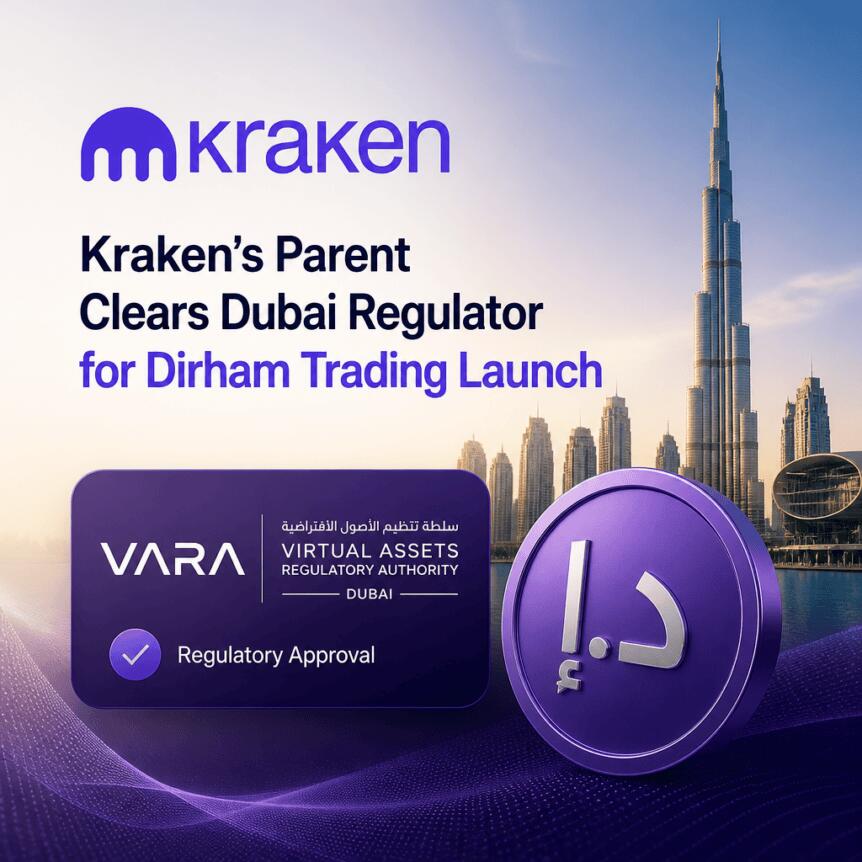
Kraken’s parent company, Payward, has received regulatory approval in the United Arab Emirates, clearing the way for the exchange’s local entity to begin offering spot and margin trading to clients in the country. The development comes after the Virtual Assets Regulatory Authority (VARA) authorized Payward FZCO to provide virtual-asset services under Dubai’s framework.
Payward said that when Kraken launches in the UAE, customers will be able to trade crypto using UAE dirham (AED) pairs and withdraw funds directly in AED. The company is aiming to start “in the coming weeks,” following what it describes as full market approval.
Key takeaways
- Payward FZCO, Kraken’s UAE entity, received a VARA virtual asset service provider (VASP) license dated Oct. 6.
- Kraken’s UAE rollout will initially include spot and margin trading with AED-denominated pairs.
- Clients will be able to make direct deposit withdrawals in UAE dirhams.
- The approval expands access to services for retail, professional, and institutional investors under VARA oversight.
- Dubai’s VARA registry shows a growing number of licensed virtual-asset providers compared with earlier in 2026.
VARA license clears the UAE path for Kraken
According to Payward’s announcement, the approval covers the company’s local entity, Payward FZCO. VARA’s public register indicates that the regulator issued the VASP license on Oct. 6, which authorizes Payward to offer management and investment services as well as broker-dealer services.
Payward said the license positions it to serve retail, professional, and institutional investors. It also marks a continuation of an earlier regulatory step: the company previously received preliminary approval in May 2026, signaling that the process had been underway before full authorization.
From an investor and market-structure perspective, full approval matters because it reduces uncertainty around whether regulated local operations can move beyond planning into actual client onboarding and trading. For traders, it also determines whether a platform can support local fiat flows and product access under the UAE’s specific rules.
What Kraken clients will get at launch in the UAE
At launch, Payward said Kraken’s UAE clients will be able to trade spot and margin products using AED-denominated pairs. The company also highlighted that users can perform deposit withdrawals directly in UAE dirhams, an element that can be crucial for liquidity and user experience—particularly for customers who prefer to transact in local fiat rather than route funds through external exchanges or conversions.
Payward did not outline additional product details in the provided information, but the focus on AED pairs and withdrawals suggests a rollout designed around enabling straightforward entry for UAE-based users, while keeping the initial feature set aligned with what VARA permitted under the local licensing structure.
VARA’s licensed market keeps expanding
VARA’s public register currently lists 58 licensed providers, up from 49 active companies in May 2026. That increase signals continued momentum in Dubai’s virtual-asset regulatory pipeline and the broader institutionalization of crypto-related offerings in the region.
For market participants, a rising number of licensed entities can mean more competition for liquidity, pricing, and institutional access—but it can also raise the bar for compliance and risk controls as firms operate under increasingly defined expectations. In that sense, Kraken’s UAE move is not just a single-company story; it reflects the ongoing build-out of regulated exchange infrastructure in a major global financial hub.
Competition grows as banks and trading platforms expand
Kraken’s UAE authorization comes alongside other moves by established financial firms to expand crypto access under relevant UAE regulations. In September, Standard Chartered launched spot Bitcoin and Ether trading for institutional clients in the UAE via its Dubai International Financial Centre (DIFC) branch, regulated by the Dubai Financial Services Authority. Earlier, in August, trading platform Capital.com revealed plans to offer spot crypto services in the UAE after its affiliate, Capital Vault, secured a virtual-asset license from the country’s Capital Market Authority (CMA).
Taken together, these announcements point to a broader pattern: rather than crypto access being limited to specialist platforms, regulated banking and trading infrastructure is increasingly being built or adapted to support digital assets in different parts of the UAE’s regulatory landscape.
As Payward targets a UAE launch in the coming weeks, the next watchpoint for users and traders will be the exact timing of Kraken’s onboarding and how AED deposits and withdrawals are implemented operationally, alongside any phased rollout of trading features beyond spot and margin.
https://www.cryptobreaking.com/krakens-parent-clears-dubai-regulator/?utm_source=blogger%20&utm_medium=social_auto&utm_campaign=Kraken’s%20Parent%20Clears%20Dubai%20Regulator%20for%20Dirham%20Trading%20Launch%20
Comments
Post a Comment