
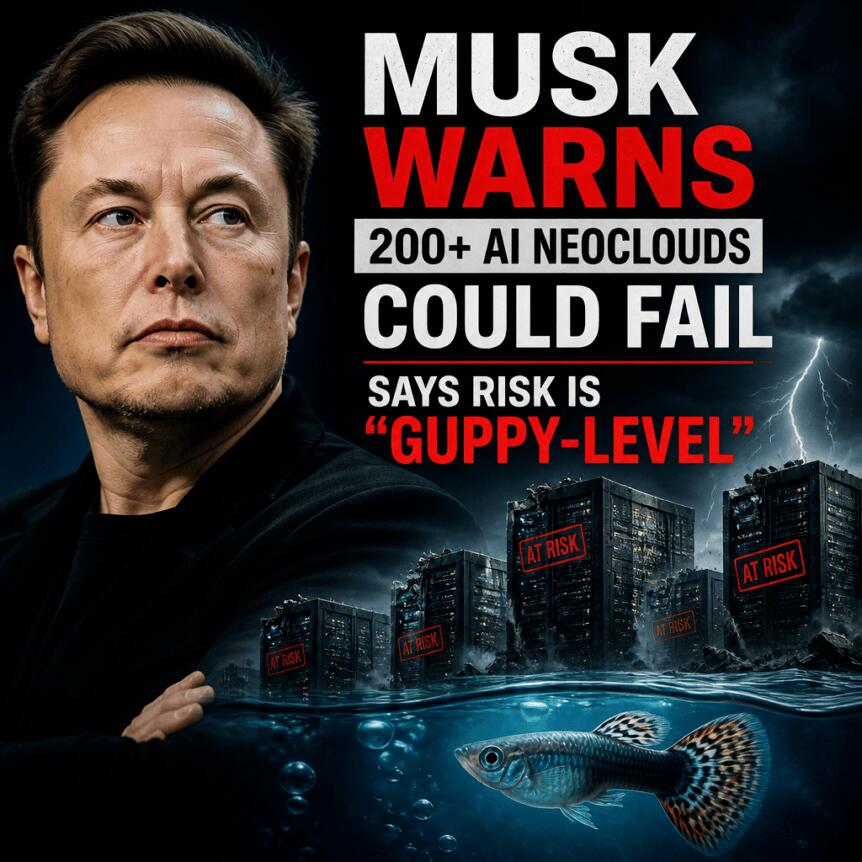
Elon Musk has warned that a large share of “neocloud” companies—specialist AI cloud providers that rent GPU-based compute—may be unable to survive as lenders become more selective about who gets financing. In comments posted on X, Musk suggested that more than 200 such providers could be forced into failure or consolidation.
Musk’s warning points to a funding squeeze driven by tighter credit standards, arguing that companies without substantial non–AI-data-center revenue streams are at a disadvantage. The issue matters beyond AI infrastructure, since some Bitcoin mining firms have moved toward building or supplying capacity for AI workloads through hosting and compute services.
Key takeaways
- Musk said lenders have largely stopped financing neoclouds that lack significant revenue outside AI data centers.
- He predicted “200+” neoclouds will face “guppy-level” failures and consolidation, though he did not quantify which will survive.
- Gartner previously forecast that more than 80% of neocloud providers could stop operating independently by 2030, citing investment returns pressure.
- Bitcoin miners that have pivoted toward AI infrastructure (via hosting or compute services) may face the same credit and profitability constraints as other AI-focused operators.
- Recent reporting indicates SpaceX’s “Super Intelligence” business is growing quickly, suggesting diversification can help fund AI-related expansion.
Musk ties neocloud survival to lender selectivity
On X, Musk said financing has tightened for companies without meaningful revenue beyond AI data centers. In his framing, that shift in lending behavior makes independent survival harder for specialist compute providers, which typically depend heavily on securing capital for GPU-heavy infrastructure and then converting that capacity into service revenue.
Musk contrasted that situation with SpaceX, saying it obtained $40 billion in debt financing for GPUs because of its investment-grade profile and revenue streams from other parts of its business, including Starlink satellite internet and rocket operations. The implication is that AI infrastructure is not being funded indiscriminately; lenders want multiple revenue anchors rather than a single line of business tied to rapidly evolving AI compute demand.
A “neocloud” generally refers to a cloud provider built around renting AI computing power—often through data centers filled with GPUs. Musk argued that under the new financing posture, many of these providers could be pushed into rapid downsizing, mergers, or closures.
Gartner’s forecast raises the stakes for AI infrastructure economics
Musk’s warning aligns with an earlier position from research firm Gartner. In an October forecast, Gartner said that more than 80% of neocloud providers could cease operating independently by 2030. Gartner’s rationale, as described in the forecast, centers on whether the sector can generate sufficient returns from massive AI infrastructure investments.
According to Gartner, AI providers are expected to spend nearly $1 trillion on infrastructure in 2026 and roughly $6 trillion between 2027 and 2030. However, Gartner said there is not enough revenue potential—at least not across the whole industry—to translate those investments into consistently profitable outcomes for every provider.
The pressure may be especially acute for neoclouds because they must earn enough directly from AI computing services to sustain operations and service debt. In contrast, larger cloud companies can potentially absorb or smooth AI infrastructure investment over longer periods due to more diversified revenue sources, Gartner said.
Gartner also suggested that even strong growth in spending may not be enough to eliminate the return gap. The forecast projected that AI-optimized infrastructure-as-a-service spending would rise from $66 billion in 2027 to $174 billion in 2030, but it warned that most providers may struggle to recover their investments before the current generation of AI chips is replaced—an important constraint in a hardware-intensive industry where technology cycles can quickly change economics.
Why this could matter for the Bitcoin mining → AI infrastructure shift
The funding-and-profitability problem raised by Musk and Gartner may have direct relevance for elements of the crypto sector. Some Bitcoin miners have moved toward AI-adjacent infrastructure, including hosting arrangements and compute rentals.
Cointelegraph previously reported that IREN expanded into AI cloud services by renting computing power to customers. The same coverage also noted that Core Scientific provides data center hosting for neocloud customers, including CoreWeave. These models sit at the intersection of creditworthiness, energy and compute economics, and the ability to secure long-term demand.
If lenders increasingly require robust revenue beyond a single AI infrastructure line, then operators—whether traditional miners or specialist AI infrastructure companies—may find it harder to finance further expansion. That does not automatically mean AI compute demand will fall, but it could reshape who can build capacity, who gets funded, and how quickly capital-intensive expansions can proceed.
It also raises a broader question for investors watching crypto-linked infrastructure: the sector’s pivot to AI may reduce some exposure to pure mining cycles, but it may not eliminate the underlying dependence on capital markets and debt financing, especially in periods when credit tightens.
SpaceX’s “Super Intelligence” growth underscores the diversification argument
Musk’s comments came days after SpaceX reported that its “Super Intelligence” business generated $7.6 billion in third-quarter revenue, up 830% year over year. Cointelegraph reported that the business accounted for more than half of SpaceX’s $14.6 billion in quarterly sales.
SpaceX attributed the growth to new cloud services agreements, its acquisition of Cursor, and increased adoption of its Grok AI model, according to the same report. The juxtaposition with Musk’s neocloud financing warning is notable: SpaceX’s ability to expand appears to be supported not just by AI demand, but by broader business strength and revenue diversification—exactly the factor Musk emphasized when describing why some lenders are willing to provide large-scale GPU financing.
For the wider neocloud market, that contrast may help explain why funding could concentrate among providers with stronger balance sheets or diversified revenue, while smaller specialist operators could face higher barriers—especially if hardware cycles and profitability timelines do not align quickly enough.
Readers should watch whether lenders continue tightening credit for GPU-heavy compute operators, and whether consolidation accelerates among neocloud providers as Gartner suggested. The next key test will be whether surviving operators can translate AI infrastructure spending into durable, lender-friendly returns before the next wave of AI chip upgrades changes the economics again.
https://www.cryptobreaking.com/musk-warns-200-ai-neoclouds/?utm_source=blogger%20&utm_medium=social_auto&utm_campaign=Musk%20Warns%20200+%20AI%20Neoclouds%20Could%20Fail,%20Says%20Risk%20Is%20“Guppy-Level”%20
Comments
Post a Comment