
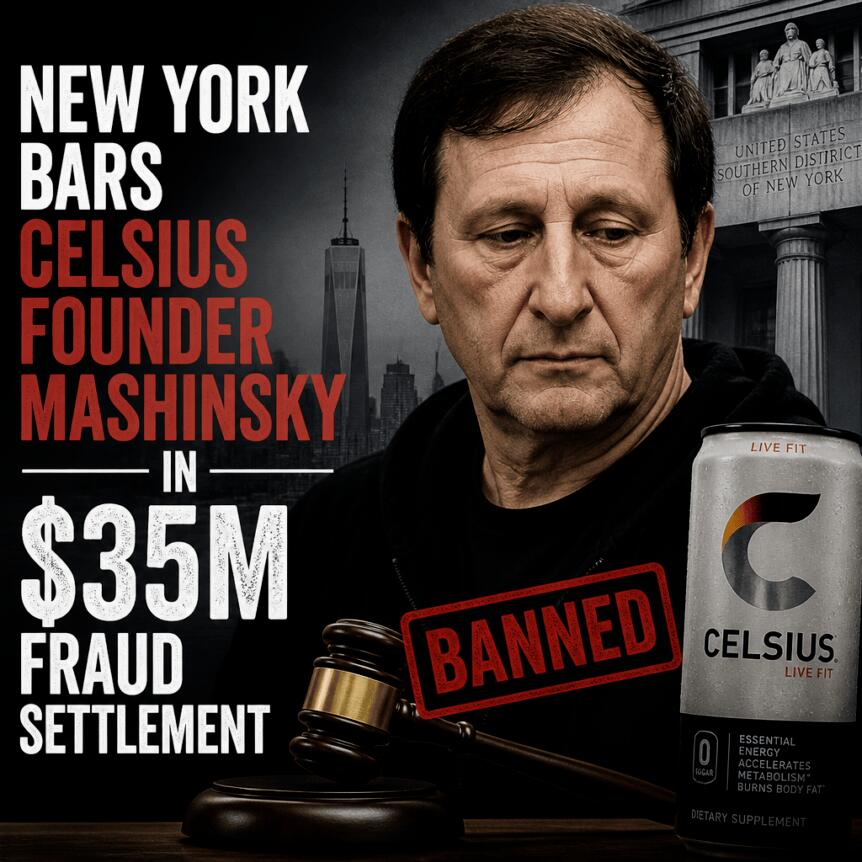
Former Celsius CEO Alex Mashinsky has been permanently barred from working in the cryptocurrency, securities, and commodities industries under a settlement with New York Attorney General Letitia James announced Friday. The deal also imposes conditional payments that could reach as much as $35 million, tying the penalties to whether Mashinsky forfeits additional funds and serves out his full prison term.
According to the New York Attorney General’s Office, the settlement resolves a 2023 civil case accusing Mashinsky of misleading hundreds of thousands of investors about the safety of Celsius prior to its collapse in 2022.
Key takeaways
- New York has secured a permanent industry ban against Alex Mashinsky covering cryptocurrency, securities, and commodities work.
- The settlement includes conditional payments up to $35 million if specific forfeiture and sentencing conditions are not met.
- Mashinsky is already serving a 12-year federal prison sentence tied to securities and commodities fraud.
- Regulators previously acted separately: the CFTC and FTC imposed bans and penalties before New York’s latest agreement.
- Celsius’s collapse left a major funding gap, with New York stating that billions have since been distributed to creditors through bankruptcy proceedings.
A permanent bar tied to conditional penalties
Under Friday’s settlement, Mashinsky must pay New York $25 million if he fails to forfeit an additional $10 million to the federal government beyond assets that have already been forfeited. The agreement also calls for another $10 million payment if he does not serve his full prison sentence.
The attorney general’s office framed the terms as an accountability measure for what it described as a promise to investors that Celsius was a secure place to keep savings—followed by an outcome that left customers without the funds they believed were protected.
New York Attorney General Letitia James also noted in the announcement that the settlement addresses allegations that Mashinsky presented Celsius as safe while the firm’s risk profile deteriorated ahead of its collapse.
How Celsius was sold to customers
New York’s 2023 lawsuit described Mashinsky as marketing Celsius as a safer alternative to traditional banking while offering high yield returns. The filing alleged that Celsius advertised rates as high as 17% and, at the same time, concealed risky investment positions and accumulating losses.
In that case, New York also pointed to the company’s scale and stress points. According to the lawsuit, by early 2022 Celsius had attracted roughly $20 billion in digital assets but struggled to generate enough revenue to sustain promised returns, leading to increasingly risky conduct. The CFTC, cited in the court record referenced by New York’s complaint, later emphasized the mismatch between the yield promises and the ability to support them.
The timeline culminated in a liquidity crisis for customers: Celsius froze customer withdrawals in June 2022 and filed for bankruptcy the following month. Its bankruptcy disclosures included a shortfall of more than $1 billion between assets and liabilities.
New York further stated that as of August 2026, more than $3.4 billion had been distributed to Celsius creditors through bankruptcy proceedings, underscoring the long-running cleanup after the platform’s failure.
Where the case fits within federal enforcement
Friday’s New York settlement follows earlier actions by other U.S. regulators and courts. In June, the Commodity Futures Trading Commission (CFTC) permanently barred Mashinsky from trading and registering with the agency, according to coverage citing the CFTC’s enforcement action.
Earlier still, a Federal Trade Commission (FTC) settlement in April barred him from working in crypto and finance and required a $10 million payment, alongside a largely suspended $4.72 billion judgment. Separately, the SEC reached an agreement in principle with Mashinsky in September to settle its civil lawsuit, which a federal judge dismissed without prejudice on Sept. 29 pending final settlement documentation.
Criminally, Mashinsky is serving a 12-year federal prison sentence for fraud. The federal case was based on his December 2024 guilty plea to securities and commodities fraud, according to the U.S. Department of Justice.
Ongoing attempts to unwind the conviction
Despite the growing set of regulatory restrictions, Mashinsky has pursued efforts to challenge the underlying federal conviction and sentence. Since May, he has been seeking to vacate the judgment, representing himself in the proceedings.
Federal prosecutors opposed the attempt in August, describing his arguments as “without merit,” according to the reporting referenced in the article. A judge denied his request for discovery, and a later order on Oct. 5 left the decision unchanged.
Mashinsky was given until Dec. 11 to respond to the government’s opposition to his petition. The settlement’s conditional payment structure makes the compliance timeline particularly significant: if he does not serve his full prison term, the additional $10 million payment to New York becomes due.
For investors and industry participants, the key question now is how these overlapping enforcement tracks—criminal punishment, civil regulator bans, and bankruptcy distributions—continue to shape the boundaries for crypto lending and custody models. Readers should watch whether Mashinsky’s petition progresses and whether any further settlements or orders tighten restrictions for other figures associated with Celsius-era conduct.
https://www.cryptobreaking.com/new-york-bars-celsius-founder/?utm_source=blogger%20&utm_medium=social_auto&utm_campaign=New%20York%20Bars%20Celsius%20Founder%20Mashinsky%20in%20$35M%20Fraud%20Settlement%20
Comments
Post a Comment