
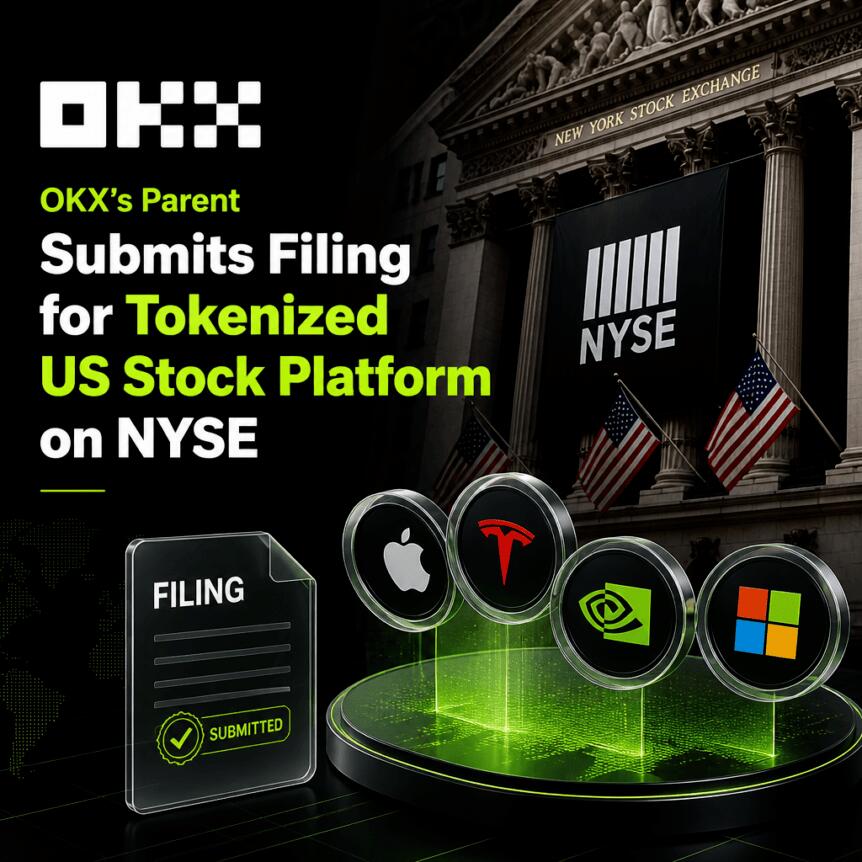
An OKX joint venture has filed with the U.S. Securities and Exchange Commission (SEC) to launch a tokenized stock trading venue, signaling another push toward onchain access to traditional markets under the agency’s newer regulatory “innovation” framework.
OKXICE LLC—formed as a 50-50 venture between crypto exchange operator OKX and Intercontinental Exchange (ICE), the parent of the New York Stock Exchange—submitted its notice to pursue a tokenized securities venue (TSV). The filing points to permissioned trading of tokenized U.S. exchange-listed shares using onchain liquidity tooling.
Key takeaways
- OKXICE has filed with the SEC to launch a tokenized securities venue under the SEC’s innovation exemption.
- The proposed platform would list 63 U.S.-stock symbols, covering large technology and consumer names as well as some crypto-related equities.
- Trading is planned to run 24/7 using permissioned Uniswap v4 liquidity pools deployed on XLayer.
- Each tokenized stock would be paired with a stablecoin—USDC, USDG, or USDT—depending on the specific market.
Filing targets tokenized stocks under the SEC innovation exemption
According to the SEC filing described by the venture, OKXICE intends to operate a TSV under the SEC’s temporary “innovation exemption.” This exemption—issued in September—allows limited trading of tokenized U.S. stocks on certain onchain venues, provided specific conditions are met.
The innovation exemption is designed to test how tokenized National Market System (NMS) stocks can be traded using automated market makers and liquidity pools, rather than relying solely on traditional brokerage or exchange mechanisms.
In its public-facing materials tied to the plan, OKXICE co-chair Andrew Cuomo said: “The digital asset revolution is already transforming our financial system. Tokenized securities are part of what comes next.” Earlier coverage of the SEC’s framework emphasized that these rules are intended to create a controlled environment for onchain securities trading while the SEC evaluates risk and market structure questions.
Proposed symbol list includes mainstream equities and crypto-linked companies
A public notice dated Oct. 4 lists 63 proposed stock symbols. The selection includes widely traded U.S. companies such as Nvidia, Apple, Microsoft, and Tesla.
The list also includes at least several crypto-related companies, including Strategy, Coinbase, Circle, and Bitgo, highlighting how the proposed venue may target a blend of mainstream market exposure alongside firms closely associated with digital assets.
For investors, the importance of the symbol list is practical: the ability to tokenize and trade particular equities is not universal by default. A curated set of shares can influence liquidity, onboarding demand, and the likelihood of successful pilot conditions—especially when onchain trading is paired with specific stablecoin rails.
24/7 trading and stablecoin pairings: how OKXICE says it will work
OKXICE says the platform plans to operate around the clock—24 hours a day, seven days a week—leveraging permissioned Uniswap v4 liquidity pools deployed on XLayer.
In the proposed design, each tokenized stock would be paired with one of three stablecoins: USDC, Global Dollar (USDG), or USDt (USDT). This matters because stablecoin choice can affect settlement mechanics, liquidity depth, and operational complexity for market participants trying to interact with the venue.
By anchoring tokenized shares to established stablecoin pairs, the venture appears to be aiming for tighter integration between traditional equity tokenization and onchain trading infrastructure. That also reflects a broader industry pattern: while tokenized securities introduce new compliance and custody considerations, the trading layer often still depends on stablecoin liquidity for execution.
What happens next: SEC review and the market-structure challenge
The joint venture’s filing comes after the SEC introduced its temporary exemption mechanism in September, creating a pathway for certain tokenized stock trading activity on eligible venues. Under that framework, tokenized securities venues are allowed to offer permissioned trading of tokenized NMS stocks through automated market makers and liquidity pools—an approach designed to test whether onchain market structures can operate within established regulatory guardrails.
Still, uncertainty remains around how quickly the SEC will process and approve TSV activity and what operational details will be scrutinized most closely. Market participants should watch for developments tied to authorization conditions, compliance requirements, and how the SEC expects venues to manage market integrity, liquidity, and investor protections in a permissioned onchain trading environment.
For readers tracking tokenized securities, OKXICE’s submission is a concrete step from conceptual tokenization toward a regulated, onchain trading pilot—one that will likely shape how other projects interpret the SEC’s innovation exemption and whether 24/7 onchain trading for equities can scale beyond initial symbol sets.
https://www.cryptobreaking.com/okxs-parent-submits-filing-for/?utm_source=blogger%20&utm_medium=social_auto&utm_campaign=OKX’s%20Parent%20Submits%20Filing%20for%20Tokenized%20US%20Stock%20Platform%20on%20NYSE%20
Comments
Post a Comment