
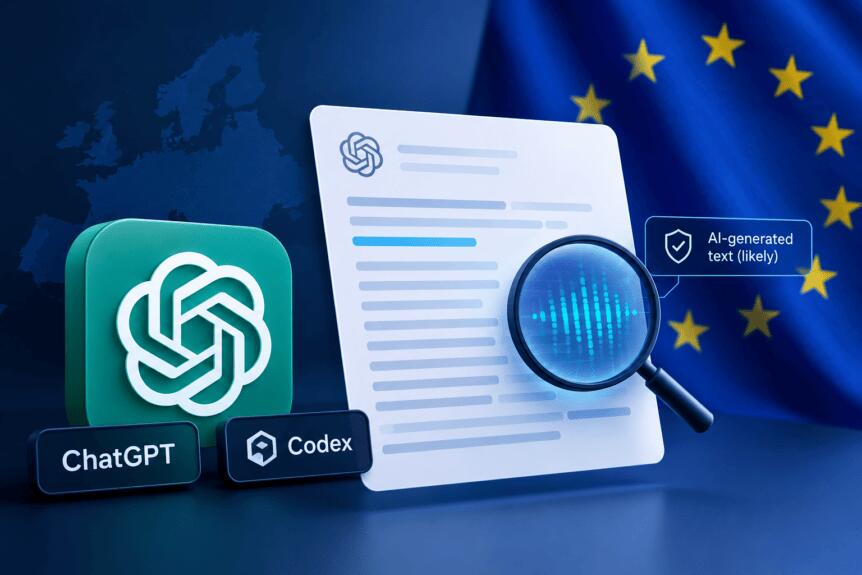
OpenAI is now looking to expand on its existing strategy for spotting AI-generated content by incorporating text watermarking for eligible ChatGPT and Codex outputs across the European Union. OpenAI says it is going to start the process of deployment within the coming weeks to meet the necessary demands of the EU AI Act.
Unlike a visible label, the watermark will be an invisible statistical signal built into text as it is generated. OpenAI says the system is designed to help determine whether a piece of text was likely produced by one of its models. The company, however, says the technology has clear limits and should not be treated as proof of who created a piece of writing.
How OpenAI’s Text Watermark Works
OpenAI’s text watermark is designed to answer a relatively narrow question: whether text was likely generated by an OpenAI model. The signal is embedded into the text during generation and does not add special characters, visible marks, or unusual formatting. According to OpenAI, testing has so far shown that the watermark does not affect the speed or capabilities of its models, or noticeably change how their responses read.
The system is different from a digital signature that could identify a particular user. OpenAI says the watermark does not reveal who originally wrote the text, who owns it, or which account, organization, conversation, or prompt was involved. For API customers, text watermarking is already available for select models worldwide.
Rewriting Can Remove the Watermark
OpenAI also acknowledges that text watermarking is not a perfect way to detect AI-generated writing. The company says the watermark can be difficult to identify in shorter pieces of text. More substantially, rewriting or translating the content can completely remove the statistical signal.
This implies that there will be times when it won’t be easy for the detector to identify if text was initially created by an OpenAI model, especially if the text has undergone extensive editing after generation. For this reason, the technology should be considered more as a provenance indicator rather than an AI detector. If a positive reading is achieved, it might imply that the text was initially created by an OpenAI model.
OpenAI Keeps Detector Access Limited
OpenAI is currently limiting access to its text watermark detector to approved researchers. The company said researchers will help evaluate how well the system works and identify ways to improve it. OpenAI described text watermarking as an ongoing area of research rather than a finished technology.
The company plans to continue testing the system and gathering feedback from users, developers, policymakers, and researchers. The EU rollout comes as regulators and technology companies look for ways to make AI-generated content easier to identify. OpenAI’s approach adds text to its existing provenance efforts for images and audio.
For ChatGPT and Codex users in the EU, the change means eligible generated text will carry an invisible signal designed to provide information about its likely origin. However, OpenAI’s own explanation makes clear that the signal cannot identify the person behind the text and can be removed through certain forms of editing or translation.
https://www.cryptobreaking.com/openai-to-watermark-chatgpt-and/?utm_source=blogger%20&utm_medium=social_auto&utm_campaign=OpenAI%20To%20Watermark%20ChatGPT%20and%20Codex%20Text%20in%20EU%20
Comments
Post a Comment