
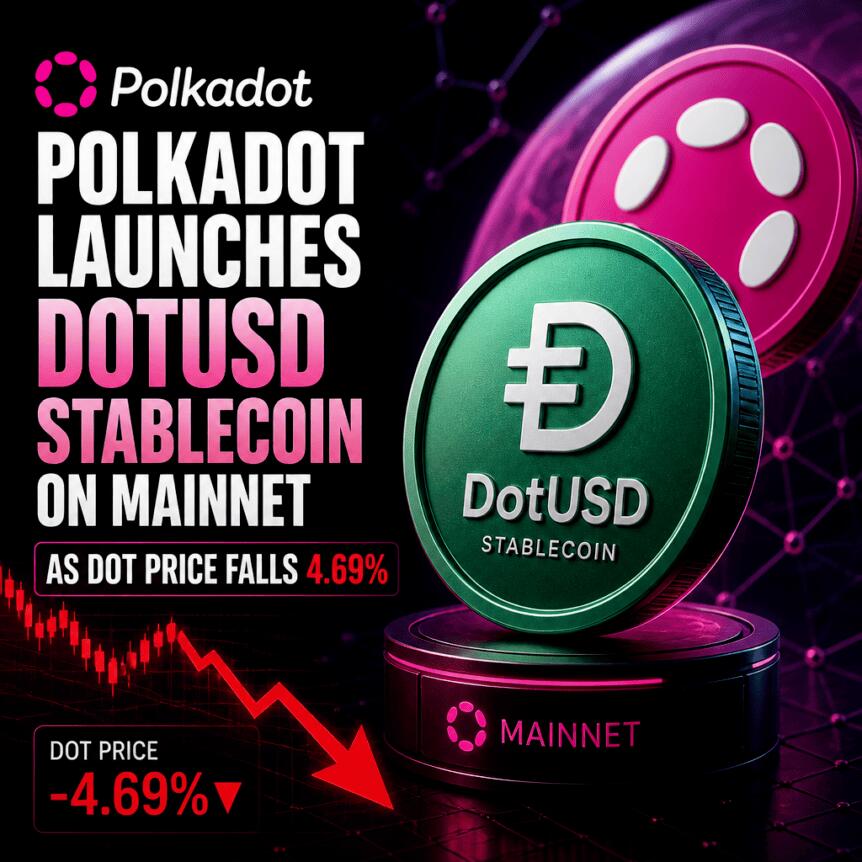
Polkadot has introduced dotUSD on its mainnet, allowing DOT holders to govern the stablecoin through OpenGov. The launch creates a dollar-pegged asset without a private issuing company. However, DOT fell 4.69% as the network began its phased stablecoin rollout.
Polkadot Approves DotUSD Launch Through OpenGov Governance
Polkadot established dotUSD through OpenGov Referendum 1944, which outlined the stablecoin's initial structure and operating requirements. The proposal secured 98.4% approval, with approximately 4.3 million DOT supporting the decision. The referendum also authorized a DOT-dotUSD liquidity pool and treasury funding to support early trading activity.
https://x.com/Polkadot/status/2108174378424803558?s=20
The stablecoin operates on Polkadot Hub and draws its design from Liquity's v2 BOLD architecture. However, developers introduced a simplified peg system before implementing the planned collateral-based borrowing features. This approach allows Polkadot to launch the asset without immediate price oracle or liquidation requirements.
Unlike conventional stablecoins, dotUSD gives DOT holders direct authority over protocol decisions through decentralized voting. Therefore, governance participants can influence future changes without relying on a corporate issuer. The launch also expands Polkadot's financial infrastructure as blockchain networks compete for stablecoin payment activity.
DotUSD Uses USDT Backing Before DOT Collateral Expansion
Polkadot initially allows users to mint dotUSD against USDT through a Peg Stability Module. Users can exchange USDT for dotUSD at a one-to-one ratio and redeem the stablecoin for equivalent USDT. However, an initial supply cap limits circulation during the first deployment stage.
The arrangement also allows users to hold dotUSD without maintaining DOT balances in their accounts. Nevertheless, the initial structure depends on USDT reserves despite the stablecoin's decentralized governance framework. Polkadot plans to replace this transitional structure with a broader collateral system supporting DOT-backed borrowing.
Under the planned model, users will lock DOT as collateral to create new dotUSD tokens. Developers will introduce price oracles, liquidations, stability pools, and redemption mechanisms based on Liquity's architecture. Additionally, borrowers will select interest rates, while the system will prioritize lower-rate positions during redemptions.
DOT Price Declines As Stablecoin Regulation Tightens
DOT traded near $1.04 at press time after losing 4.69% over the previous 24 hours. The decline followed September's stronger performance, when the cryptocurrency gained approximately 45%. Consequently, the mainnet launch has not reversed the latest downward movement in DOT's market value.
Meanwhile, stablecoin adoption continues expanding across enterprise payment platforms and blockchain networks. Circle and Tereina are integrating USDC and EURC into SAP payment workflows for eligible businesses. Similarly, BVNK has added Stellar support, allowing companies to process USDC payments and settlements through the network.
However, European regulations create additional requirements for stablecoin services operating under the Markets in Crypto-Assets framework. Circle recently called for MiCA revisions and reported that only three of the 30 largest stablecoins complied. ESMA has also directed crypto firms to address noncompliant stablecoin exposures within three months, while allowing certain limited services.
https://www.cryptobreaking.com/polkadot-launches-dotusd-stablecoin-on/?utm_source=blogger%20&utm_medium=social_auto&utm_campaign=Polkadot%20Launches%20DotUSD%20Stablecoin%20On%20Mainnet%20As%20DOT%20Price%20Falls%204.69%%20
Comments
Post a Comment