
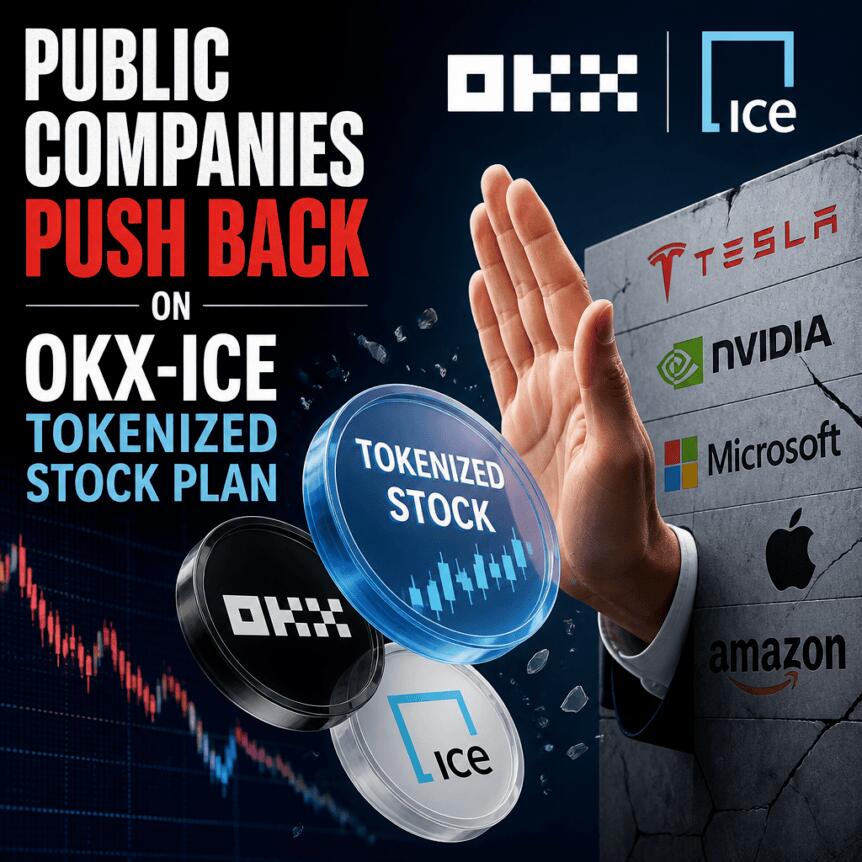
Nine public companies have formally objected to having their shares offered in tokenized form on a proposed tokenized stock platform backed by OKX and Intercontinental Exchange (ICE), the parent of the New York Stock Exchange (NYSE). The companies—Cerebras Systems, AppLovin, Applied Digital, Rocket Lab, CoreWeave, Verizon Communications, Applied Optoelectronics, Broadcom and UnitedHealth Group—were named in a notice published by OKX and ICE on Thursday.
The objection notice does not explain the companies’ rationale. However, under the U.S. Securities and Exchange Commission (SEC) “innovation exemption,” tokenized trading venues must provide issuers with written notice and an opportunity to object before listing third-party tokenized stocks.
Key takeaways
- Nine named issuers objected to their shares being offered as tokenized stocks on an OKX- and ICE-backed platform.
- The SEC’s innovation exemption requires tokenized venues to notify issuers and allow objections before listing.
- Commentary from market participants focuses on pricing and “best execution” concerns—how onchain trading could affect the issuer’s underlying share price.
- Analysts view the objections as venue- and consent-specific rather than a blanket rejection of tokenization.
- The outcome may shape how quickly tokenized stock platforms can expand without direct issuer cooperation.
Why issuers can block tokenized stock listings
The SEC’s innovation exemption—announced in a Sept. 17 statement—creates a compliance pathway for tokenized trading of “tokenized NMS stocks.” A key feature of the framework is issuer involvement: before a tokenized venue can list third-party tokenized stocks, it must give issuers advance notice and allow them to formally object.
In the OKX and ICE notice, the objections were formally submitted by the nine companies, but no explanation accompanied the filing. That lack of detail leaves investors watching for the next signal: whether the platform will redesign the listing approach, seek additional permissions, or encounter similar objections from other issuers.
Concerns centered on pricing mechanics, not blockchain technology
While the notice itself is silent on reasons, market experts told Cointelegraph that the core issue may be less about blockchain infrastructure and more about trading outcomes.
Robin Nordnes, CEO of trading validation platform Raiku, said issuers are not necessarily objecting to the blockchain itself. Instead, he argued that the objection reflects uncertainty about how tokenized trading will translate into price behavior once orders execute onchain. Nordnes emphasized that on public chains the validator producing blocks sets ordering, which can make “best execution” difficult to quantify until market desks can measure how onchain execution affects their results.
That framing matters for investors because tokenized stock products are expected to replicate—or improve upon—traditional market quality metrics such as execution quality, liquidity continuity, and resistance to adverse short-term distortions. If participants cannot reliably evaluate how onchain execution aligns with those benchmarks, issuers may prefer to withhold consent rather than accept unknown trading effects.
Tokenized stocks may need “real-world” evidence on efficiency
Another line of critique relates to whether tokenized offerings can demonstrate consistent, efficient pricing in practice. Misha Putiatin, co-founder of collateral markets platform Symbiotic, told Cointelegraph that companies typically want evidence of upside and a track record of pricing efficiency. He argued that “real-world data” would help market participants evaluate both benefits and risks, rather than relying on theoretical claims about tokenized market structure.
In his view, additional institutional efforts could help build that credibility. Putiatin pointed to the Depository Trust and Clearing Corporation’s (DTCC) tokenization services as an example of initiatives that may strengthen confidence in tokenized offerings by tying them more closely to established market infrastructure.
For traders and liquidity providers, this signals a broader expectation: tokenized markets may be judged not only on the novelty of settlement or custody, but on whether they produce measurable improvements—or at least stable outcomes—in pricing and execution quality compared to existing trading venues.
Analysts see the objection as consent- and venue-specific
CoinShares senior research associate Luke Nolan said the objections should not be interpreted as a general rejection of tokenization. Instead, he suggested the filing appears to be directed at being tokenized without consent on a particular venue.
Nolan added that such “veto” power may be venue-specific, allowing companies to refuse a listing on one platform while potentially permitting tokenization through other channels. That interpretation, if correct, would imply that tokenized stock expansion could proceed unevenly—advancing fastest where issuers are more comfortable with the proposed market design and safeguards.
Nolan also argued that the concerns underlying objections are plausible, noting that market participants have previously exploited certain trading mechanics to create squeezes or short-term swings in an underlying asset’s price. In that context, tokenized stock venues may need to demonstrate protections against forms of market manipulation or execution-driven volatility that issuers are already wary of in traditional markets.
What this means for the push to onchain public markets
Taken together, the objections underscore a key friction point for tokenized stocks: bridging onchain trading mechanics with the issuer-centric expectations embedded in securities regulation. Even when a platform has a compliant pathway under the SEC’s innovation framework, issuer cooperation remains central.
Cointelegraph attempted to contact OKX for comment on the implications of the objections, but did not receive a response at the time of publication.
Looking ahead, the market will likely focus on whether additional issuers file similar objections and whether the tokenized stock platform provides clearer data about execution quality and pricing integrity. Until those questions are answered, tokenized public equity trading may remain constrained—not by the technology alone, but by the trust and consent needed to launch at scale.
https://www.cryptobreaking.com/public-companies-push-back-on/?utm_source=blogger%20&utm_medium=social_auto&utm_campaign=Public%20Companies%20Push%20Back%20on%20OKX-ICE%20Tokenized%20Stock%20Plan%20
Comments
Post a Comment