
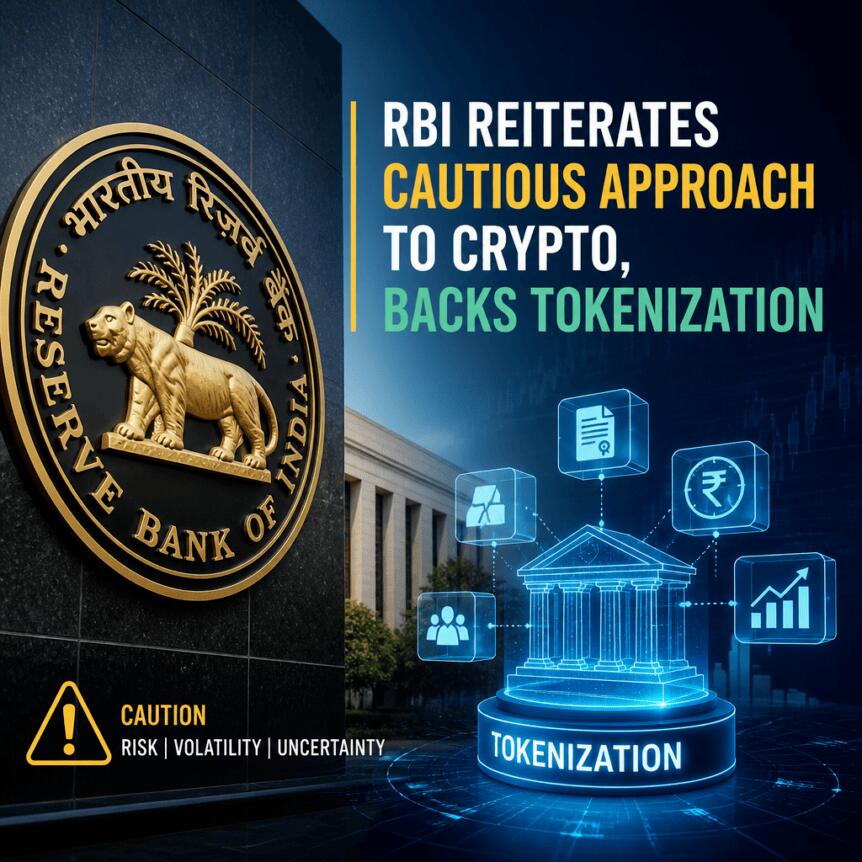
Reserve Bank of India (RBI) Governor Sanjay Malhotra has reiterated India’s cautious approach to crypto, but extended support to blockchain technology and tokenization.
India has yet to enact a comprehensive regulatory framework for crypto. Platforms are required to comply with existing tax and anti-money laundering (AML) laws, and the FIU has issued notices to 15 firms for violating AML compliance requirements.
Rbi Still Wary About Crypto
Speaking at the Kautilya Economic Conclave in New Delhi on October 3, RBI Governor Sanjay Malhotra maintained a cautious approach to crypto, citing key risks around monetary policy, monetary sovereignty, and capital flows. However, he said the RBI backs the underlying technologies, such as distributed ledgers and tokenization, adding that the central bank has used both internally and through public-private partnerships.
“So, our approach has been to promote the underlying technologies, and we are using some of these in the central bank and outside in PPP (public-private partnership) mode. But insofar as crypto is concerned, it has been a cautious approach.”
The RBI Governor highlighted the “singleness of money” and its implications for monetary policy in emerging markets with capital flow restrictions as a key concern.
“The problem that you are trying to address is primarily not so much of domestic payments, because domestic payments within our country and in many countries now are quite fast, cheap and convenient.”
Malhotra believes cryptocurrencies and privately issued currencies could create problems and complications if their value, settlement structure, or backing differs from sovereign money.
Financial Innovation Must Preserve “Singleness Of Money”
The RBI Governor stated that financial innovation must preserve settlement finality, financial integrity, and the singleness of money. He also highlighted technologies like AI and tokenization to improve financial efficiency. Malhotra further noted India’s quick and low-cost payment infrastructure and questioned the narrative that private cryptocurrencies could improve domestic payments.
Malhotra believes cross-border payments present a far more significant challenge, but can be addressed through central bank digital currencies (CBDCs). He also spoke about rising public debt and bond yields, identifying a lack of liquidity and increased government and private spending as key reasons.
“Money is scarce; spending has increased, both by the government as well as private enterprises, led by AI, and so that's what is leading to the hardening of the bond yields and debts.”
Malhotra warned that global interest rates could have significant ramifications for India, such as impacting domestic interest rates. He also cautioned that a resilient financial system today cannot guarantee immunity against future vulnerabilities.
“Our experience of the past two decades offers an important lesson: banking stress can build quickly and take years to resolve. It took nearly a decade to clean up the legacy of excessive lending and NPAs from the early 2000s. We cannot afford to become complacent; the economic and financial costs of allowing vulnerabilities to build up are simply too high. Today's resilience may not necessarily imply tomorrow's immunity, and we are committed to remain vigilant of emerging vulnerabilities and continue to keep our financial system strong and resilient.”
Rbi Favors Crypto Ban
The RBI had recommended a complete ban on cryptocurrencies and private stablecoins during a Parliamentary Standing Committee on Finance meeting. It added that cryptocurrency regulation under existing, conventional financial regulations could give them an appearance of legitimacy and create a false sense of security among users. However, cryptocurrencies continue to operate under existing tax and anti-money laundering rules.
Rbi Backs Tokenization, Underlying Blockchain Technology
However, the RBI has adopted a more favorable stance toward tokenization. Speaking at the Global Fintech Festival in September, Malhotra highlighted projects using programmable CBDCs, tokenized certificates of deposit, and corporate bonds settled using the wholesale digital rupee. The RBI is using tokenized certificates of deposit issued using its Unified Markets Interface to study how financial markets could operate with digital settlement infrastructure.
Meanwhile, SEBI launched the Demat 2.0 pilot for tokenized corporate bonds on September 10. The project uses a distributed ledger to maintain securities records and settles the cash side through central bank money.
Rbi Pushes Ahead With Digital Rupee Program
In parallel, the RBI is pushing ahead with its digital rupee program. The government announced a CBDC-based direct benefit transfer program for the Union Territories of Chandigarh and Dadra and Nagar Haveli under the Pradhan Mantri Garib Kalyan Anna Yojana. CBDC pilot projects are exploring targeted government transfers under beneficiary schemes, along with other use cases.
India has also initiated discussions about CBDC-based trade settlement infrastructure with Russia and is exploring links between sovereign digital currencies. India has expanded its UPI system in multiple foreign markets, including France, Singapore, the UAE, Nepal, and Mauritius.
Disclaimer: This article is provided for informational purposes only. It is not offered or intended to be used as legal, tax, investment, financial, or other advice.
https://www.cryptobreaking.com/rbi-reiterates-cautious-approach-to/?utm_source=blogger%20&utm_medium=social_auto&utm_campaign=Rbi%20Reiterates%20Cautious%20Approach%20To%20Crypto,%20Backs%20Tokenization%20
Comments
Post a Comment