
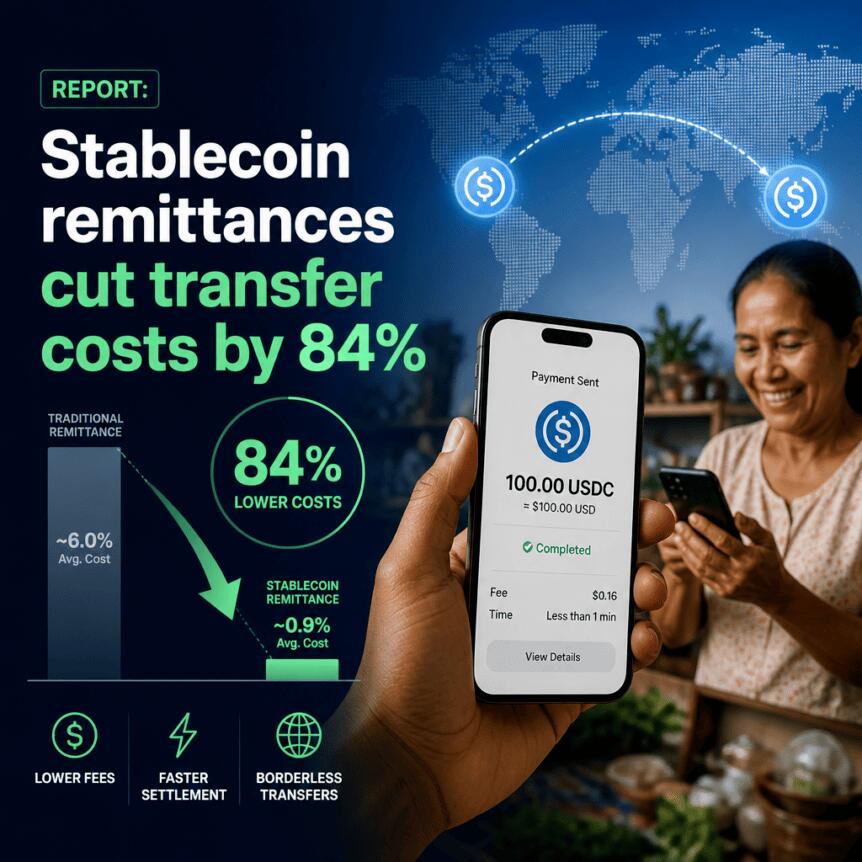
Stablecoins are continuing to carve out a clear niche in cross-border payments, with a new Borderless.xyz report pointing to major savings versus traditional remittance rails. The study focuses on payments funded via stablecoin payment networks and compares those costs with figures drawn from World Bank data.
Borderless.xyz estimates that sending a $200 remittance using stablecoin-funded rails costs a median of 1%—about $2—versus 6.36% (about $12.72) for traditional transfers. The gap persists across multiple regions and extends beyond consumer remittances to larger business payments.
Key takeaways
- A $200 stablecoin-funded remittance is priced at a median 1% (about $2) compared with 6.36% (about $12.72) for traditional remittances, based on World Bank-referenced pricing.
- Borderless data suggests stablecoin-funded remittances are substantially cheaper in Sub-Saharan Africa and Latin America.
- Settlement speed can be measured in minutes for stablecoin-funded payouts, with performance varying by country and underlying payment network.
- Reliability differs: completion rates range from about 73% in Costa Rica to nearly 99% in Mexico.
Stablecoin remittances deliver large cost advantages
The report’s central message is straightforward: stablecoin-funded payment rails reduce the cost burden associated with sending money internationally. For the median $200 remittance example, Borderless.xyz uses its third-quarter 2026 pricing and compares it to traditional remittance costs using World Bank figures from the same period in 2025.
On that basis, the study frames stablecoin-funded remittances as roughly 84% cheaper than traditional alternatives. While the comparison relies on pricing captured in different years (2026 for stablecoin-funded rails and 2025 World Bank figures referenced for traditional transfers), it still highlights a consistent magnitude of savings that matters for households where small fee differences can significantly affect monthly budgets.
The economics look similar when the comparison is broken down by region. According to Borderless.xyz’s analysis, stablecoin-funded remittances cost 2.9% in Sub-Saharan Africa versus 8.46% for traditional transfers. In Latin America, the figures are 1.25% and 5.64%, respectively.
For investors and operators watching stablecoins move beyond speculative trading, this type of use-case evidence is often more important than short-term price narratives. Remittances remain one of the most operationally measurable applications for digital dollars—fees, settlement times, and payout success rates can all be evaluated on an ongoing basis.
Business payouts: savings scale with transaction size
Borderless.xyz also looks at bigger payments routed through stablecoin-funded pathways. In one example, a $10,000 stablecoin-funded transfer to the eurozone can cost as little as $26 when routed through the lowest-cost provider.
Using the median provider across corridors, the report estimates the same $10,000 transfer at $52. Borderless contrasts those figures with traditional bank wire costs, which it places between $135 and $150 for the same amount—including transfer fees and an assumed 1% foreign-exchange margin.
That spread suggests stablecoin-based payment rails may be particularly attractive for businesses dealing with frequent cross-border obligations—whether that’s distributing funds to counterparties or settling invoices across jurisdictions. Even when settlement and reliability differ, fee compression at larger sizes can materially improve margins.
Settlement in minutes—but completion rates vary widely
Beyond cost, the report highlights how quickly stablecoin-funded payments can reach local bank accounts, depending on the payment network used. Borderless.xyz finds that recipients can often receive funds within minutes.
In Brazil, payouts routed through the PIX network settled in a median of two minutes during the third quarter. Mexico’s SPEI network took three minutes on median. Colombia’s PSE network also showed a median settlement time of two minutes.
Traditional SWIFT transfers, by comparison, typically settle by the next business day. The slowest 10% of SWIFT transfers in the report’s framing can take up to three business days, underscoring that stablecoin-funded settlement may help reduce waiting time—an issue that can affect both consumers and companies operating across time zones.
However, faster settlement does not automatically mean uniform reliability. Borderless.xyz reports that payment completion rates vary by network. Mexico’s SPEI achieved 98.6% completion, followed by Brazil’s PIX at 97.8%. Colombia’s PSE recorded 79% completion, while Costa Rica’s SINPE reached just 73%.
That spread points to a practical reality in the stablecoin payments stack: performance depends not only on the stablecoin layer, but also on the local rails, payout integrations, and network conditions once funds reach the destination banking system. For users, this means evaluating networks by both speed and reliability—not just headline settlement times.
Why the data matters as stablecoin usage grows
The Borderless findings arrive as stablecoin transaction activity continues to rise. Borderless’s report is discussed alongside commentary from Standard Chartered, which has highlighted growing transaction volumes even as broader stablecoin market capitalization has shown relatively flat growth this year.
Standard Chartered expects the stablecoin market to reach $2 trillion by 2030, two years later than a previous forecast, signaling that while growth in capital might be slower than earlier projections, usage patterns may still be intensifying. The implication for remittances and payments is that stablecoin networks may be seeing more real-world throughput even when measured market capitalization does not surge at the same pace.
For readers, the next question is whether the lower costs and faster settlement times demonstrated in the third quarter can be sustained as adoption expands—especially in markets where completion rates are weaker. Networks with higher completion consistency may attract more volume, while lower-performing corridors could require operational upgrades to improve completion outcomes.
As stablecoin-funded payments move from pilot efforts toward scaled usage, investors and payment providers will likely focus on two metrics: whether fee advantages remain stable over time, and whether completion rates improve across lower-performing destination rails—so that faster settlement can be backed by dependable delivery.
https://www.cryptobreaking.com/report-stablecoin-remittances-cut-transfer/?utm_source=blogger%20&utm_medium=social_auto&utm_campaign=Report:%20Stablecoin%20remittances%20cut%20transfer%20costs%20by%2084%%20
Comments
Post a Comment