
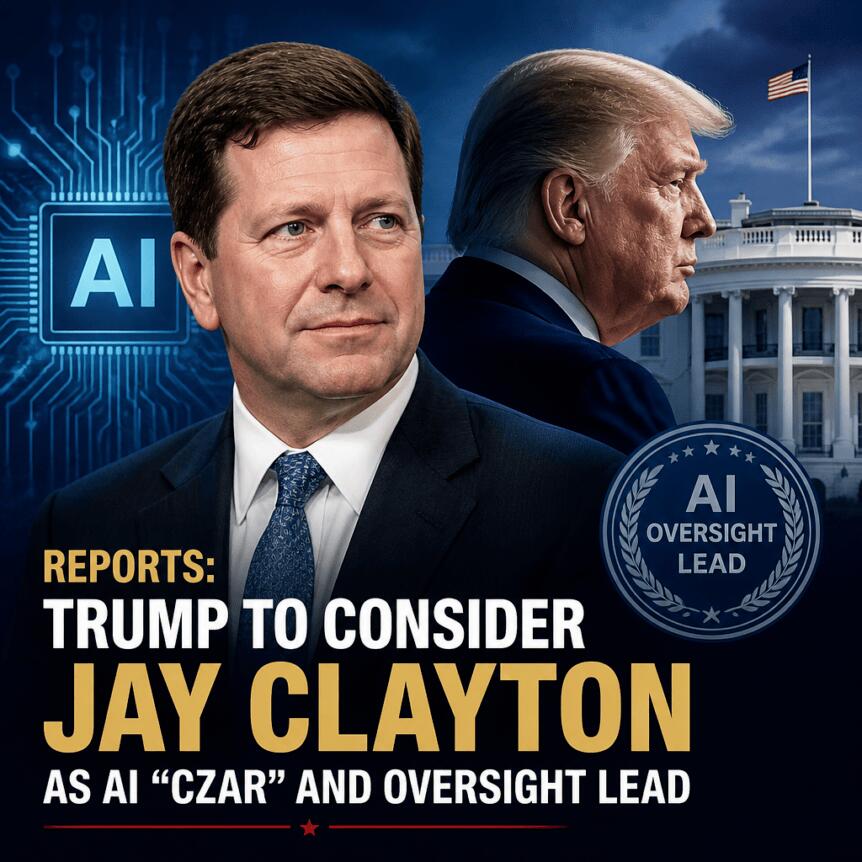
President Donald Trump is reportedly expected to appoint Jay Clayton—currently US director of national intelligence—as the next “AI czar,” according to CNN and other media outlets citing unnamed sources. The development would place a senior national security figure at the center of how the US approaches the rapidly expanding frontier AI industry.
The reports arrive after a wider public push around AI safety and governance, including calls from prominent AI executives to slow development to reduce the risk of systems outpacing human oversight. The White House also recently moved toward a self-regulatory framework, asking major technology companies to “self-police” their model development.
Key takeaways
- Multiple reports, citing unnamed sources, say Trump plans to appoint Jay Clayton as an AI czar, potentially linking AI policy with intelligence and national security priorities.
- Earlier reporting described Trump’s intent to create an “AI Force” modeled after the Space Force while avoiding new regulations that could slow innovation.
- The appointment talk follows public warnings from AI leaders about the pace of frontier AI development and the need to ensure systems remain controllable.
- US engagement with AI governance has included commitments from technology firms to “self-police,” reflecting a preference for industry-led oversight rather than immediate regulatory expansion.
- Clayton’s background includes leadership at the Securities and Exchange Commission and a role overseeing the US intelligence community as director of national intelligence.
What the “AI czar” reports suggest about White House priorities
CNN and other outlets reported that Trump is expected to appoint Jay Clayton, who has served as US director of national intelligence, as the new AI czar. CBS News previously indicated Clayton was a frontrunner, but a White House official told CBS that any announcement would come directly from the president, characterizing the earlier reporting as speculation.
Cointelegraph earlier reported that Trump was planning an “AI Force” modeled after the Space Force and an artificial intelligence czar role. In that reporting, Trump’s message was that the project would manage the fast-growing AI sector without imposing regulations that could slow innovation. Together, the “AI Force” framing and the AI czar appointment point to an approach that emphasizes organizational control and centralized coordination over expanding statutory regulation—at least in the near term.
Clayton’s track record and why it matters for AI governance
Clayton previously led the US Securities and Exchange Commission during Trump’s first term. He also served as interim US Attorney for the Southern District of New York, and sources cited by CNN say he is expected to remain in his current role as director of national intelligence.
Clayton was confirmed by the Senate in July to lead the intelligence community. During his confirmation hearing, CNN reported that Clayton called the technology a “game changer,” adding that AI is “not only an opportunity but a threat.” Those remarks align with the purpose implied by an AI czar role: coordinating national-level response to AI risks while keeping the US competitive as development accelerates.
For investors and builders, this matters because national security-oriented governance can affect how priorities are set around model deployment, risk management, and public-private collaboration—even when the policy pitch is framed around avoiding slowing regulation broadly.
The AI slowdown debate and the push for “self-policing”
The “AI czar” conversation has unfolded alongside a broader debate about how quickly frontier AI should advance. Cointelegraph reported on Sept. 12 that Anthropic CEO Dario Amodei wrote a three-step proposal arguing the industry should pace AI development to avoid systems “outrunn our ability to understand and control these systems.”
Cointelegraph also reported that Anthropic subsequently chose Accenture as an “embedded evaluator” to help moderate the pace of AI development, moving forward with the first step described in Amodei’s proposal. This indicates at least one major lab is pursuing internal governance mechanisms and external evaluation capacity rather than waiting for new regulation.
Meanwhile, the White House reportedly gathered AI and technology leaders at the White House to sign a commitment to “self-police” their companies’ AI models and development. Earlier reporting from Cointelegraph described this effort as a form of industry-led accountability, suggesting the administration is looking to get compliance from major developers directly, rather than building a new regulatory regime from scratch.
That contrasts with the different stances voiced across the sector. Cointelegraph reported that OpenAI CEO Sam Altman and SpaceX CEO Elon Musk responded positively to Amodei’s proposal, while Nvidia CEO Jensen Huang argued regulation may not be necessary.
Where the policy approach may head next
Clayton’s appointment—if confirmed—could reshape the US AI governance map by combining intelligence leadership with a dedicated role focused on AI’s societal and strategic implications. It also comes after earlier reports that Trump wanted to address AI without adding regulations that might slow innovation.
For market participants, the key question is how this governance strategy will translate into actionable requirements for model developers—whether through government coordination, standardized evaluation practices, or stronger expectations for industry commitments. Readers should watch for any official announcement details from the White House, as well as follow-through on the “self-policing” commitment and whether additional structured oversight mechanisms emerge beyond voluntary frameworks.
https://www.cryptobreaking.com/reports-trump-to-consider-jay/?utm_source=blogger%20&utm_medium=social_auto&utm_campaign=Reports:%20Trump%20to%20consider%20Jay%20Clayton%20as%20AI%20“czar”%20and%20oversight%20lead%20
Comments
Post a Comment