
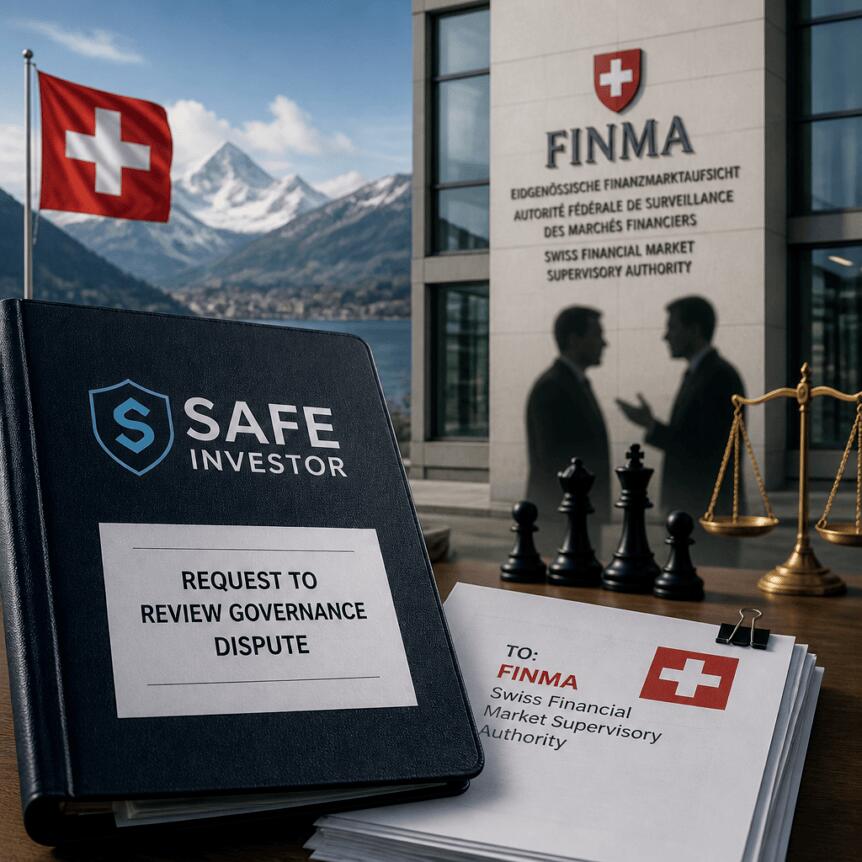
Greenfield Capital, an investor in Safe, says it has escalated a governance dispute with the Safe Ecosystem Foundation by filing a supervisory complaint with Switzerland’s foundation watchdog, the Federal Supervisory Authority for Foundations (ESA). The move follows what the firm describes as months of engagement that did not resolve its concerns.
In an open letter to the Safe community published Sunday, Greenfield founding partner Jascha Samadi said his team has become increasingly concerned about Safe’s trajectory since early 2025. The complaint is aimed at prompting changes to the foundation’s board, which Greenfield argues lacks sufficient independence to guide the organization effectively. The filing arrives as Safe’s project leadership continues to pursue revenue and growth targets for 2026 and beyond.
Key takeaways
- Greenfield Capital has filed a supervisory complaint with Switzerland’s ESA over governance issues tied to the Safe Ecosystem Foundation’s board.
- Greenfield says Safe’s governance lacks independent voices and alleges conflicts of interest involving specific board members.
- The dispute is unfolding alongside Safe project plans to reach break-even and double revenue in 2026, after reporting $10M+ in annualized project-wide revenue at the end of 2025.
- Greenfield argues Safe has lost ground versus the broader DeFi market, using data on Safe account value and stablecoin share.
- The foundation’s leadership targets longer-term growth, but Greenfield wants the ESA to review whether corrective governance measures are needed.
Greenfield escalates a governance dispute to Switzerland’s watchdog
Greenfield said its complaint to the ESA is the next step after more than a year of what Samadi described as research, dialogue, and patience. In the open letter, Samadi stated that the firm now believes Safe “will not reach its potential under its current governance.”
While Greenfield has framed the complaint primarily as a governance matter, it links the board’s composition to the project’s ability to execute its commercial and ecosystem goals. The firm’s core claim is that Safe’s foundation needs stronger independent oversight and fewer internal incentives that could impair decision-making.
The filing also reflects a broader pattern in crypto foundations: when investors or ecosystem participants feel strategic direction has stalled, they increasingly turn to formal governance processes—especially where foundations operate under specific regulatory frameworks.
Revenue targets vs. questions about execution
Safe’s fundraising and operating goals remain a central backdrop to the dispute. According to an earlier project update, Safe is targeting break-even and a doubling of revenue in 2026. In February, Safe reported that it had more than $10 million in project-wide annualized revenue as of the end of 2025 and laid out a longer-term ambition to reach $100 million in annual recurring revenue by 2030.
Greenfield argues that the numbers it points to do not match those ambitions. The firm cited $1.98 million in second-quarter revenue—an annualized run rate of about $8 million—describing it as far below a 2026 expectation of $20 million. Greenfield’s point is less about a single quarter and more about momentum: it claims Safe is falling behind at the moment it most needs consistent traction.
Investors often watch revenue-run-rate alignment closely in crypto infrastructure businesses, because delays in monetization can ripple into hiring, product development, and ecosystem incentives. Greenfield’s complaint effectively combines financial scrutiny with governance oversight, suggesting that board-level decisions may be constraining performance.
“Losing ground” amid DeFi growth, Greenfield says
Beyond revenue, Greenfield’s letter focuses on ecosystem share and usage. Samadi said that between January 2024 and August 2026, the total value held in Safe accounts dropped from $66 billion to $30 billion—down more than 50%—while total value locked across DeFi increased by 40% over the same span.
Greenfield also used stablecoin data to argue Safe is not capturing demand in the self-custody category. According to the letter, total stablecoin supply grew roughly 135% during the period. But stablecoins held in Safes on Ethereum increased only 11%, and Safe’s share of USDC in circulation fell from 12.8% to 2.5%.
For Greenfield, these figures are evidence that Safe’s growth has not kept pace with the markets it is designed to serve. As Samadi wrote, Safe is “losing ground” in the segment that has grown the fastest, where the infrastructure for self-custody is arguably best positioned to benefit.
Greenfield attributed part of these concerns to board composition—specifically, what it describes as insufficient independent board members with “experienced decision-making.” The firm also alleged conflicts of interest. In its account, the concerns include board member Stefan George’s role at Gnosis and fellow board member Richard Meissner’s ties to companies involved in developing and operating Safe products.
What Greenfield wants the foundation and ESA to do next
Greenfield says it spent months pressing for governance restructuring. The firm claimed it asked the foundation to replace George and expand the board with independently recruited members, emphasizing expertise in finance, risk management, and business strategy.
Now, Greenfield says it wants the ESA to examine the foundation’s governance and determine whether corrective measures are required. The supervisory complaint framework matters here: it suggests Greenfield believes the issue is not merely internal disagreement, but a governance structure that may need regulatory scrutiny under Swiss oversight.
For Safe’s stakeholders, the immediate question is what action—if any—the ESA will take and on what timeline. Equally important will be how Safe responds to the allegations and whether the foundation’s board composition changes during the supervisory process.
As the governance review plays out, investors and builders should watch for two signals: any ESA feedback that clarifies whether the watchdog sees governance deficiencies, and any interim steps the Safe Ecosystem Foundation takes to adjust board oversight while the revenue and ecosystem targets remain in view.
https://www.cryptobreaking.com/safe-investor-requests-swiss-regulator/?utm_source=blogger%20&utm_medium=social_auto&utm_campaign=Safe%20Investor%20Requests%20Swiss%20Regulator%20to%20Review%20Governance%20Dispute%20
Comments
Post a Comment