
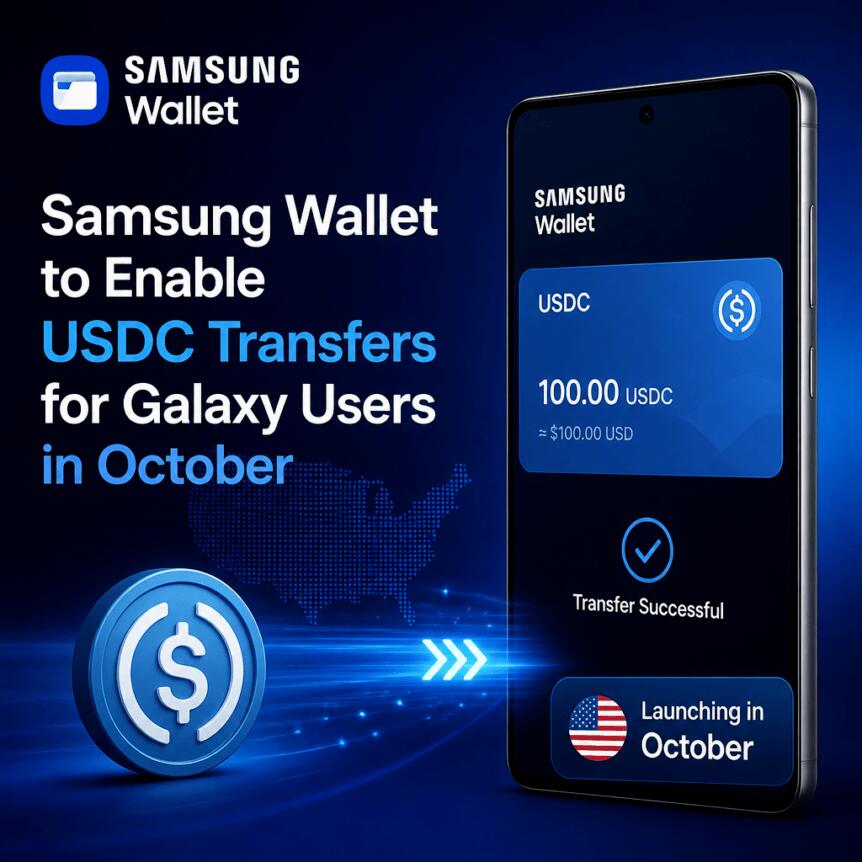
Samsung is preparing to bring USDC transfers to its Samsung Wallet app, rolling the feature out to eligible Galaxy users in the final week of October. In a company announcement, Samsung said the update will enable users to send USDC to compatible external crypto wallets and move money to bank accounts in more than 60 countries, with recipients receiving funds in their local currency.
The rollout is focused on the US market at first. Samsung said the service will be available to 82 million compatible Galaxy devices, but access requires identity verification before users can use the stablecoin transfer functions.
Key takeaways
- Samsung Wallet will support USDC transfers in the last week of October for eligible Galaxy users in the US.
- The feature includes sending USDC to compatible crypto wallets and initiating international transfers to local bank accounts in 60+ countries.
- Only users who complete identity verification can access the service, and availability is limited to eligible devices running Android 13 or later.
- Infrastructure will be handled by Bastion, with Coinbase listed as a sub-custodian through Coinbase Prime Vault.
- Samsung says it will not charge for USDC transfers to external wallets, though recipient platforms and international bank transfers may carry fees.
Samsung Wallet adds USDC transfers for eligible Galaxy users
Samsung’s announcement positions the Samsung Wallet update as a bridge between stablecoin transfers and traditional banking rails. According to Samsung, eligible users will be able to send USDC internationally to compatible crypto wallets and transfer funds to recipient bank accounts across more than 60 countries, where end users can receive payments in their local currency.
Samsung also set clear eligibility requirements. The company said the service is available to US residents aged 18 or older with compatible Galaxy devices running Android 13 or later. As with many regulated financial features, Samsung emphasized that users must complete identity verification to access the stablecoin functionality.
On pricing, Samsung stated that it will not charge fees for USDC transfers to external wallets. However, the company noted that fees may be imposed by the recipient’s platform, and international bank transfers would incur charges that vary based on destination and transfer size.
Back-end infrastructure: Bastion, Coinbase Prime Vault, and crypto partners
While Samsung is delivering the front-end experience through Samsung Wallet, it did not frame the upgrade as purely a software update. Instead, the company pointed to a structured infrastructure setup for stablecoin accounts and payments.
Samsung named Bastion as the provider of stablecoin account and payment infrastructure. For custody and related controls, the announcement also states that Coinbase will act as a sub-custodian via Coinbase Prime Vault.
On the technical side, Samsung identified Solana and Sui as technical partners. The presence of these networks suggests that the transfer flow may need to accommodate different blockchain environments for “compatible crypto wallets,” though Samsung did not provide additional specifics on wallet support beyond that general compatibility language.
For investors and builders, this matters because phone-based stablecoin access is largely about reliability and compliance, not just app integration. The combination of a wallet user interface (Samsung Wallet), a regulated infrastructure layer (Bastion), and an identified custody arrangement (Coinbase Prime Vault) is designed to reduce friction for end users while meeting institutional requirements.
Why this approach could lower friction for cross-border payments
Samsung’s plan follows its earlier messaging about stablecoin support. During its Galaxy Unpacked event in July, Samsung announced that stablecoins would be integrated into Samsung Wallet. At the time, Samsung did not specify which stablecoins would be supported, which infrastructure partners would be used, or when the functionality would launch.
Now, the company has narrowed that gap with a concrete stablecoin target—USDC—and a launch window for eligible US users. Samsung’s product framing also emphasizes practicality: stablecoins here are presented as a tool to reach bank accounts in local currency, rather than as a new destination for retail crypto speculation.
Kevin Lehtiniitty, CEO of Borderless.xyz, told Cointelegraph that the company’s network is designed to handle payouts in more than 60 countries, while Bastion provides the regulated infrastructure underpinning the service. He argued that mass adoption is more likely to come from features embedded in everyday devices rather than from users downloading standalone crypto apps.
Lehtiniitty also suggested that big mobile platforms could follow. In his view, Apple and Google may introduce similar stablecoin capabilities—an idea that, if it plays out, could significantly change how consumers experience international payments and how quickly stablecoin rails become normalized.
Samsung’s stance that it will not charge for USDC transfers to external wallets also highlights a strategic choice: the company is focusing on removing one of the most immediate friction points for users, while acknowledging that fees could still appear through recipient platforms and bank transfer endpoints.
What to watch next
With Samsung Wallet’s USDC transfer feature slated for late October, the main questions for users will be which wallets are considered “compatible,” how identity verification is implemented in practice, and whether Samsung expands beyond transfers into broader online and in-store stablecoin payments as it has suggested for the future. As with any regulated rollout, the early phase will likely reveal how smooth the on-ramp from stablecoin to local-currency payouts truly is across different destinations.
https://www.cryptobreaking.com/samsung-wallet-to-enable-usdc/?utm_source=blogger%20&utm_medium=social_auto&utm_campaign=Samsung%20Wallet%20to%20Enable%20USDC%20Transfers%20for%20Galaxy%20Users%20in%20October%20
Comments
Post a Comment