
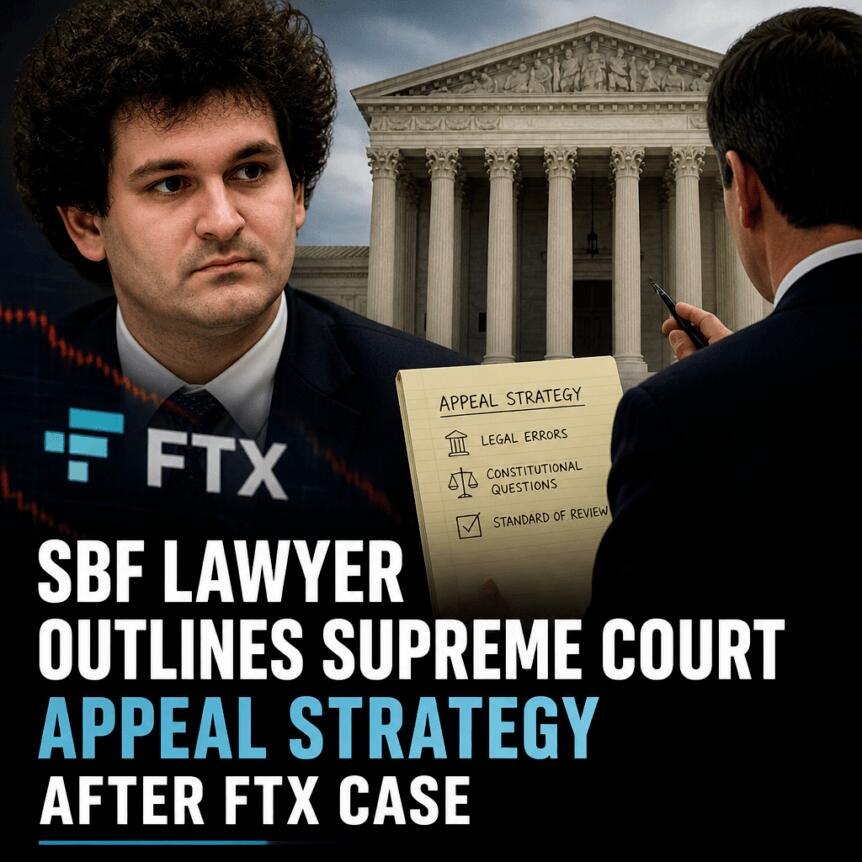
Former FTX CEO Sam “SBF” Bankman-Fried is asking the US Supreme Court to take up his fraud conviction, after losing his appeal in the Second Circuit and while he also pursues clemency. His lawyers say the procedural clock for a Supreme Court petition is tied to the appellate ruling, and that any decision to hear the case could come in late 2026 or in early 2027.
Bankman-Fried’s counsel, Jeffrey Fisher of Hecker Fink LLP, told Cointelegraph that the next steps hinge on whether the justices accept the petition for a writ of certiorari—potentially opening the door to a new trial. At the same time, the former executive is seeking a presidential pardon from President Donald Trump, a route that could remove the need for further court proceedings.
Key takeaways
- Bankman-Fried is pursuing Supreme Court review after the Second Circuit upheld his conviction, while also continuing efforts for a presidential pardon.
- Fisher says Supreme Court filing rules require a petition within 90 days of the appellate court’s decision.
- The Supreme Court’s response deadlines have been extended to Nov. 16, leaving a possible window for a decision to hear the case in late 2026 or early 2027.
- Legal arguments focus on whether evidence about customer losses—and the size and conditions of the $11 billion forfeiture order—raises issues under longstanding fraud and “excessive fines” principles.
- Separate from the SBF litigation, former Alameda CEO Caroline Ellison is reported to have begun working for Manifund after her release and prison time under a plea agreement.
Why SBF is pushing for Supreme Court review
Bankman-Fried’s Supreme Court effort centers on the arguments developed during his criminal case and reiterated by the Second Circuit’s ruling. According to Fisher, his filing raises concerns that the lower courts improperly treated certain prosecution evidence—particularly evidence related to customer harm—as either irrelevant or legally insufficient to affect the outcome.
In outlining what the Supreme Court would be asked to consider, Fisher pointed to the “prejudice” question that arises when courts admit evidence that, in his view, could improperly influence a jury. He framed the broader issue as one of prosecutorial scope in fraud prosecutions and whether the manner in which evidence is used creates a legal problem significant enough for the nation’s highest court to intervene.
Cointelegraph previously reported that Bankman-Fried is also pursuing clemency. That parallel strategy matters because a pardon could potentially change the practical stakes of a Supreme Court review—though the petition itself remains a separate legal process.
‘Assets are fine’ argument and the competing fraud precedents
One of the core themes in Bankman-Fried’s Supreme Court petition relates to how courts treated the question of whether customers ultimately lost money. Fisher said prosecutors argued—and the Second Circuit agreed—that it was “immaterial as a matter of law” whether Bankman-Fried had the funds and intended to repay FTX victims, even if the plan to reimburse them existed.
The Second Circuit, in its June 2026 decision, wrote that customers were defrauded when Bankman-Fried transferred funds to Alameda, regardless of later beliefs about repayment. Bankman-Fried’s legal team argues this framing is unusual compared with many fraud cases where the defendant both deprives victims of money and enriches himself at the victims’ expense.
In Fisher’s telling, the government’s theory of criminal liability made customer loss evidence legally irrelevant, including evidence about whether victims actually lost money or how much they lost.
The petition also invokes how Supreme Court doctrine has treated similar situations. Bankman-Fried’s filing references Kousisis v. United States, where the Supreme Court ruled in 2025 that prosecutors could pursue decades-long prison sentences when people are induced to part with money by misrepresentations—even if the victims do not suffer pecuniary harm.
At the same time, Bankman-Fried’s lawyers argue that an older First Circuit case, United States v. Carpenter, is more applicable. In that 2007 decision, the appellate court held that a jury’s verdict could rest on factors such as moral disapproval rather than on evidence tied to financial loss. Attorneys close to the case described this as an uphill legal effort, especially against the more recent direction of Kousisis.
Mark Bini, a former federal and state prosecutor and now a partner at Reed Smith, told Cointelegraph that while the chance of acceptance “seems low,” the forfeiture issue remains particularly noteworthy because of its unusual scale.
Forfeiture: an $11 billion order with long-term consequences
Another focal point for Bankman-Fried’s Supreme Court request is the forfeiture order. He was convicted on seven felony fraud counts connected to the misuse of customer funds and later sentenced to 25 years in prison. The court also ordered $11 billion in forfeiture.
Fisher emphasized that forfeiture could follow Bankman-Fried even after release. He said the terms function like a continuing financial obligation to the government for the remainder of Bankman-Fried’s life, meaning any earnings after prison could be swept away under the rules governing the penalty. Fisher added that while rules might theoretically allow him to keep a portion, the basic obligation is structured to transfer future income to the government.
Bini said the best-case interpretation for the defense would be more likely to reduce the forfeiture amount rather than to require a new trial—depending on how the Supreme Court evaluates the tension between restitution for victims and forfeiture pursued by the government. In his view, the case presents a legal asymmetry: if the defense’s portrayal that victims were made whole is accepted in some form, the government’s ability to also pursue a massive forfeiture becomes harder to reconcile.
Cointelegraph reached out to the US Department of Justice for comment but did not receive a response.
Caroline Ellison’s post-prison move to Manifund
While SBF’s legal fights continue through the appeal-and-petition process, another FTX-adjacent development is emerging outside the courtroom. Caroline Ellison, formerly the head of Alameda Research and one of the central figures in FTX’s collapse, is reported to be working at Manifund, a charitable fundraising organization tied to the effective altruism movement.
According to Manifund co-founder and CEO Austin Chen, Ellison began a work trial on July 13, roughly six months after her release from federal custody, and accepted a full-time role on Aug. 10. Chen said in a public statement that he supports redemption and that Ellison has acknowledged her role, served her sentence, and helped make creditors whole.
Ellison also issued a rare public statement expressing gratitude to Chen for the chance and saying she hopes her work performance going forward will be judged more than her past.
The announcement drew sharp backlash in public comments, including criticism that hiring Ellison reflects poor judgment and that prosecutors made concessions in pursuit of cooperation. Coin Metrics co-founder Nic Carter, in particular, argued that Ellison benefited from a comparatively light outcome and criticized the effort to frame the hiring as rehabilitation.
What to watch as the Supreme Court timetable forms
The immediate question for observers is whether the Supreme Court grants certiorari and, if so, how the justices treat the petition’s twin themes: the legal relevance of customer loss evidence under the government’s theory, and the scope and constitutional limits of a forfeiture order as large as $11 billion. With deadlines extended and a decision potentially coming in late 2026 or early 2027, the next moves in SBF’s case could quickly clarify whether the courts will revisit the boundaries of fraud prosecution and forfeiture.
https://www.cryptobreaking.com/sbf-lawyer-outlines-supreme-court/?utm_source=blogger%20&utm_medium=social_auto&utm_campaign=SBF%20Lawyer%20Outlines%20Supreme%20Court%20Appeal%20Strategy%20After%20FTX%20Case%20
Comments
Post a Comment