
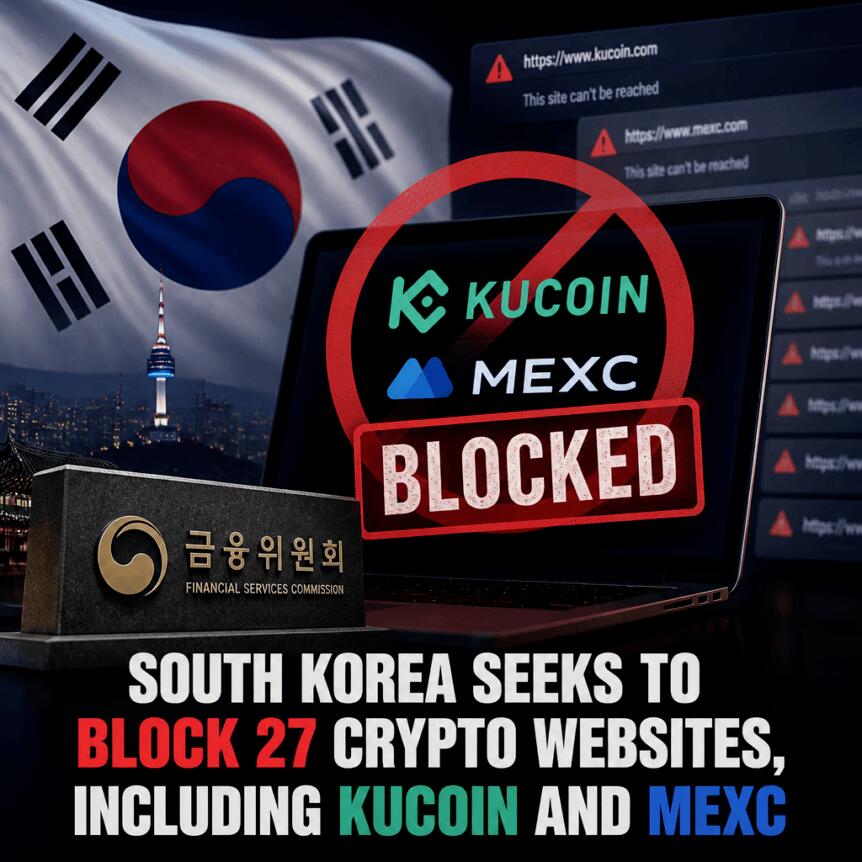
South Korean financial authorities have approved new enforcement steps aimed at unregistered crypto trading and virtual asset platforms. The Financial Intelligence Unit (FIU) said the measures will block domestic access to 27 websites operated by operators that have not registered under the country’s anti-money-laundering framework for digital assets.
In a Tuesday announcement, the FIU said the decision followed reviews by the Korea Media and Communications Standards Commission on Oct. 6 and 7. The action targets crypto platforms that are not covered by South Korea’s Act on Reporting and Using Specified Financial Transaction Information, which governs reporting and compliance obligations tied to money-laundering controls.
Key takeaways
- South Korea’s FIU approved blocking measures covering 27 websites linked to unregistered crypto and virtual asset service operators.
- The enforcement follows prior restrictions on crypto exchange mobile apps distributed via Apple’s App Store and Google Play.
- Authorities said overseas platforms may be flagged as targeting South Korean users based on language, marketing, and support for KRW transactions.
- The FIU acknowledged website blocks could complicate withdrawals for existing users and said it will coordinate withdrawal guidance through DAXA.
- Blocking can be implemented through terminating domestic services or restricting access to overseas-hosted sites.
27 website blocks approved for unregistered operators
The FIU’s announcement specified that the blocking measures apply to crypto platforms operating websites that are not registered under South Korea’s anti-money-laundering legislation. The list includes well-known global exchanges and trading platforms such as KuCoin, MEXC, Phemex and Bitrue, alongside other operators including CoinW, BTCC, BitMart, BingX and DigiFinex.
The FIU said the measures will extend to websites in addition to earlier app-focused restrictions. “With this decision, blocking measures against illegal virtual asset operators will also apply to internet websites, following apps such as those on Apple and Google,” the FIU said, according to a translation provided in the announcement.
Practically, the FIU indicated the approach can include ending services hosted domestically and blocking access to websites operated from abroad. That matters for users because enforcement can differ depending on where a site is hosted and how it is served to South Korean internet traffic.
Why overseas platforms are singled out
South Korea’s FIU said that when evaluating whether an overseas operator is effectively targeting customers in South Korea, it looks at several indicators. Those factors include whether a platform offers Korean-language services, markets directly to South Korean users, or supports trading and transactions in South Korean won.
This framework is important because it addresses a common challenge in cross-border crypto enforcement: even if a company is based overseas, its products can still be accessible to South Korean residents. By focusing on practical indicators of local engagement and payment rails, regulators are drawing a line between operators that merely have global reach and those actively serving the domestic market.
Enforcement escalates from app restrictions to web access
The website blocks come after earlier actions aimed at mobile apps. Earlier coverage from Cointelegraph reported that South Korea blocked downloads and updates for 14 unregistered crypto exchange apps on Apple’s App Store in April 2025, after restricting 17 apps through Google Play.
While app-store restrictions primarily affect new installs and updates, website blocks can influence ongoing access for users who may have already installed trading apps or used web interfaces. The shift to web enforcement therefore broadens the regulatory pressure surface: even if mobile app distribution is no longer the only bottleneck, access can still be limited when users attempt to use websites directly.
For market participants, the sequence suggests a coordinated tightening rather than one-off measures. It also increases the probability that additional operators—or additional domains related to the same operators—could be reviewed as regulators refine their registration and targeting assessments.
Withdrawals, user access, and coordination via DAXA
In its announcement, the FIU acknowledged that blocking websites could complicate withdrawals for existing users. That acknowledgment is notable because it recognizes a practical downstream effect: if users rely on blocked interfaces to move funds off a platform, enforcement could create friction even for lawful withdrawals.
To mitigate disruption, the FIU said it plans to provide withdrawal guidance and support through the Digital Asset eXchange Alliance (DAXA), in cooperation with the operators. While the FIU did not outline detailed operational steps in the provided reporting, the intent is clear—authorities want to reduce the risk that users are trapped or forced to delay access to their assets.
For users, the main takeaway is that enforcement can affect not only trading or onboarding but also the usability of exit pathways. For platforms and liquidity providers, it underscores the compliance and operational demands of maintaining access in regulated jurisdictions—particularly when public-facing services can be cut off quickly.
The next phase readers should watch is how DAXA-coordinated withdrawal guidance plays out for the affected operators and whether regulators expand blocking to additional related domains or services. Equally important will be whether the FIU’s targeting criteria—Korean-language offerings, KRW transaction support, and local marketing—continue to shape which cross-border platforms face future restrictions.
https://www.cryptobreaking.com/south-korea-seeks-to-block/?utm_source=blogger%20&utm_medium=social_auto&utm_campaign=South%20Korea%20seeks%20to%20block%2027%20crypto%20websites,%20including%20KuCoin%20and%20MEXC%20
Comments
Post a Comment