
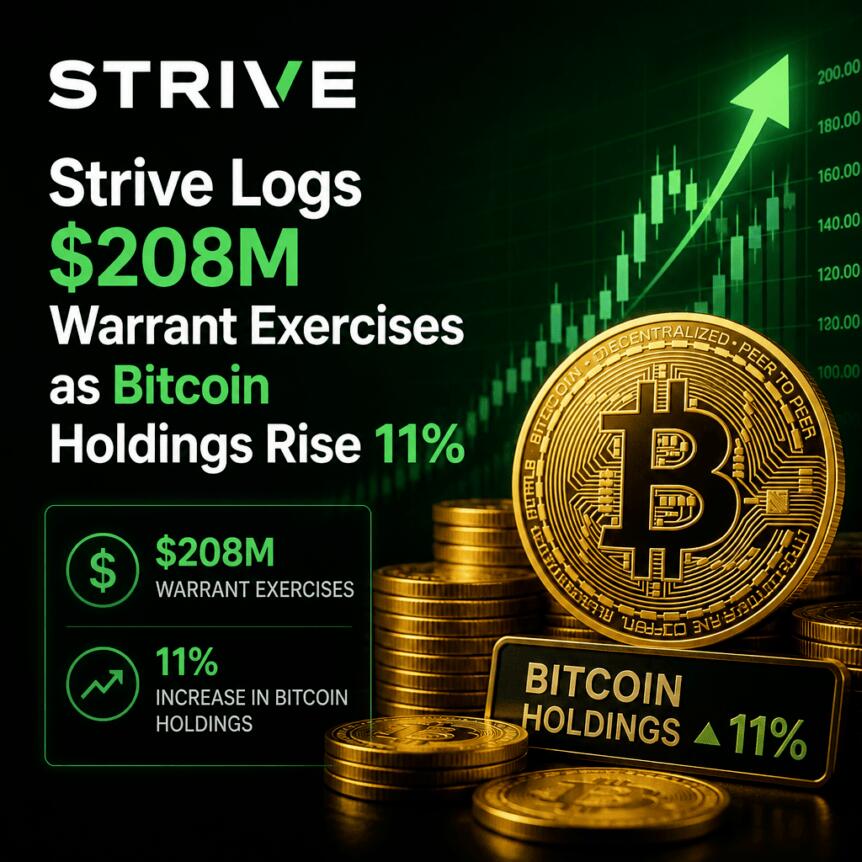
Strive, a publicly traded company focused on Bitcoin treasury strategy, expanded its holdings by more than 11% over the week ending Oct. 9, underscoring how corporate access to capital markets continues to translate into direct BTC accumulation.
According to a Tuesday filing with the U.S. Securities and Exchange Commission, Strive bought 3,311 Bitcoin (BTC) at an average price of roughly $84,500 per coin during the reporting period. The purchases increased its total holdings to 32,773 BTC, placing the firm among the largest publicly traded corporate Bitcoin holders, per industry tracking at bitcointreasuries.net.
Key takeaways
- Strive purchased 3,311 BTC in the week ending Oct. 9, lifting its total treasury to 32,773 BTC.
- Bitcoin purchases outpaced share issuance during the period, raising BTC exposure per share for existing investors.
- In its filing, Strive tied activity to warrant exercises totaling $208 million, with about 15.3 million warrants remaining until a Tuesday expiration.
- The company amended its governing documents to establish a binding $100 minimum issuance price for SATA preferred shares.
- Michael Saylor praised Strive’s approach, framing it as turning demand for digital equity and credit into demand for Bitcoin.
Warrant-driven buying pushes Strive’s Bitcoin treasury higher
Strive’s most recent accumulation appears closely linked to shareholder-driven capital flows. In the SEC filing, the company reported that it purchased 3,311 BTC during the week ending Oct. 9 at an average price of approximately $84,500. Those buys brought Strive’s Bitcoin balance to 32,773 BTC.
The scale of the week’s warrant activity was also highlighted by Strive leadership. Chairman and CEO Matt Cole said on X that investors exercised $208 million worth of warrants, leaving roughly 15.3 million warrants outstanding ahead of their Tuesday expiration.
At the time of reporting, Bitcoin was trading around $83,300 per coin, according to Yahoo Finance, while Strive shares were little changed at $27.52.
Purchases grew faster than the effective share count
While Strive continued to issue equity alongside its Bitcoin buying, the company reported that reserve growth outpaced dilution. In the reporting period, Strive’s Bitcoin reserves increased by 11.2%, while its effective common share count rose by 9.4%.
That difference matters for investors because it signals that Strive added more BTC relative to the growth in shares than it might have under a purely dilution-heavy financing model. In practical terms, existing shareholders typically view such periods as favorable when Bitcoin per share rises—even if new equity is still being introduced to fund additional buys.
The dynamic is also consistent with Cole’s comments about warrant exercises: when warrant holders convert at agreed terms, it can create a funding stream that supports purchases without immediately forcing the same degree of share issuance that might occur under other capital-raising routes.
Changes to SATA preferred share terms set a $100 floor
Alongside its Bitcoin disclosures, Strive amended key provisions in its governing documents. The filing states that the company set a binding $100 minimum issuance price for its SATA preferred shares. The move limits Strive’s ability to issue those shares below the threshold.
At last look, SATA preferred shares were trading around $99.40. By establishing a floor, the amendment could affect how Strive manages future financing conditions—particularly during periods when market prices for the preferred class sit near or below issuance levels.
For investors, the implication is straightforward: changes to issuance floors can influence the cost of capital and the degree of potential dilution, especially if Strive intends to keep using equity-linked instruments to fund Bitcoin purchases.
Saylor frames Strive as a capital-markets on-ramp for Bitcoin demand
Strive’s buying also drew public attention from prominent corporate Bitcoin advocate Michael Saylor. Writing on X, Saylor praised the company’s structure, saying: “Strive is turning demand for digital equity (ASST) and digital credit (SATA) into demand for Bitcoin.” He added that the firm’s “hypergrowth shows how the capital markets are accelerating Bitcoin adoption.”
Saylor’s comments referred to Strive’s use of common and preferred share instruments to raise capital, which is then used for BTC treasury accumulation. The general approach mirrors Strategy’s own model—using its publicly traded shares to access capital markets and, in turn, expand its Bitcoin holdings.
Saylor also compared Strive’s activity with Strategy’s recent actions. Earlier coverage noted that Strategy added a comparatively modest 250 BTC last week, bringing its total holdings to 848,250 BTC and maintaining its position as the largest publicly traded corporate Bitcoin holder.
What to watch next for Strive’s BTC and financing mix
With a meaningful warrant exercise period already cited in Strive’s disclosures, investors will likely focus on how consistently the company can convert equity-linked demand into additional Bitcoin buys without letting share growth erode per-share exposure. The $100 issuance floor for SATA preferred shares is another factor to monitor, as it may shape the company’s future ability to fund new treasury purchases during different market conditions.
https://www.cryptobreaking.com/strive-logs-208m-warrant-exercises/?utm_source=blogger%20&utm_medium=social_auto&utm_campaign=Strive%20Logs%20$208M%20Warrant%20Exercises%20as%20Bitcoin%20Holdings%20Rise%2011%%20
Comments
Post a Comment