
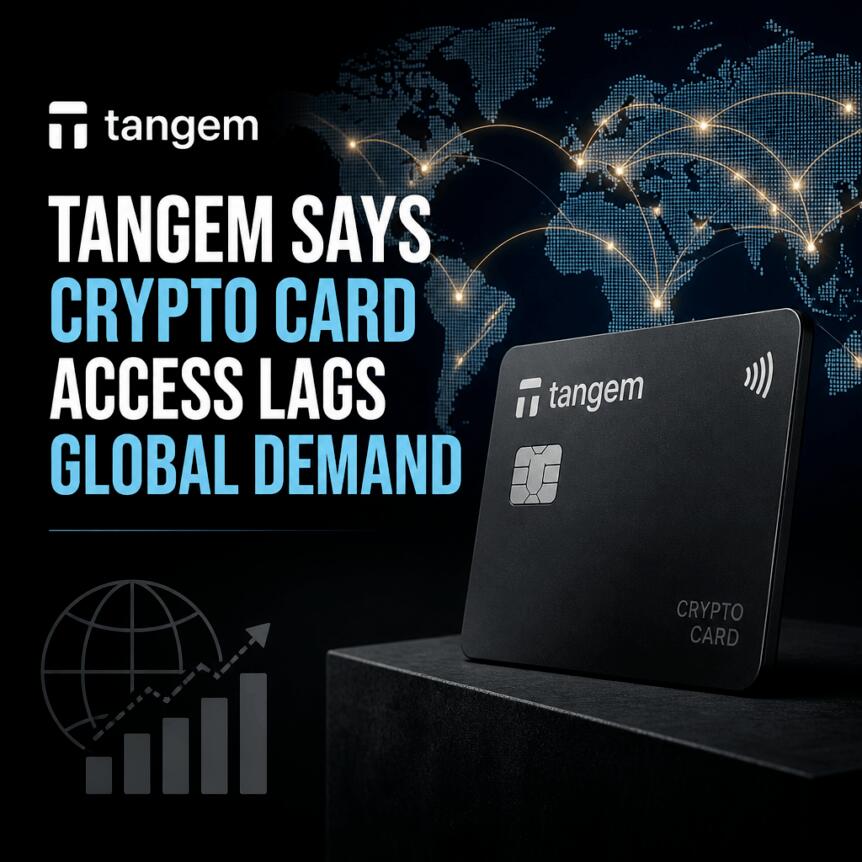
Tangem Pay is revealing the practical friction behind crypto-linked card expansion: demand for payments and the ability to issue regulated cards do not always align. According to the Swiss crypto wallet provider, more than 40% of Tangem Pay payments originate from Latin America and over 30% come from the United States, yet physical card availability is still constrained in certain jurisdictions.
In an interview with Cointelegraph, Andrey Ilinskiy, head of Tangem Pay, said the key issue is less about where users “want” crypto cards and more about where the necessary regulatory and issuing conditions are present. “It is not simply a question of where people want crypto cards,” he explained. “It is where demand, regulation, banking infrastructure and card-issuing requirements happen to line up — and today, those maps do not always overlap.”
Key takeaways
- Tangem Pay reports that Latin America accounts for over 40% of payments and the US for more than 30%, even though physical card availability remains limited in some regions.
- Tangem’s first physical Visa card roll-out will begin with an initial supply of 5,000 cards for in-store and online purchases and ATM withdrawals.
- Users can fund the card from their self-custodial wallet and transfer funds back if the card is suspended or closed, emphasizing self-custody during the payment cycle.
- Tangem says it currently cannot deliver physical cards to roughly 20 countries, including China and Russia, citing KYC, sanctions, local banking rules, and card-issuing compliance.
- Cashback on eligible purchases is being introduced using Circle’s USDC, with rates of 1% for Basic users and 2% for Plus users.
A regulated card network adds new boundaries
Tangem’s pitch is rooted in self-custody: the user keeps control of their assets instead of placing them with a traditional custodian. However, Ilinskiy’s comments highlight a different kind of limitation that emerges when tokens enter mainstream payment rails.
As Tangem put it, “Self-custody removes one major boundary: there is no custodian standing between the user and their assets. But when those assets enter a regulated payment network, another set of boundaries appears.” In practice, that means card issuance is constrained by the same compliance factors that govern other regulated financial services—rather than by crypto demand alone.
For users and builders, this framing matters because it clarifies why card roll-outs can lag even in markets that show strong activity. If payment usage is already concentrated in regions like Latin America and the US, the next bottleneck is not necessarily onboarding crypto holders, but meeting the requirements of banks, issuers, and regulated card programs in each country.
First physical Visa card: small start, clear use cases
On Wednesday, Tangem announced its first physical Visa card, designed for in-store and online purchases and for ATM withdrawals. The initial release is limited to 5,000 cards, signaling a controlled launch rather than an immediate global rollout at full scale.
Functionally, Tangem says users can fund the card directly from their self-custodial wallet. If the card is suspended or closed, users can move funds back to the wallet—an important operational detail given how often card-based products depend on account status and payment network rules.
The limited initial supply also suggests Tangem is managing risk and compliance verification typical of regulated products—especially when a crypto-linked card must operate within the constraints of card issuing and local regulations. Investors and traders watching the sector should note that infrastructure roll-outs of this kind often start small, then expand as compliance workflows and partnerships mature.
Tangem also indicated it plans to showcase the first physical Tangem Pay cards at Token2049 in Singapore, positioning the launch within a broader industry context where hardware wallets, payments, and institutional-ready rails are a frequent theme.
Nearly 200 countries—except about 20
Tangem said it can deliver physical Tangem Pay cards in nearly 200 countries, while excluding roughly 20. The company named several restricted jurisdictions, including China, Russia, North Korea, and Palestine.
Importantly, Tangem said these delivery limits do not necessarily mirror the rules governing crypto itself. Instead, availability is shaped by a broader set of compliance and operational factors, including KYC requirements, sanctions, local banking regulations, and card-issuing compliance.
In its explanation, the company drew a connection between the same forces that create crypto demand and the forces that can complicate card issuance. “The same conditions that can create demand for crypto as an alternative financial rail can make regulated card issuance more difficult,” Tangem said. That statement underscores a tension the market often glosses over: regions that may seek financial alternatives due to banking constraints can simultaneously be the hardest to integrate into regulated card networks.
For users, the takeaway is practical. Even if Tangem Pay is accessible digitally in many places, physical card availability can still depend on eligibility checks and partnerships that vary by country. For builders and compliance teams, it’s a reminder that payments are not purely a technical layer; they are also a jurisdiction-by-jurisdiction permissioning exercise.
USDC cashback rolls in alongside the hardware launch
Alongside the physical card announcement, Tangem is introducing cashback funded in Circle’s USDC stablecoin. The company set cashback at 1% for Basic users and 2% for Plus users on eligible purchases.
The choice to pay cashback in a stablecoin is consistent with the broader direction of crypto payments: rewards are designed to remain value-stable and immediately usable within crypto ecosystems. For Tangem users, the offer may also strengthen engagement by linking everyday spending to a crypto-denominated benefit, rather than limiting rewards to traditional fiat mechanisms.
Because cashback is conditional on eligibility, it will likely be influenced by the same compliance and payment-network constraints that govern card availability. That means the real-world impact of the USDC cashback program may be uneven across regions—potentially reinforcing the geographic patterns Tangem described earlier about where demand and payments are most concentrated.
As Tangem expands beyond its initial 5,000-card release, readers should watch how quickly the company increases inventory and whether physical availability grows in the regions with the highest share of payments. The key uncertainty remains how fast regulatory and banking infrastructure constraints can be resolved country by country—especially in places where crypto demand is already strong.
https://www.cryptobreaking.com/tangem-says-crypto-card-access/?utm_source=blogger%20&utm_medium=social_auto&utm_campaign=Tangem%20Says%20Crypto%20Card%20Access%20Lags%20Global%20Demand%20
Comments
Post a Comment