
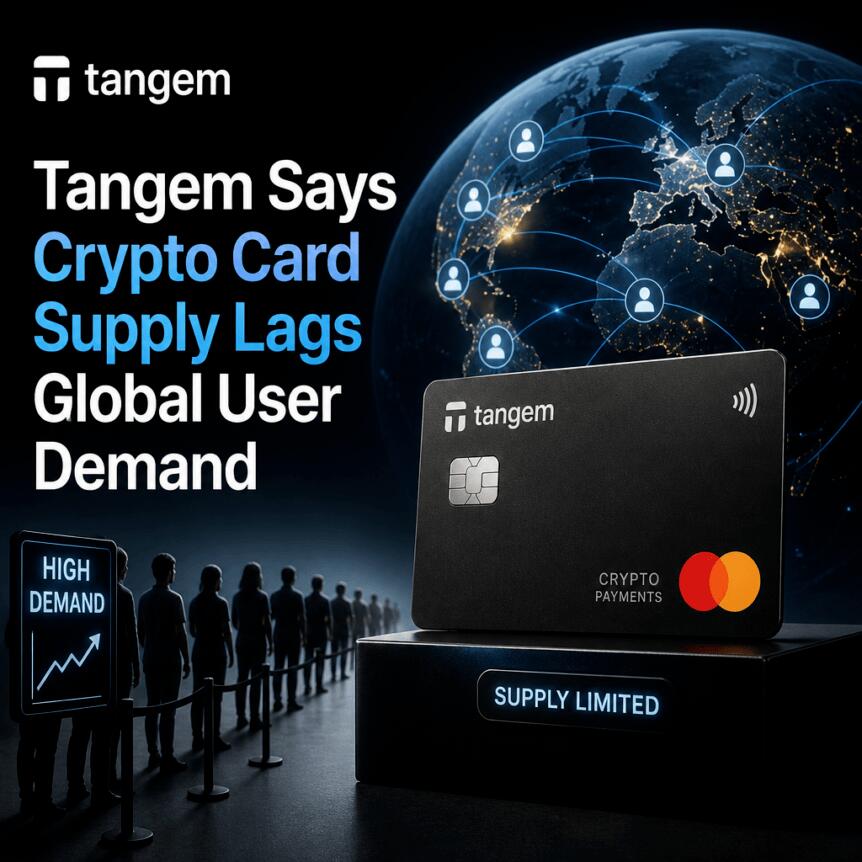
Swiss self-custody wallet provider Tangem says consumer demand for crypto-linked payments is already concentrated in specific regions—particularly Latin America—yet physical card rollout is constrained by a separate, harder-to-map set of requirements around regulation, banking, and card-issuing compliance.
In an interview with Cointelegraph, Andrey Ilinskiy, head of Tangem Pay, argued that expanding “where people want crypto cards” is only part of the challenge; the other part is whether “those maps” overlap with the locations where the necessary infrastructure and legal conditions line up.
Key takeaways
- Tangem Pay says more than 40% of its card payments come from Latin America, with over 30% coming from the US.
- Physical Tangem Pay card availability is limited in some jurisdictions, reflecting differences in KYC, sanctions, local banking rules, and card-issuing compliance.
- Tangem launched its first physical Visa card for in-store and online purchases and ATM withdrawals, starting with a limited release of 5,000 cards.
- Users can fund the card directly from their self-custodial wallet and move funds back if the card is suspended or closed.
- Cashback is being introduced using Circle’s USDC in the US, at 1% for Basic users and 2% for Plus users on eligible purchases.
Demand is global, but card rollout isn’t
Tangem Pay’s payment data points to uneven regional demand. According to the company, over 40% of Tangem Pay payments come from Latin America, while more than 30% originate in the United States. However, Tangem says physical card availability does not automatically follow that demand because distributing and operating a regulated payment instrument depends on factors beyond consumer interest.
Ilinskiy told Cointelegraph that card availability is shaped by where demand, regulation, banking infrastructure, and card-issuing requirements “line up,” noting that those geographic conditions “do not always” overlap.
That distinction matters for users and investors watching the broader adoption curve for crypto payments. Even if demand exists, the path to mass availability for hardware-linked, card-based rails can stall when compliance and partner requirements are harder to satisfy than typical crypto onboarding.
First physical Visa card: limited release and self-custody mechanics
On Wednesday, Tangem announced its first physical Visa card, designed for in-store and online purchases as well as ATM withdrawals. The initial release is capped at 5,000 cards, signaling a cautious rollout rather than an immediate nationwide scale-up.
Tangem says cardholders can fund the card directly from their self-custodial wallet. The company also states that users can move funds back to their wallet if the card is suspended or closed.
In its explanation, Tangem framed self-custody as removing one major barrier—there is “no custodian standing between the user and their assets.” But it emphasized that bringing assets into a regulated payment network introduces “another set of boundaries.” For readers, this is a useful reminder that the product combines two worlds: self-managed crypto control on one side, and compliance-heavy card infrastructure on the other.
About 20 countries not currently supported
Tangem says it cannot currently deliver physical Tangem Pay cards to roughly 20 countries, listing China, Russia, North Korea, and Palestine among those excluded. The company adds that the shipping restrictions do not necessarily track the rules that govern cryptocurrency generally.
Instead, Tangem points to the practical compliance steps that can affect whether a crypto-linked card can be issued in a particular jurisdiction. These include Know Your Customer (KYC) requirements, sanctions, local banking rules, and the requirements needed for card-issuing partners to meet compliance obligations.
In Tangem’s view, some of the same conditions that can create demand for crypto as an alternative financial rail may also make regulated card issuance more difficult. The implication is that card programs may end up operating in a narrower corridor than crypto interest itself—especially in regions where banking systems, sanctions exposure, or documentation standards complicate issuance.
USDC cashback and plans for Token2049 showcase
Alongside the card announcement, Tangem said it is introducing cashback denominated in Circle’s USDC stablecoin. The company set the rates at 1% for Basic users and 2% for Plus users on eligible purchases, positioning the stablecoin reward as a recurring incentive tied to everyday spending.
Earlier than broader card availability, reward programs can also serve as a signal of product maturity—because they require payment-side tracking, eligibility rules, and a stable mechanism for distributing USDC. For Tangem users, this means the card may provide utility beyond spending by turning part of that activity into additional stablecoin exposure, while still staying within Tangem’s self-custody narrative.
Tangem also said it plans to showcase the first physical Tangem Pay cards at Token2049 in Singapore, pointing to an effort to connect the rollout with industry visibility as it begins the initial 5,000-card distribution.
What to watch next
As Tangem moves from a limited physical release toward broader availability, the key uncertainty is not whether there is demand—its own payment figures suggest otherwise—but whether card-issuing compliance and banking infrastructure can expand into more jurisdictions. Readers should watch for updates on country eligibility and whether reward features like USDC cashback broaden alongside card distribution.
https://www.cryptobreaking.com/tangem-says-crypto-card-supply/?utm_source=blogger%20&utm_medium=social_auto&utm_campaign=Tangem%20Says%20Crypto%20Card%20Supply%20Lags%20Global%20User%20Demand%20
Comments
Post a Comment