
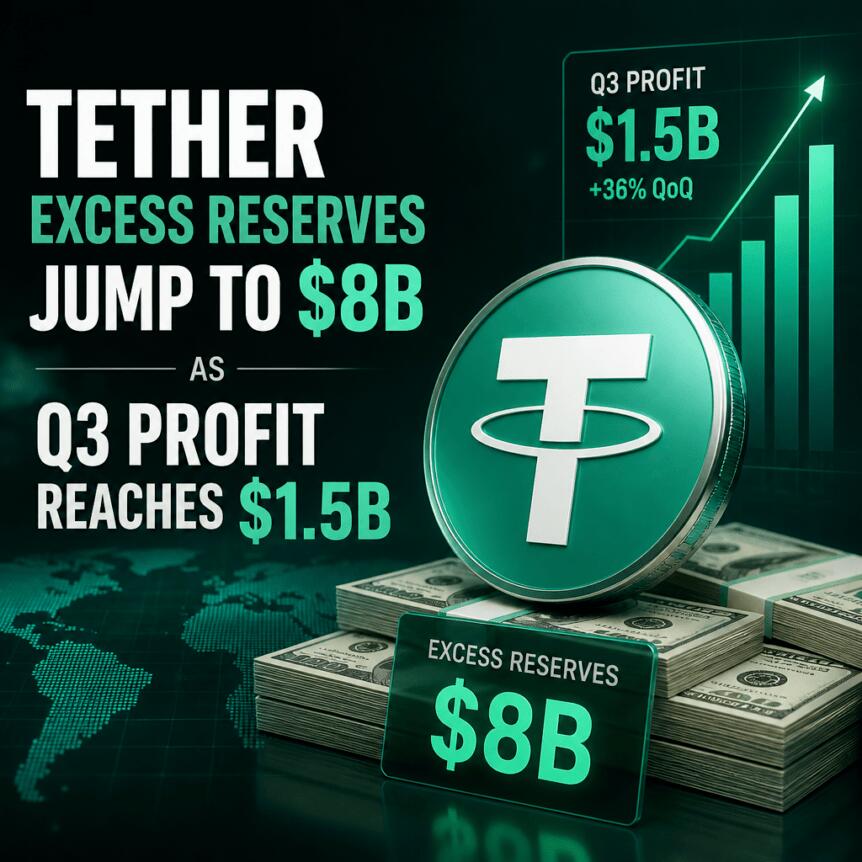
Tether says it generated $1.5 billion in third-quarter net operating profit, with its reserve buffer widening substantially as excess reserves nearly doubled to $7.95 billion, according to an attestation prepared by independent accounting firm BDO. The update arrives with figures released alongside Tether’s latest quarterly attestation and highlights how the company’s earnings and balance sheet remain closely tied to traditional markets.
At the end of September, Tether reported $191.5 billion in assets against $183.5 billion in liabilities, implying a surplus of $7.95 billion. That figure is close to twice the $4.1 billion reported for the earlier June period referenced in Tether’s disclosure, signaling a stronger cushion during the third quarter.
Key takeaways
- Tether reported $1.5 billion in third-quarter operating profit, alongside an increase in excess reserves to $7.95 billion.
- Assets exceeded liabilities by $7.95 billion at end of September, up from $4.1 billion reported in June.
- US Treasury bill exposure remains central, with $132.4 billion reported in direct and indirect holdings.
- Tether’s first nine months of 2026 operating profit totaled $4.5 billion, largely driven by Treasury bills and reverse repurchase agreements.
- Tether indicated USDT’s user base surpassed 700 million, while DefiLlama data places USDT at roughly 60% of the stablecoin market.
Reserves strengthen as Tether’s surplus grows
Tether’s third-quarter attestation shows a widening gap between what it holds and what it owes. The company reported $191.5 billion in assets versus $183.5 billion in liabilities at the end of September. With a reserve surplus of $7.95 billion, Tether’s buffer effectively grew to nearly double the $4.1 billion surplus it reported in June.
This improvement matters for market participants because reserve surpluses—how much is held above liabilities—often factor into how traders and risk managers evaluate issuer capacity to meet redemptions. While stablecoin markets are influenced by many variables, reserve coverage is a core element of issuer solvency narratives.
In its attestation, Tether also emphasized the structure of its holdings. The company reported $132.4 billion in direct and indirect US Treasury bill holdings, an exposure that forms the economic backbone for earnings in Tether’s disclosure.
Treasury exposure and how it stacks up internationally
Tether’s reported Treasury bill holdings also invite broader comparison. According to August data from the US Treasury Department’s Treasury International Capital (TIC) system, Tether’s $132.4 billion in US government debt exposure is comparable to South Korea’s $134.2 billion and higher than the United Arab Emirates’ $116.1 billion.
Those comparisons are not claims about direct credit risk or settlement practices, but they do underline the scale of Tether’s positioning in US government instruments. For investors focused on fiat-linked crypto products, such concentration is often viewed as both a stability factor (through exposure to liquid government collateral) and a dependency factor (through reliance on the yield and liquidity dynamics of traditional rates markets).
Earnings continue to be tied to Treasuries
Tether reported $4.5 billion in net operating profit over the first nine months of 2026. In the company’s figures, income is largely driven by US Treasury bills and reverse repurchase agreements, both of which are commonly used to monetize short-duration government exposure and liquidity.
Its Bitcoin reserves were valued at $8.37 billion, up from roughly $5.8 billion at the end of June, according to Tether’s disclosure. While Bitcoin holdings are not the main driver of USDT operating income—per the company’s own explanation of earnings—the increase points to continued exposure to crypto assets alongside fiat instruments.
USDT adoption: largest stablecoin by market share
USDT remains the largest stablecoin by market share. DefiLlama data referenced by Tether places USDT at around 60% of the $297.3 billion stablecoin market, with the figures cited in Tether’s disclosure.
In a post on X, Tether CEO Paolo Ardoino said USDT’s user base has surpassed 700 million, with adoption concentrated in emerging markets. That type of usage claim matters because stablecoins are often measured not only by market capitalization, but by the breadth of wallets and use cases—particularly where users rely on stablecoins for payments, remittances, and trading access in environments where local currency volatility is higher.
Reserve transparency: audit progress, still a key question
Tether has faced years of scrutiny over its reserve transparency. In August, the company announced completion of its first full independent financial statement audit by KPMG US. However, the audited statements were not made public, a detail that continues to shape how observers assess the depth of disclosure.
Against that backdrop, the third-quarter BDO-attested numbers provide an additional checkpoint. Still, the most relevant open issue for market watchers is how “attestation” disclosures compare with full audited statements and what level of detail is ultimately made available to the public.
As Tether continues to report operating profit, reserve buffer changes, and the composition of assets, readers should watch for whether the surplus trend persists in subsequent quarters and whether transparency improves beyond reserve attestations. Any future shift in earnings drivers—such as changing returns on Treasury bills or reverse repo funding conditions—could also affect how quickly the reserve buffer grows or contracts.
https://www.cryptobreaking.com/tether-excess-reserves-jump-to/?utm_source=blogger%20&utm_medium=social_auto&utm_campaign=Tether%20Excess%20Reserves%20Jump%20to%20$8B%20as%20Q3%20Profit%20Reaches%20$1.5B%20
Comments
Post a Comment