
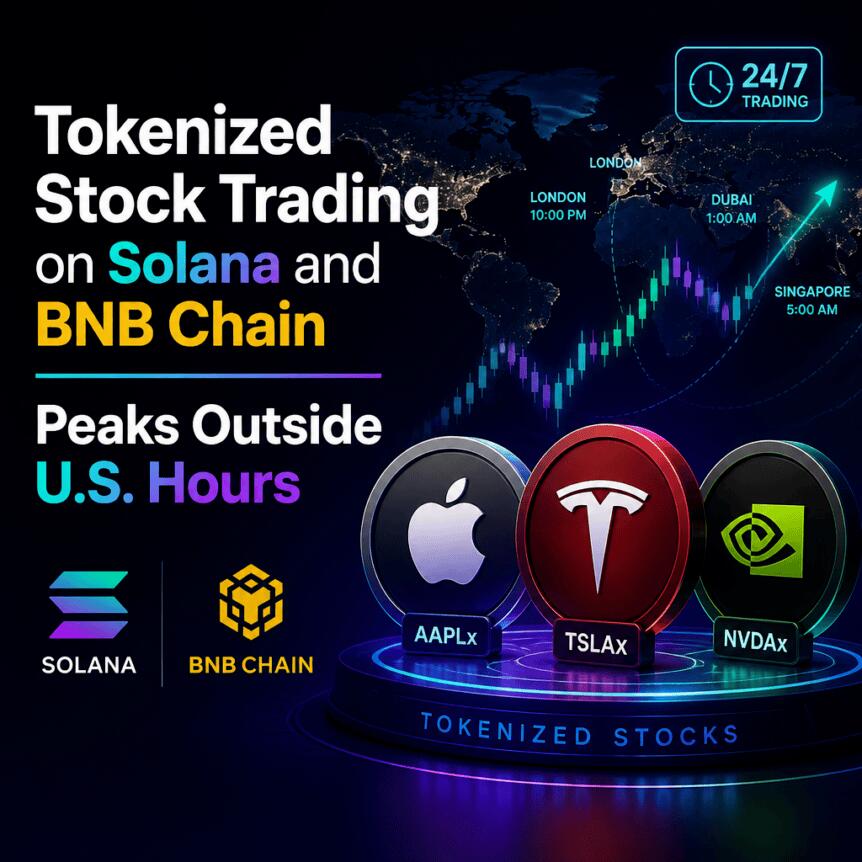
Tokenized stock trading is increasingly shifting to the hours when traditional US exchanges are closed, reinforcing a core promise of putting equities onchain: continuous market access. Data referenced from Blockworks shows that on several major networks, the majority of tokenized stock volume is happening outside the standard 9:30 am to 4 pm Eastern trading window.
According to Blockworks data cited by The Kobeissi Letter, more than 70% of tokenized stock trading volume on BNB Chain occurs outside regular US market hours. The same pattern is visible on other networks as well—63% on Solana and nearly 60% on Base—suggesting market participants are using tokenized equities to trade when liquidity and timing on traditional venues may be limited.
Key takeaways
- Over half of tokenized stock trading volume on BNB Chain, Solana, and Base occurs outside US exchange hours, according to Blockworks data cited by The Kobeissi Letter.
- Solana-based trading platform Jupiter reported a 50% month-over-month rise in tokenized asset trading volume.
- RWA.xyz data indicates the value of tokenized stocks rose about 15% over the past 30 days to nearly $3.3 billion.
- Regulatory progress is underway: the SEC’s “innovation exemption” is designed to allow qualifying venues to trade tokenized US-listed stocks on public blockchains, with disclosure requirements.
Trading patterns point to true “around-the-clock” use
The headline signal in the figures is not simply that tokenized stocks trade heavily onchain—it’s when that activity occurs. If tokenized equities were mostly mirroring what happens on regulated US exchanges, a larger share of volume would cluster during the 9:30 am to 4 pm Eastern session. Instead, Blockworks’ figures cited by The Kobeissi Letter indicate that outside that window, activity dominates.
On BNB Chain, the portion of volume outside US market hours is above 70%. Solana follows at 63%, while Base is close behind at nearly 60%. The spread across multiple ecosystems matters: it suggests the behavior is not isolated to one chain’s user base or infrastructure.
This timing pattern is consistent with an investor use case—trading tokenized stock exposure when US markets are closed. The implication for onchain equity adoption is straightforward: investors appear to be treating tokenized assets not only as a different wrapper for existing securities, but as a mechanism for extending trading flexibility.
It also aligns with activity growth seen in core Solana trading infrastructure. Jupiter, a major Solana-based trading platform, reported a 50% month-over-month increase in tokenized asset trading volume. While Jupiter’s figure covers tokenized assets broadly, it supports the broader theme of increasing onchain demand for tokenized financial instruments.
Onchain tokenized stocks keep accumulating value
The shift in trading hours comes alongside growth in the overall value of tokenized stock offerings. RWA.xyz data cited in the report indicates tokenized stock values have increased by about 15% over the past 30 days, reaching nearly $3.3 billion.
Just as important as total value is who is behind it. The market remains concentrated among several issuers whose tokens can be issued and traded across different blockchains, including Ondo Global Markets, xStocks, and bStocks. That cross-chain availability may help explain why trading volume is visible outside US hours across multiple networks: participants are not restricted to a single venue or settlement environment.
For market observers, this matters because it suggests the ecosystem is maturing beyond early experiments. When value grows and volume shifts meaningfully in time-of-day terms, it signals a sustained trading preference rather than a one-off burst of speculation.
Regulators move toward allowing tokenized US equities on public chains
The trading pattern gains additional context from regulatory developments. US regulators have started to outline pathways for tokenized equity trading in traditional market structures. Last month, the Securities and Exchange Commission (SEC) introduced an “innovation exemption” framework, as previously reported, which allows qualifying venues to trade tokenized US-listed stocks on public blockchains.
As stated by SEC Commissioner Mark Uyeda, participating venues must publish transaction data in US dollars, including trade prices, sizes, timestamps, and daily trading volumes. They must also disclose liquidity pool addresses and balances.
The SEC’s approach also contrasts with the accessibility constraints found in many existing tokenized stock products. The article notes that products such as xStocks and Ondo Global Markets are generally not available to US investors. Under the exemption, qualifying venues can potentially offer tokenized US equities domestically—provided they preserve shareholder rights and meet trading and disclosure requirements.
That difference—international token access versus domestic availability—could be a key catalyst to watch. If tokenized equities become more accessible within the US market while maintaining regulatory-aligned disclosure standards, more participants may be encouraged to use tokenized trading for its extended hours advantage.
What investors should watch next
The clearest near-term question is whether regulatory clarity will deepen demand in exactly the way the trading data hints at. If more US participants gain compliant access to tokenized US-listed stocks, the share of volume outside US exchange hours could rise further—or, at minimum, remain elevated.
Investors should also monitor how venues operationalize the SEC’s disclosure expectations for public chains, and whether cross-chain liquidity continues to expand around major issuers. The current numbers suggest onchain tokenized stocks are already delivering something traders value: more time to trade. The next test is whether that advantage scales as the regulatory framework becomes more enabling.
https://www.cryptobreaking.com/tokenized-stock-trading-on-solana/?utm_source=blogger%20&utm_medium=social_auto&utm_campaign=Tokenized%20Stock%20Trading%20on%20Solana%20and%20BNB%20Chain%20Peaks%20Outside%20U.S.%20Hours%20
Comments
Post a Comment