
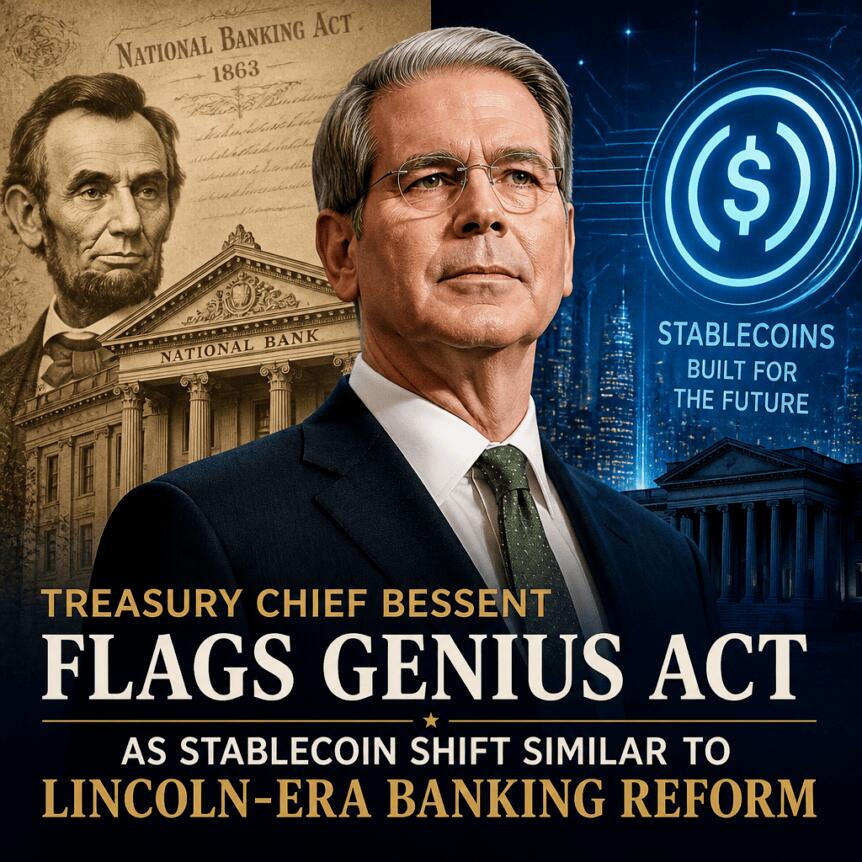
U.S. Treasury Secretary Scott Bessent on Wednesday framed the Trump administration’s stablecoin push as a historic step toward building a national framework for digital payments, drawing an analogy to major banking reforms during Abraham Lincoln’s presidency.
In a post on X, Bessent praised the Office of the Comptroller of the Currency’s (OCC) final rule implementing the GENIUS Act, calling it a “watershed moment in American finance.” He compared the legislation’s role in regulating payment stablecoins to the National Currency Act of 1863, which helped establish a federal structure for nationally chartered banks to issue currency.
Key takeaways
- Bessent compared the GENIUS Act’s stablecoin framework to the National Currency Act of 1863, emphasizing the goal of a national payments system.
- The OCC finalized rules covering how supervised entities must handle reserves, redemptions, and risk management for payment stablecoins.
- The OCC’s rules are scheduled to take effect on Jan. 18, 2027, with authorization generally required for issuers by then.
- Penalties may apply to companies that issue payment stablecoins without the necessary approvals under the GENIUS Act framework.
- The rule applies not only to national banks and certain savings associations, but also to some foreign issuers seeking approval under federal supervision.
The GENIUS Act as a “national framework” for payment stablecoins
The GENIUS Act, signed into law in 2025, created a federal regulatory structure specifically for “payment stablecoins.” In broad terms, it established the legal basis for how the U.S. will regulate stablecoins intended for payments and related financial use cases—an area that has drawn intense attention from regulators due to concerns over reserves, redemption risk, and systemic stability.
Bessent’s comments focused on the political and economic meaning of that framework: he argued that the final OCC rule would encourage “private-sector innovation, competition, and American leadership in digital assets.” Rather than positioning stablecoin rules as a barrier, his framing suggests the administration views clarity and oversight as prerequisites for scaling digital payment rails in the U.S.
Investors and market participants may see value in this “regulatory runway” approach. When rules are defined in advance and tied to a clear effective date, issuers can plan product timelines, compliance processes, and reserve management strategies with greater certainty than under a shifting patchwork of interpretations.
What the OCC’s final rule covers and who it applies to
According to reporting by Cointelegraph, the OCC’s final rules govern stablecoin reserves, redemptions, and related services under the GENIUS Act. The OCC described the approach as a “clear, practical framework for payment stablecoin innovation,” with implementation scheduled to begin on Jan. 18, 2027.
The OCC says the final rule applies to multiple categories of institutions that would be under federal supervision, including national banks, federal savings associations, federal branches of foreign banks, and nonbank companies seeking approval to issue payment stablecoins. It also covers certain foreign payment stablecoin issuers.
Crucially for market structure, the rule is not limited to one type of issuer. That matters because stablecoin issuance in practice has involved a mix of bank-affiliated arrangements and nonbank-led models. By specifying an approval path for a broader set of entities, the OCC’s framework can influence which businesses are able to scale and how quickly—especially as stablecoin activity becomes more tied to regulated payment ecosystems.
For readers looking for the regulatory language itself, the OCC’s bulletin describing the rule is available on its website: OCC Bulletin 2026-50.
The timeline: authorization, reserves, and redemption readiness
The OCC’s approach sets a concrete deadline. Beginning Jan. 18, 2027, companies issuing payment stablecoins in the United States will generally need authorization under the GENIUS Act framework. The article notes that issuing stablecoins without required authorization could trigger penalties.
While the headline narrative emphasizes innovation, the operational implications for issuers are straightforward: reserves and redemption mechanics are central to stablecoin credibility. The OCC rule’s focus on reserves and redemptions signals that compliance will likely require demonstrable, auditable reserve practices and clear processes for handling customer redemption requests—core elements in avoiding liquidity stress.
From a risk-management standpoint, stablecoin buyers and partners (including payments providers) tend to evaluate whether an issuer’s redemption process is reliable under normal conditions and during periods of market volatility. A standardized regulatory framework can reduce uncertainty for counterparties and potentially streamline due diligence.
At the same time, the scope of compliance preparation is substantial. Nonbank issuers and foreign firms seeking U.S. approval may need to design or restructure custody, reserve reporting, and risk controls to match federal supervisory expectations. The time between now and Jan. 18, 2027 becomes a critical window for applications, internal governance updates, and partnership alignment.
Why this matters now: stablecoins gaining payment traction
Even as growth in the overall supply of dollar-denominated stablecoins has stalled, the article notes that traction for payments and money transfers has continued to grow. That dynamic—steady use in transfers and payments alongside uneven expansion in total supply—helps explain why regulators are moving toward detailed issuance rules rather than focusing only on market growth.
In practical terms, “payment stablecoins” sit closer to everyday financial flows than earlier speculative or exchange-focused uses. As adoption spreads into transfer services and payment channels, regulators face greater pressure to ensure that stablecoins function predictably and that failures do not cascade into broader financial systems.
The broader industry context also shows regulators paying close attention to how stablecoin risk is managed by institutions that interface with the tokens. For example, Cointelegraph has previously reported on Mastercard launching stablecoin risk screening tools for banks and payment providers, underlining that compliance and risk controls are becoming a mainstream requirement rather than an edge-case concern.
What to watch next
With the OCC’s stablecoin rules set for an effective date of Jan. 18, 2027, the next phase for issuers will be preparing for authorization requirements under the GENIUS Act and aligning reserve, redemption, and risk management processes with federal supervision. Market participants should watch how applications progress and whether regulated issuance expands the share of compliant stablecoins in U.S. payment workflows.
https://www.cryptobreaking.com/treasury-chief-bessent-flags-genius/?utm_source=blogger%20&utm_medium=social_auto&utm_campaign=Treasury%20Chief%20Bessent%20Flags%20GENIUS%20Act%20as%20Stablecoin%20Shift%20Similar%20to%20Lincoln-Era%20Banking%20Reform%20
Comments
Post a Comment