
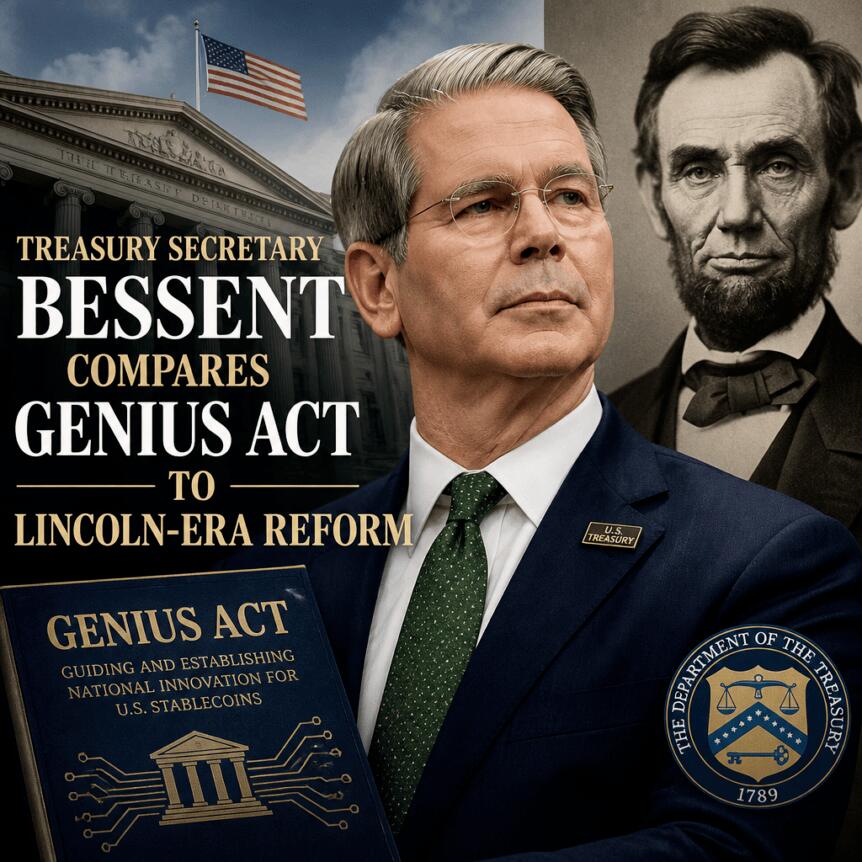
U.S. Treasury Secretary Scott Bessent on Wednesday compared the Trump administration’s stablecoin legislation to historic banking reforms, arguing that the rules now taking shape could help define how payment stablecoins operate in the United States.
In a post on X, Bessent praised the Office of the Comptroller of the Currency’s (OCC) final rule implementing the GENIUS Act, calling it a “watershed moment in American finance.” He likened the move to the National Currency Act of 1863—an effort that created a federal structure for nationally chartered banks to issue currency—framing the GENIUS Act as a similar attempt to set national standards for digital payments.
Key takeaways
- The OCC finalized rules under the GENIUS Act covering reserve management, redemptions, and risk controls for payment stablecoin issuers.
- The final rule is scheduled to take effect on Jan. 18, 2027, with broader regulatory authorization expected for issuers from that date.
- Issuing without the required approval under the GENIUS framework could expose companies to penalties.
- The OCC’s scope includes banks and nonbank companies seeking approval to issue payment stablecoins under federal supervision.
- Bessent’s analogy positions the GENIUS framework as an effort to establish long-term national rules for digital currency, not just short-term oversight.
The OCC’s GENIUS Act rule and what it regulates
According to Cointelegraph’s report on the finalized rule, the OCC’s updates spell out how the GENIUS Act will apply to stablecoin issuers, with specific emphasis on the mechanics that regulators typically focus on for consumer and payment-related instruments.
The GENIUS Act itself, which was signed into law in 2025, created a federal regulatory framework for payment stablecoins. The OCC’s final rule operationalizes that framework for institutions under its supervision, including requirements tied to stablecoin reserves, how redemptions should work, and the risk management expectations issuers must meet.
OCC Comptroller Jonathan Gould characterized the regulation as a “clear, practical framework for payment stablecoin innovation,” signaling the agency’s intent to provide implementable guidance for companies seeking to build within the law.
For investors and market participants, the practical significance is that regulatory compliance is no longer just a policy discussion—it is becoming a set of defined operational requirements. Stablecoins are increasingly marketed for payments and money transfers, so the reserve and redemption rules can influence how issuers structure products and how counterparties assess risk.
When the rules start and why authorization matters
Cointelegraph reports that the OCC rules are scheduled to take effect on Jan. 18, 2027. From that date, companies issuing payment stablecoins in the United States will generally need regulatory approval under the GENIUS Act framework.
The OCC also indicated that issuing without the required authorization could lead to penalties, making timing an urgent planning issue for issuers and service providers that rely on stablecoins for settlement and payment flows.
In its bulletin on the final rule, the OCC said the regulations apply to national banks, federal savings associations, federal branches of foreign banks, and nonbank companies seeking approval to issue payment stablecoins under federal supervision. The bulletin further notes that the rules also cover certain foreign payment stablecoin issuers, extending the compliance conversation beyond purely domestic entities.
Room for “innovation,” but within a federal structure
Bessent’s remarks were notable not only for the historical comparison, but for how they framed the GENIUS Act as an engine for competition and growth. He said the OCC rule would support “private-sector innovation, competition, and American leadership in digital assets.”
The Lincoln-era parallel Bessent drew is meant to communicate continuity: just as the National Currency Act established a system for currency issuance within a federal banking structure, the GENIUS Act and OCC rule are positioned to establish an analog for digital payment stablecoins. Whether the outcome mirrors the effectiveness of the 1863 legislation will depend on implementation details—particularly how strictly authorization requirements are applied and how quickly industry participants can align reserves, redemption processes, and risk governance.
There is also a market timing angle. Cointelegraph noted that dollar-denominated stablecoins have been gaining traction for payments and money transfers, even as growth in overall supply has stalled. A regulatory framework that reduces uncertainty could matter most at the margin—encouraging additional payment-focused deployment while discouraging activity that can’t meet reserve and redemption requirements.
What issuers, banks, and payment providers should watch next
With the effective date set for Jan. 18, 2027, attention will likely shift from rulemaking to execution: how companies apply for authorization, how supervisors evaluate reserves and redemption readiness, and what risk management standards issuers must demonstrate in practice.
Industry watchers may also want to monitor how banks and payment providers respond as the stablecoin compliance boundary firms up. The broader ecosystem is already trending toward more formal risk controls for stablecoin-related activity, and the OCC rule adds another layer of standardized expectations for issuers under federal oversight.
For now, the central open question remains whether the new framework will accelerate adoption by clarifying permissible structures—or slow it by raising the cost and timeline of authorization. Either way, the shift from legislative intent to enforceable rules is likely to be a defining moment for payment stablecoins in the U.S.
https://www.cryptobreaking.com/treasury-secretary-bessent-compares-genius/?utm_source=blogger%20&utm_medium=social_auto&utm_campaign=Treasury%20Secretary%20Bessent%20Compares%20GENIUS%20Act%20to%20Lincoln-Era%20Reform%20
Comments
Post a Comment