
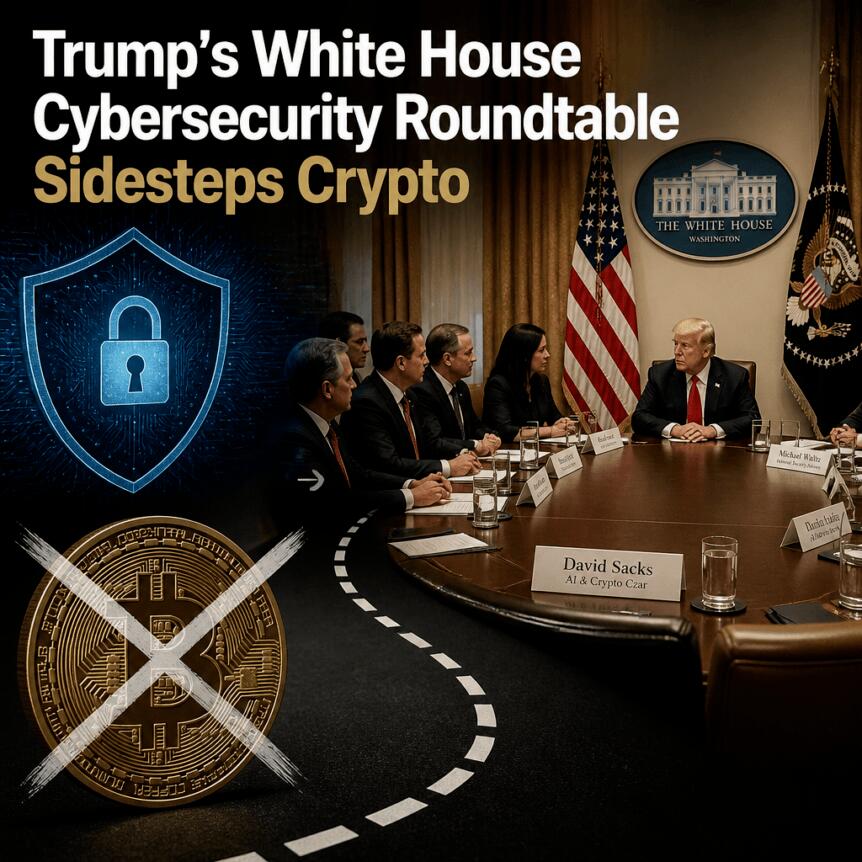
U.S. President Donald Trump hosted a White House roundtable focused on cybercrime on Wednesday, citing large losses suffered by Americans and highlighting government actions aimed at stopping criminals who operate through online scams. The event comes amid heightened political scrutiny over allegations that Trump and members of his administration have profited from digital-asset-related activity.
Trump said “countless” Americans lost more than $20 billion to cybercrime in 2025, describing a range of tactics including impersonation schemes, ransomware attacks, scam centers, and other methods. He also claimed that federal officials froze $1 billion in “cybercurrency tied to foreign scammers” and prevented $1.6 billion in losses from reaching criminals after a March executive order.
Key takeaways
- Trump framed 2025 cybercrime losses as exceeding $20 billion and pointed to specific government actions, including freezing $1 billion tied to foreign scammers.
- The White House discussion avoided the terms “cryptocurrency” and “digital assets,” even though related reporting before the event indicated a possible crackdown on foreign crypto scams.
- Trump used “cybercurrency,” a less common term that many in the industry associate with older language for cryptocurrency.
- Separate reporting cited U.S. investigations that attribute significant 2025 losses to scams involving digital assets, including through crypto ATMs.
- The event unfolded alongside ongoing U.S. political controversy over connections between the Trump administration and the digital-asset sector.
White House cybercrime claims and the “cybercurrency” wording
At the Wednesday roundtable, Trump described the scale of cybercrime losses in broad terms, tying them to scams and extortion techniques commonly used by cybercriminal groups. In discussing countermeasures, he pointed to two figures: $1 billion frozen in what he called “cybercurrency” connected to foreign scammers, and $1.6 billion in losses reportedly blocked from reaching criminals following a March executive order.
Notably, Trump and Attorney General Todd Blanche did not explicitly use the terms “cryptocurrency” or “digital assets” during the roundtable remarks. Earlier coverage had indicated that the event could center on foreign crypto scams, and Homeland Security Secretary Markwayne Mullin likewise referred to “digital extortion” rather than cryptocurrency.
Trump’s use of “cybercurrency” stands out because it is widely viewed as dated—language that does not match how most of the public and industry now discuss cryptocurrencies. For investors and compliance professionals, terminology matters: the way officials label threats can influence how regulators and law enforcement coordinate, and how institutions interpret the scope of enforcement priorities.
What U.S. reporting says about crypto-linked losses
While the White House event did not explicitly highlight “cryptocurrency,” U.S. law-enforcement reporting has linked a substantial portion of scam losses to digital assets. According to reporting attributed to the Federal Bureau of Investigation, Americans lost $11 billion in 2025 from scams specifically involving digital assets, including scams involving crypto ATMs. (This figure was reported by Cointelegraph, citing the FBI.)
That mismatch—government officials speaking generally about cybercrime without naming cryptocurrency, while other reporting emphasizes crypto-linked losses—creates a question for the market: is the administration positioning the issue as a broader cyber threat first, with digital assets as one component, or is it narrowing language for political or regulatory reasons? Either way, the underlying theme for users remains the same: scams involving digital-asset rails continue to be a material driver of reported losses.
Political scrutiny continues alongside the enforcement push
The roundtable took place as Trump and administration figures face questions from lawmakers and voters about allegations that they used their positions to enrich themselves through digital-asset holdings. Separate reporting referenced claims that Trump’s crypto-related ventures generated significant net gains in 2025 and that alleged “schemes” involving investors may have led to substantial losses, according to a Public Citizen report.
Trump’s family’s company, World Liberty Financial, has also drawn scrutiny connected to its USD1 stablecoin and claims about how it was used in relation to a large investment connected to an entity in the United Arab Emirates. In parallel, reporting also noted that Trump’s memecoin project, Official Trump (TRUMP), has continued with tokenholder events, which have in turn fed accusations from lawmakers and advocacy groups about “pay-to-play” dynamics.
For the crypto ecosystem, the practical implication is that enforcement narratives do not operate in a vacuum. Market participants often watch whether public anti-crime messaging is matched by consistent policy implementation and credible separation between official actions and personal or political financial interests. Even if the cybercrime crackdown is legitimate and substantive, the political context can affect regulatory credibility and sentiment.
Europe’s arrests underscore the cross-border nature of laundering
The White House event followed international reporting that Italian authorities arrested 30 people in connection with a crypto money-laundering scheme. Bloomberg reported that the case involved alleged use of crypto to launder millions of dollars through a bank allegedly linked to the mafia, with investigators tracing funds from sources including corporate fraud, crypto investment scams, and drug trafficking to digital wallets.
The juxtaposition matters. When cybercriminal and laundering networks move value through digital assets across jurisdictions, policy and enforcement efforts tend to require cross-border coordination. The U.S. officials’ emphasis on freezing funds tied to foreign scammers aligns with that reality, and the Italian case reinforces that laundering activity continues to exploit crypto rails internationally—not only for ransomware but also for fraud and trafficking proceeds.
Looking ahead, readers should watch whether the White House’s messaging translates into clearer policy signals on digital-assets-related enforcement—particularly how authorities describe cryptocurrency in official frameworks, what legal mechanisms are used to freeze or seize funds, and whether international cases like the Italy arrests prompt more coordinated action with U.S. partners.
https://www.cryptobreaking.com/trumps-white-house-cybersecurity-roundtable/?utm_source=blogger%20&utm_medium=social_auto&utm_campaign=Trump’s%20White%20House%20Cybersecurity%20Roundtable%20Sidesteps%20Crypto%20
Comments
Post a Comment