
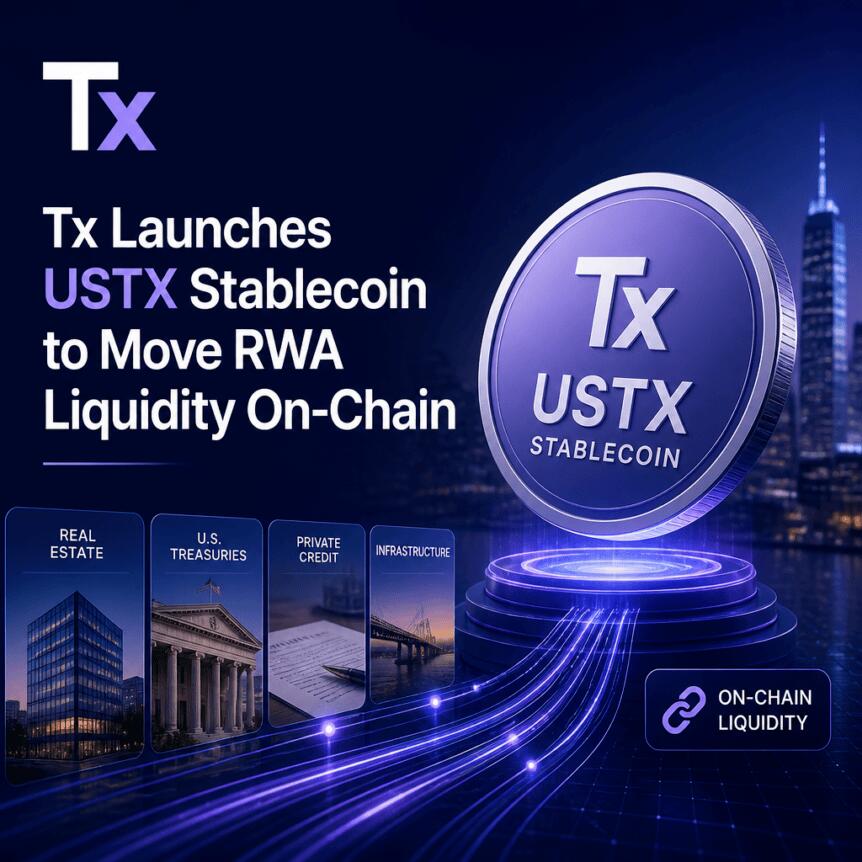
Real-world asset (RWA) platform tx has launched USTX, a dollar stablecoin designed for use in its wallet and its planned tokenized-stock marketplace. In a Tuesday announcement shared with Cointelegraph, tx said users will be able to mint USTX using USDC and later redeem it back for USDC.
tx also said USTX is not intended to be a mere wrapper around USDC. Instead, the company described the token as having its own 1:1 reserve structure, issued and managed through its partner infrastructure provider, Brale. The platform supports deposits from eight blockchains, including Ethereum, Solana, and Base.
Key takeaways
- tx has introduced USTX, a dollar stablecoin meant for its wallet and a forthcoming tokenized-stocks marketplace.
- USDC is the minting and redemption on-ramp: users can mint USTX with USDC and redeem USTX back into USDC.
- USTX is designed with its own reserve structure, with reserves managed via Brale rather than functioning as a USDC wrapper.
- Brale handles issuance and reserve management, with tx describing reserves as including cash, bank deposits, money market funds, and short-term U.S. Treasury bills.
- Rewards are being positioned around legal constraints related to the GENIUS Act’s restrictions on yield for holding stablecoins.
Why tx’s USTX launch is positioned as more than a USDC mirror
Stablecoins are increasingly used as shared dollar liquidity across wallets, marketplaces, and trading systems—especially where tokenized assets need consistent settlement and collateral. tx’s USTX follows that broader industry pattern, but the company is explicitly drawing a line between USTX and a simpler “wrap” model.
According to tx co-founder and chief legal officer Ashley Ebersole, USTX is “not a USDC-backed wrapper or synthetic representation of USDC.” Instead, Ebersole said USDC is used as a mechanism to mint USTX, which then operates under its own 1:1 reserve approach through Brale.
For investors and builders, that distinction matters because reserve design affects operational assumptions: how redemption is handled, what regulatory and custody expectations are applied, and how reserve composition supports the token’s peg over time. tx’s description implies that USTX aims to function as a standalone dollar instrument within its ecosystem rather than simply pass through USDC balances.
How minting and redemption work, and what reserves support USTX
tx said users will need USDC to mint USTX, and that each USTX is redeemable for USDC. That structure keeps a clear relationship between the stablecoin and an established settlement asset, which can lower friction for users who already hold USDC.
Under the arrangement described by tx, Brale is responsible for issuing USTX, managing its reserves, and facilitating minting and redemption. tx also said that each token is backed by $1 in assets, including:
- cash
- bank deposits
- government money market funds
- short-term U.S. Treasury bills
tx’s approach fits a wider trend among dollar stablecoin products: while many ecosystems begin with a chain-native token, they often rely on specialized issuers and reserve managers to handle the balance-sheet and operational components. By naming Brale’s role directly, tx signals that the stablecoin’s core mechanics are externalized—potentially improving scalability for an RWA-focused platform while keeping the token embedded in its own application layer.
Multi-chain access through deposits from eight networks
In addition to reserve mechanics, tx highlighted accessibility. The platform accepts deposits from eight blockchains, listing Ethereum, Solana, and Base among them.
From a user perspective, multi-chain deposit support is often the practical difference between adopting a stablecoin in a wallet versus seeing it remain siloed. If tx can mint USTX from assets originating on multiple networks, it lowers the friction for users who trade, hold, or transact across different chains—an important consideration for tokenized securities workflows, where users may not share the same default network.
For the tx ecosystem, the broader goal appears to be enabling a consistent dollar balance that can be used to buy tokenized assets and support trading activity within its wallet and planned marketplace.
Rewards, compliance, and the GENIUS Act restriction
tx also discussed rewards connected to USTX usage. The company said eligible users may receive rewards through wallet programs. It also acknowledged a regulatory constraint: the GENIUS Act prohibits stablecoin issuers from paying holders interest or yield solely for holding, using, or retaining a payment stablecoin.
When asked how tx’s rewards fit within the restriction, Ebersole said “The overall rewards program was designed based on legal advice to ensure it falls within what’s permissible under the law.”
While tx did not provide additional granular details in the announcement excerpt shared with Cointelegraph, the compliance framing is a key signal for the industry. Stablecoin issuers have increasingly faced scrutiny over whether certain promotional programs effectively function like yield. In that context, tx’s language suggests the program is structured to avoid characteristics that could be interpreted as prohibited interest for mere holding or retention.
Readers should watch for how tx defines eligibility and reward triggers over time—specifically whether rewards are tied to activities beyond simply keeping the token, such as transaction behavior, wallet engagement, or other permissible user actions.
How this fits the broader stablecoin strategy for RWA ecosystems
tx’s announcement reflects a recurring model in crypto: platforms focused on trading, payments, or tokenized real-world assets often introduce a dedicated stablecoin—or bring one into the stack—so settlement and collateral can be handled uniformly. The company’s description also aligns with an emerging pattern where networks and trading venues launch dollar stablecoins through outside partners that specialize in issuance and reserve management.
Earlier coverage from Cointelegraph noted that Brale has been working on stablecoin settlement improvements with Visa, with an emphasis on speeding up settlement and improving programmability in environments where privacy, compliance, and operational control are essential.
For tx, the next practical test is whether USTX becomes meaningfully embedded in its wallet experience and whether its planned tokenized-stock marketplace ties directly into the stablecoin’s utility—rather than functioning as a stand-alone asset.
Going forward, investors and users should monitor USTX’s adoption across networks supported by tx, how minting/redemption flows are operationalized at scale, and—most importantly—how the wallet rewards are structured to remain within the GENIUS Act’s boundaries as the program evolves.
https://www.cryptobreaking.com/tx-launches-ustx-stablecoin-to/?utm_source=blogger%20&utm_medium=social_auto&utm_campaign=Tx%20Launches%20USTX%20Stablecoin%20to%20Move%20RWA%20Liquidity%20On-Chain%20
Comments
Post a Comment