
The U.S. Treasury has proposed new outbound investment restrictions aimed at curbing foreign access to artificial intelligence and certain high-risk semiconductor technologies. The proposal would implement the COINS Act provisions referenced for December 2025 and broaden the scope of the Outbound Investment Security Program that began in January 2025.
Meanwhile across Asia, regulators and institutions are continuing to test stablecoin rails, expand tokenized finance, and address public-sector risks from advanced AI tools—illustrating how both policy and infrastructure are evolving in parallel for crypto markets.
Key takeaways
- The U.S. Treasury’s proposed outbound investment rules target AI projects and high-risk semiconductors, widening beyond China to include Russia, Iran, North Korea, and Cuba.
- DHS has ordered the removal of DeepSeek products from federal civilian agency IT systems, also covering affiliates and third-party offerings built using DeepSeek implementations.
- Solana’s Shanghai event was postponed after pre-registration surpassed the local authorities’ event cap, raising questions about execution risk as crypto events move through local compliance processes.
- South Korea’s finance officials met major exchanges amid calls to delay a new crypto tax, with regulators already extending the start date to 2027.
- Central banks and financial groups in the region are advancing tokenized-market plumbing—ranging from won-stablecoin settlement concepts to a Bank Negara Malaysia DLT platform for tokenized bonds.
U.S. proposes wider AI and semiconductor investment blocks
The U.S. Treasury’s proposal would block or restrict investment in certain foreign AI activities—described as “Super Intelligence” projects—and in specific high-risk semiconductor categories in designated countries. While geopolitical concerns are central, the scope is set to extend beyond China to include Russia, Iran, North Korea, and Cuba.
According to the Treasury’s framing, the rules would roll forward COINS Act requirements slated for December 2025 and expand the Outbound Investment Security Program that started in January 2025. The effort builds on earlier U.S. restrictions aimed at limiting the sale of high-powered AI chips to China, tightening the net from hardware controls toward investment flows.
The proposal also comes as the U.S. begins to reinforce compliance through enforcement. This month, the U.S. Treasury announced a first penalty of $200,000 to Amidi, LLC Treasury for failing to report an investment made by a Chinese subsidiary into Shanghai Qiongche Intelligent Technology—also known as Noematrix—an embodied AI and robotics company. For investors, this matters because the rules signal that disclosure obligations and screening of cross-border exposure may become an increasingly important part of diligence, not just an afterthought.
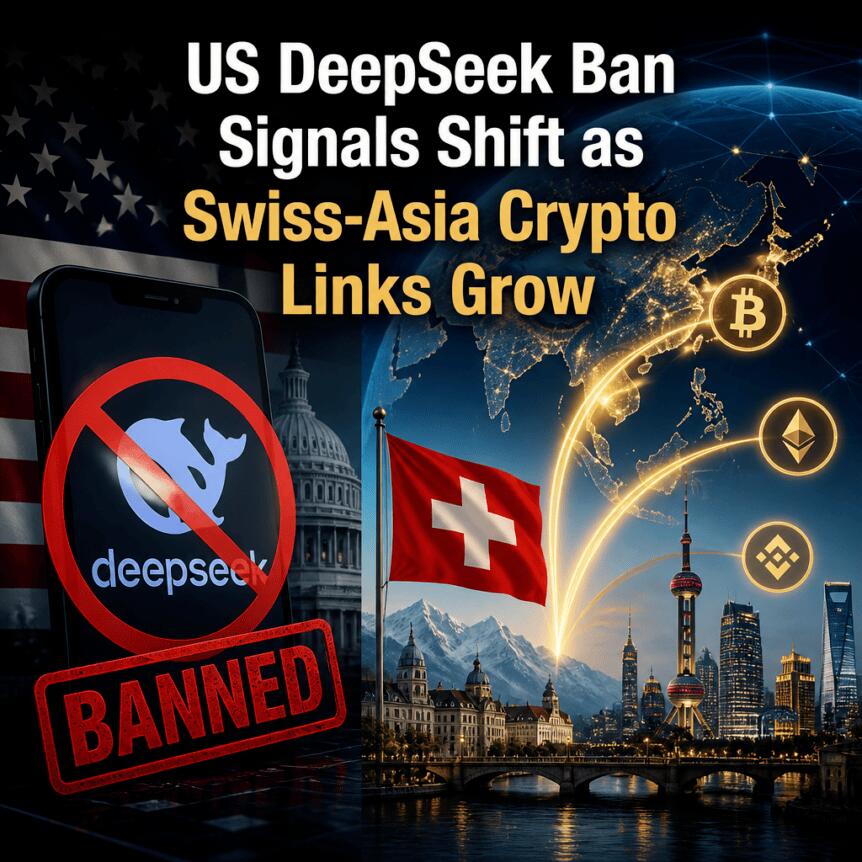
DHS orders DeepSeek removal from federal systems
In a separate but related thread of government caution around AI, the U.S. Department of Homeland Security ordered federal civilian agencies to remove DeepSeek products from their IT systems. The order, reported via Cointelegraph, is based on a DHS directive to remove products, along with related DeepSeek affiliates and third-party products/services developed using DeepSeek implementations, while preventing affected agencies from making new purchases.
DHS warned that using DeepSeek by government employees and contractors could expose sensitive information to China, potentially including details about U.S. citizens and federal programs. The action also highlights an operational dimension of AI risk: even where a product’s technical performance is strong, agencies may still limit adoption when national security concerns are raised.
The directive was filed with the Federal Register, underscoring that this is not merely an informal recommendation. For market participants supplying tools to government-adjacent workflows, it’s a reminder that AI adoption can shift quickly once procurement and information-handling policies change.
Solana Shanghai postponed after registration surge
On the events front, Solana Foundation president Lily Liu said the Solana Accelerate event in Shanghai was postponed after pre-registration exceeded an event cap set by local authorities. Liu stated that registration “quadrupled overnight” following publicity, and that organizers chose to pause the event to “comply with local requirements.”
Earlier on the day, X users claimed the event was “abruptly suspended,” citing the presence of law enforcement officers at the venue. Liu’s explanation provides a different causal emphasis—registration volume rather than an outright stop—though the underlying message for builders and organizers is the same: local administrative limits can become the gating factor, even when demand is high.
The episode also drew attention from figures in the broader ecosystem. Binance founder Changpeng Zhao posted that he was impressed Solana Foundation had been allowed to open a Shanghai office, comparing it with BNB Chain’s previous difficulty in doing so.
Stablecoins and tokenized rails accelerate across Asia
While U.S. policy focuses on controlling exposure to AI and semiconductors, parts of Asia continue to test how crypto rails integrate with mainstream payments and financial infrastructure.
Japan-Korea travel payments become a yen stablecoin test case
In Japan–South Korea cross-border use cases, Shinhan Card signed an agreement with Japan’s SBI VC Trade and SBI XDC Network APAC to test yen stablecoin payments for travelers and settlement. The pact includes trial card payments, wallet-to-wallet payments, and cross-border trade settlement, with assessments that include anti-money-laundering and fraud-detection controls.
The test is notable because it frames a stablecoin not just as an investment instrument, but as infrastructure designed to handle everyday transactional flows while meeting compliance requirements.
South Korea weighs crypto tax timing after exchange consultations
South Korean finance officials met major crypto exchanges this week as industry groups pushed for a delay to a new crypto tax timeline. Cointelegraph reported that representatives from Upbit, Bithumb, Coinone, DigitalX, and Gopax participated, alongside executives from DAXA (Digital Asset Exchange Alliance).
South Korea has delayed the crypto tax three times already. The most recent adjustment pushed the start date to 2027 amid political disagreements and industry pushback. The consultation suggests regulators are actively engaging with exchanges as they evaluate whether the remaining transition period is adequate for the market’s ability to comply.
Won-stablecoin settlement for tokenized assets
Injective entered into a memorandum of understanding with South Korean digital asset custodian BDACS to bring a won-backed stablecoin to its tokenized asset markets. The stated objective is to enable institutional settlement without relying solely on U.S. dollar stablecoins, an angle that could matter for organizations seeking different base-currency settlement options for tokenized transactions.
Malaysia’s central bank launches a DLT platform for tokenized bonds
Malaysia’s central bank, Bank Negara Malaysia, launched a distributed-ledger platform for issuing and holding tokenized bonds designed to connect digital securities records with payments capable of operating around the clock. Bank Negara Malaysia said its next-generation Scripless Securities Depository System (SSDS+) supports issuance, depository, and safekeeping of tokenized debt securities, including sukuk.
For investors and issuers, the practical significance is that tokenized debt infrastructure is moving from pilots toward systems that resemble the operational expectations of traditional capital markets—particularly around custody, settlement workflows, and continuous processing.
What to watch next
As U.S. rules tighten around outbound AI and semiconductor investments and federal agencies restrict certain AI tooling, regional efforts to integrate stablecoins and tokenized assets into mainstream payment and securities workflows will likely accelerate. Investors and builders should monitor how compliance requirements evolve in parallel—especially where government procurement, taxation schedules, and central bank infrastructure milestones intersect with crypto adoption.
https://www.cryptobreaking.com/us-deepseek-ban-signals-shift/?utm_source=blogger%20&utm_medium=social_auto&utm_campaign=US%20DeepSeek%20Ban%20Signals%20Shift%20as%20Swiss-Asia%20Crypto%20Links%20Grow%20
Comments
Post a Comment