
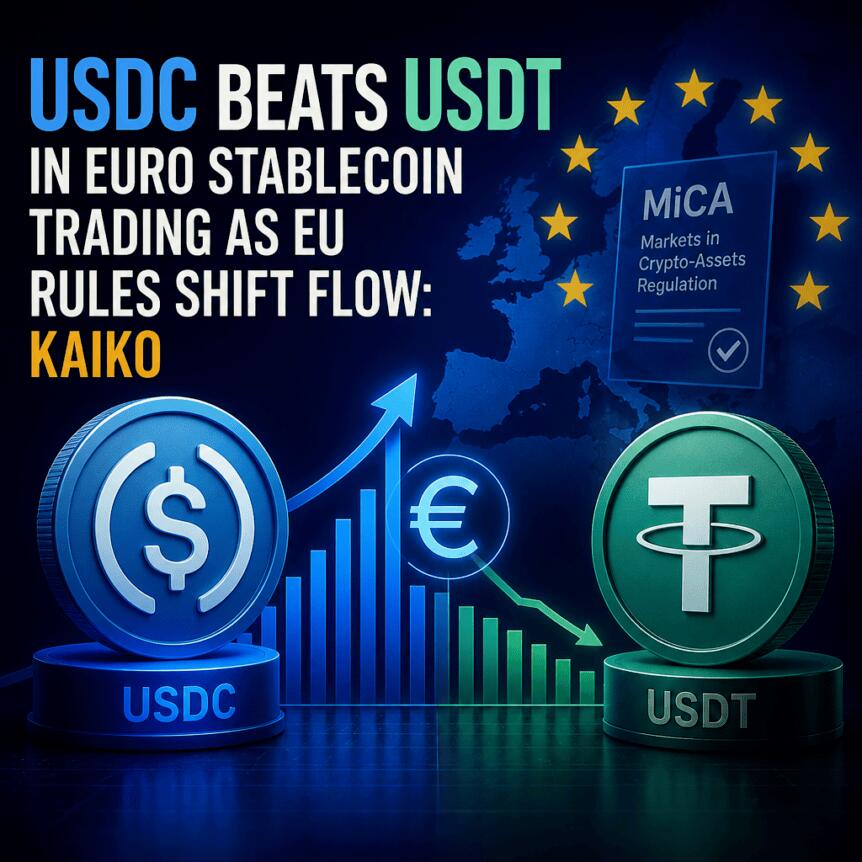
Circle’s USDC has surpassed Tether’s USDT in euro-denominated stablecoin trading, according to a new report from market data provider Kaiko. The shift highlights how rapidly stablecoin market structure in Europe is being reshaped by MiCA-related compliance preferences and exchange restrictions.
Kaiko data shows USDC now represents 56% of stablecoin trading against the euro, up from 10% in January 2024. The acceleration came after large exchanges limited USDT services for customers in the European Economic Area (EEA) under the EU’s Markets in Crypto-Assets regulation (MiCA).
Key takeaways
- USDC leads euro trading: Kaiko reports USDC holds 56% of stablecoin volume against the euro, up sharply from 10% in January 2024.
- Exchange access changes matter: USDT’s market share declined after major venues restricted trading for EEA users under MiCA.
- Liquidity advantage is widening: In euro pairs, Kaiko says USDC order books are about 40% deeper than USDT’s.
- Global scale still favors Tether: Despite the euro shift, Tether remains the bigger stablecoin by supply, with circulation estimated at roughly 2.5x USDC.
- Regulatory spillover may follow to the US: Kaiko links the European shift to the direction of US stablecoin regulation under the GENIUS Act.
Why the euro market shifted toward USDC
Kaiko frames euro-stablecoin pairs as a practical bridge for European users entering and exiting crypto markets. Stablecoin-to-euro trading often functions as a “main on-ramp and off-ramp,” allowing customers to convert euros into dollar-pegged stablecoins when positioning for crypto exposure—and then reverse those trades when unwinding.
In that context, regulatory and compliance outcomes are not just theoretical. If exchanges reduce access to certain stablecoins in a region, liquidity tends to migrate toward the assets that remain widely tradable and easier for compliant platforms to support. That dynamic appears to be working in USDC’s favor within Europe.
Beyond market share, Kaiko also points to depth of liquidity: USDC’s euro order books are reported to be roughly 40% deeper than USDT’s. For traders, deeper books typically translate into tighter execution costs and smoother sizing—especially during volatile periods when order flow accelerates.
MiCA momentum: the “significant e-money token” milestone
The Kaiko findings arrive roughly two weeks after the European Banking Authority designated USDC as the EU’s first “significant e-money token” under MiCA. According to earlier coverage from Cointelegraph, this classification puts USDC under direct EBA supervision and imposes additional requirements on Circle.
Designation as a significant token can influence how exchanges and custody providers approach integration, operational risk controls, and ongoing compliance. Even when stablecoins are broadly available, the set of assets that are easiest for platforms to treat as MiCA-compliant often gains an advantage in day-to-day trading support.
At the same time, Tether continues to hold an edge globally. Kaiko notes that Tether’s circulating supply is about 2.5 times that of USDC, underscoring that the euro market’s rebalancing does not immediately translate into USDT losing its overall dominance. Instead, the data suggests a growing regional preference that can coexist with Tether’s larger global footprint.
What changes could be coming from US stablecoin rules
Kaiko also draws a parallel between Europe’s experience and the US regulatory trajectory under the GENIUS Act. The report suggests that the US may eventually see similar routing of trading activity toward issuers that are positioned to meet the stricter stablecoin requirements applied through US oversight.
In a development that aligns with that possibility, the Office of the Comptroller of the Currency (OCC) issued its first final rule under the GENIUS Act on Oct. 21, establishing reserve and redemption requirements for stablecoin issuers under its supervision. The rule is scheduled to become effective on Jan. 18, 2027, and beginning in July 2028, US platforms will face restrictions when offering stablecoins from issuers that do not meet GENIUS approval requirements.
These timelines matter for exchanges and trading venues because liquidity planning typically starts well before compliance deadlines. If US venues begin prioritizing certain issuers earlier—whether through listing decisions, custody arrangements, or product support—the trading mix could start changing before the toughest constraints formally take effect.
Circle vs. Tether: regulatory positioning and market expectations
Regulatory design is beginning to influence competitive strategy between issuers. Kaiko’s report indicates that Circle—having pursued authorization in both Europe and the US—may be better positioned if the same pattern that played out in Europe repeats across the Atlantic.
Tether, meanwhile, has reportedly taken a different path by launching a US-focused stablecoin called USAT, described in earlier Cointelegraph coverage as a distinct approach aimed at the US regulatory environment.
While Kaiko’s euro-focused numbers do not establish how the US market will behave, the implication is straightforward: regulatory compliance can determine which stablecoins are easiest for major platforms to support at scale. In a world where stablecoins act as payment rails and liquidity buffers, that access tends to feed back into trading dominance—one region at a time.
For readers, the next watch item is whether US trading platforms begin shifting liquidity ahead of GENIUS Act enforcement milestones, mirroring Europe’s post-MiCA trading reallocation. The open question is how quickly venues and market makers adjust before the July 2028 offering restrictions, and whether order-book depth trends in the US start to resemble what Kaiko has already observed for euro pairs.
https://www.cryptobreaking.com/usdc-beats-usdt-in-euro/?utm_source=blogger%20&utm_medium=social_auto&utm_campaign=USDC%20Beats%20USDT%20in%20Euro%20Stablecoin%20Trading%20as%20EU%20Rules%20Shift%20Flow:%20Kaiko%20
Comments
Post a Comment