
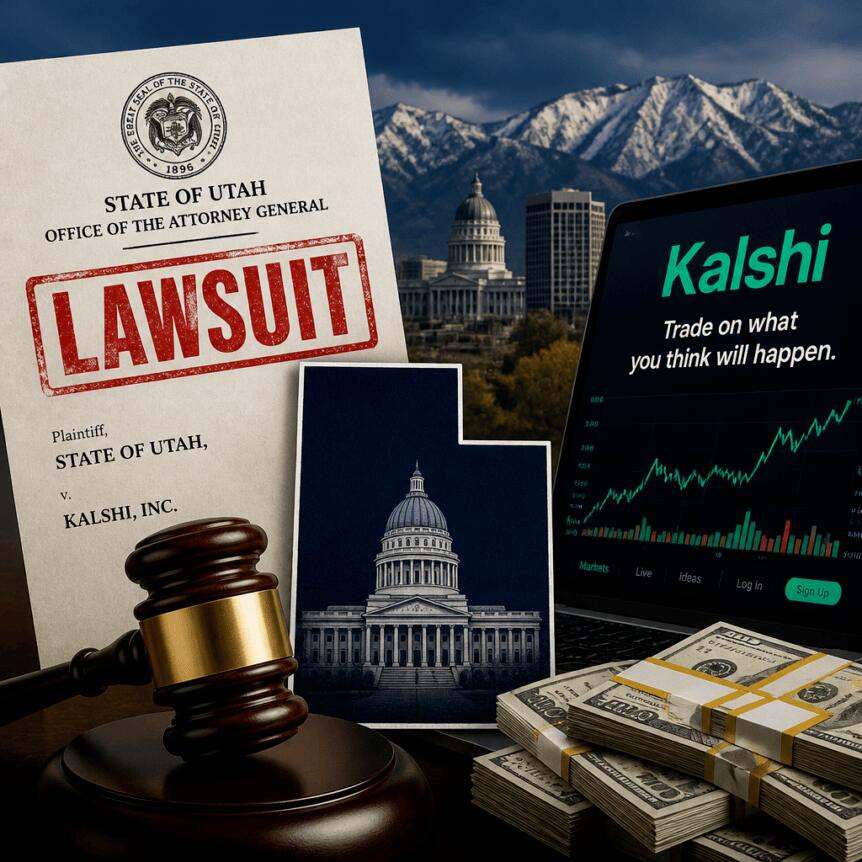
Utah Attorney General Derek Brown has filed a lawsuit against prediction market platform Kalshi, multiple affiliated entities, and two Susquehanna trading firms, alleging the companies have been facilitating illegal betting in the state since 2024. The state is asking a court to halt the alleged conduct and require the defendants to return profits—described by Brown as roughly $30 million to $60 million—generated through so-called event contracts.
Brown said the attorney general’s office believes the operation is causing “significant and substantial ongoing harm” to Utah residents and urged the court to stop “sports, elections, politics, culture and mention bets” in Utah. The filing comes after a series of earlier rulings in Utah’s dispute with Kalshi about whether federal oversight under the CFTC can supersede state gambling laws.
Key takeaways
- Utah is seeking to recover about $30 million to $60 million in alleged profits from Kalshi and related companies tied to event contracts.
- Utah claims Kalshi offered services to more than 32,000 users in the state and that users incurred significant losses.
- Earlier court decisions in Utah sided with state officials, holding that CFTC-related federal law does not automatically preempt Utah’s gambling rules.
- Kalshi argues it is a CFTC-regulated derivatives exchange and says Utah cannot override federal jurisdiction through state litigation.
- The case feeds into a broader US legal fight over whether prediction markets fall under state gambling authority or the CFTC’s “exclusive jurisdiction.”
Utah’s lawsuit targets Kalshi’s alleged “event contracts”
In a Tuesday press briefing, Brown said Utah officials petitioned the court to compel the defendants to return profits the state alleges were earned through illegal event contracts. The attorney general framed the suit as an effort to stop what Utah views as an ongoing illegal betting operation.
According to Brown’s statements, Utah believes Kalshi’s platform was available to more than 32,000 users in the state and that residents suffered “significant losses.” Brown also described the alleged harm as both ongoing and widespread, arguing that it warranted immediate judicial intervention.
“Under Utah law, I have determined that this operation is causing a significant and substantial ongoing harm to a significant number of Utahns,” Brown said.
The lawsuit also asserts that Kalshi’s market offerings touch categories Utah views as gambling content, including “sports, elections, politics, culture and mention bets.”
Kalshi says the platform is federally regulated—and not subject to a “state veto”
Kalshi has already been litigating Utah’s attempts to regulate its business model. In response to the new Utah action, a Kalshi spokesperson told Cointelegraph that the company operates as a “federally regulated financial exchange.”
Kalshi spokesperson Jacki McGavick said Kalshi’s customers trade with each other and set prices, and that as a national derivatives market overseen by the CFTC, the exchange answers to federal law. McGavick added that no single state should be able to block the platform through state court action, and emphasized that the lawsuit does not affect Kalshi’s ongoing federal litigation.
This argument reflects a key fault line in the broader prediction-market disputes in the US: whether these products should be treated as derivatives subject to the federal commodities framework, or as wagers governed primarily by state gambling statutes.
How Utah’s earlier rulings set the stage
The new suit follows a sequence of court decisions in Utah that have already narrowed Kalshi’s ability to operate in the state while it challenges the legality of Utah’s approach.
Kalshi sued Utah in February after lawmakers passed a bill that classified betting on prediction markets as gambling under Utah law. In August, a judge ruled for Utah officials, concluding that federal law under the US Commodity Futures Trading Commission (CFTC) does not preempt state gambling restrictions. In September, an appellate court denied Kalshi’s bid for an injunction, blocking the platform from continuing operations during the appeal.
Utah’s lawsuit now expands the pressure on Kalshi by combining the argument about legality with a direct request to claw back profits and stop the alleged conduct.
For investors, traders, and platform users, these procedural milestones matter because they signal that Utah courts have already accepted the state’s basic legal framing. That, in turn, raises the risk that prediction-market operators could face not only operational constraints but also financial remedies in states that pursue similar theories.
Prediction markets remain in a patchwork of state and federal fights
Utah is not alone. The civil lawsuit is part of a wave of actions filed by state authorities against prediction market platforms such as Kalshi and Polymarket, with allegations centered on violations of state gambling laws—many involving sports-related event contracts.
According to the broader reporting referenced in Cointelegraph, Arizona has been the only state to pursue criminal charges against Kalshi. Other states—indicated as including Michigan, Ohio, Kentucky, Nevada, Massachusetts, Wisconsin, and New York—have filed civil suits against one or more prediction market companies.
The legal uncertainty has persisted largely because the cases often hinge on the same jurisdictional question: whether the CFTC’s authority over certain derivatives-style contracts is exclusive, or whether states retain the power to apply gambling laws.
Adding another layer, the situation intersects with the US Supreme Court’s consideration of whether to weigh in on a New Jersey dispute involving Kalshi. The underlying question—if the Supreme Court accepts the petition—could clarify whether prediction market event contracts fall under state enforcement or the CFTC’s reach. The concept of “exclusive jurisdiction,” as claimed by the CFTC, is at the heart of those arguments.
For market participants, this matters because the outcomes could determine how uniformly prediction markets can operate across jurisdictions. A rule emphasizing CFTC exclusivity would likely benefit operators seeking a consistent national framework, while a ruling that preserves state authority would keep the current fragmented landscape—where legal risk varies widely by location—front and center.
What to watch next
Utah’s lawsuit asks the court to stop alleged activity and recover profits, so the immediate focus will be on whether the state seeks or obtains further injunction-style relief while the case proceeds. Separately, readers should watch how the Supreme Court’s decision on the New Jersey matter evolves, since it could reshape the jurisdictional debate that currently drives these disputes state by state.
https://www.cryptobreaking.com/utah-ag-sues-kalshi-seeks/?utm_source=blogger%20&utm_medium=social_auto&utm_campaign=Utah%20AG%20Sues%20Kalshi,%20Seeks%20Damages%20Over%20Prediction%20Market%20Profits%20
Comments
Post a Comment