
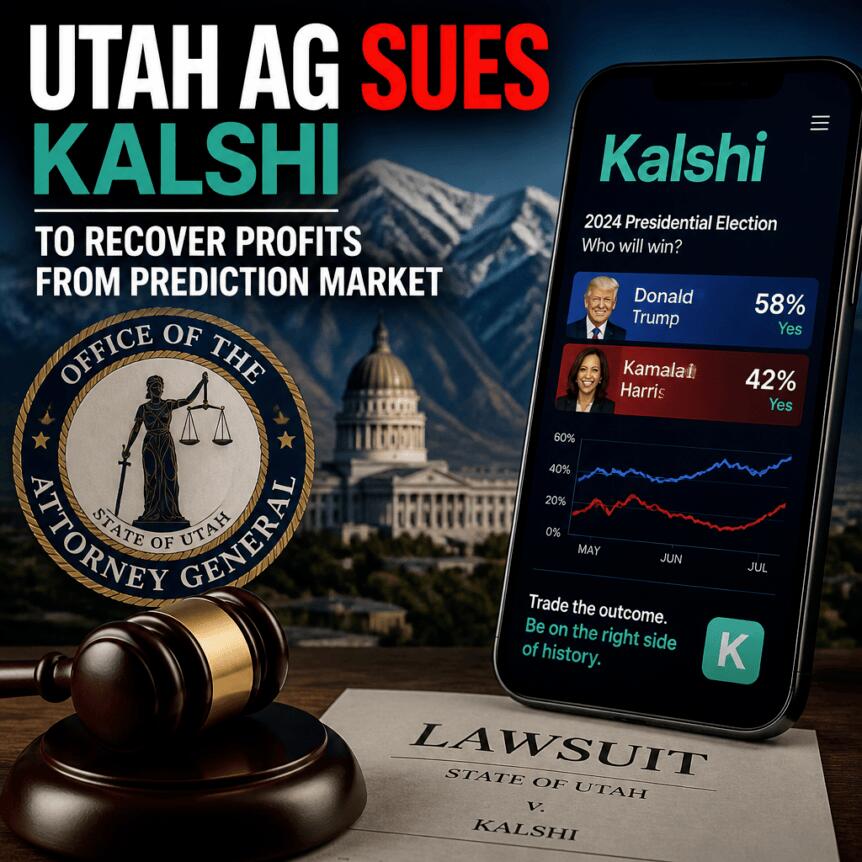
Utah Attorney General Derek Brown has filed a lawsuit against prediction market platform Kalshi, along with its affiliates and two Susquehanna trading companies, accusing the business of facilitating illegal betting in the state since 2024. The complaint alleges Kalshi offered “event contracts” to users in Utah and that the activity caused ongoing harm to residents.
In a Tuesday press briefing, Brown said Utah officials asked the court to order the defendants to return approximately $30 million to $60 million in profits they allegedly earned through unlawful contracts. Utah also argues the platform reached more than 32,000 users in the state and that those participants incurred significant losses.
Key takeaways
- Utah is seeking a court order compelling Kalshi and related entities to return $30 million to $60 million in alleged profits from event contracts tied to prediction markets.
- The lawsuit asserts Kalshi’s offerings to Utah users since 2024 violate Utah gambling law, and that the state has seen ongoing harm.
- Kalshi is already litigating against Utah following changes in state law; a Utah judge previously ruled that federal CFTC law does not override state gambling rules.
- More states have launched civil actions against prediction market operators, while Arizona is noted as the only state pursuing criminal charges against Kalshi.
- The dispute continues to hinge on whether jurisdiction belongs primarily with state gambling regulators or the CFTC at the federal level.
Utah alleges illegal betting and asks for profit disgorgement
Utah’s complaint frames the issue as a straightforward conflict between prediction market activity and state gambling restrictions. According to Brown, Utah officials determined that Kalshi’s operation is causing “significant and substantial ongoing harm” to a large number of Utah residents.
Brown said Utah asked the court to halt what he described as betting involving “sports, elections, politics, culture and mention bets” in Utah. The request also includes disgorgement of profits within a stated range, reflecting the state’s claim that unlawful contracts generated meaningful revenue.
While the brief focused on the alleged scale of participation—Utah’s stated figure exceeds 32,000 users—the lawsuit’s core legal theory is that Kalshi’s event contracts amount to illegal gambling under Utah law.
Kalshi disputes Utah’s position and points to federal oversight
Kalshi has previously pushed back against Utah’s attempts to regulate it under state gambling statutes. In response to the new lawsuit, Kalshi spokesperson Jacki McGavick told Cointelegraph that Kalshi operates as a federally regulated financial exchange. McGavick characterized Kalshi as comparable to the stock market in structure, saying customers trade with each other and set prices.
The company also argued that, because Kalshi is overseen by the CFTC as a national derivatives market, individual states should not be able to “veto” its operations. Kalshi said the Utah court action does not change its ongoing federal litigation.
For investors and traders, this matters because the regulatory outcome affects where platforms can legally operate, which in turn influences liquidity, market access, and the perceived durability of the platform’s product in the U.S.
How Utah’s legal fight escalated: prior rulings and a blocked operating pause
Utah’s new lawsuit sits within a broader, ongoing sequence of court decisions tied to prediction markets. Kalshi sued Utah in February after lawmakers passed a bill treating betting on prediction markets as gambling under state law. That challenge did not succeed.
In August, a judge ruled for Utah officials, concluding that federal laws—specifically those associated with the Commodity Futures Trading Commission—do not preempt Utah’s gambling laws. Later, an appellate court denied Kalshi’s request for an injunction in September, which had sought to block enforcement while the appeal proceeded. The result is that Utah’s position has gained traction in state court even as the platform continues to press its federal arguments.
These steps are important because they show the dispute is not only about whether Kalshi’s contracts resemble gambling, but also about which legal regime has priority when federal market-structure rules intersect with state enforcement.
A patchwork of state actions and the growing question of CFTC vs. states
Utah’s lawsuit is part of a larger legal wave targeting prediction market platforms such as Kalshi and Polymarket. Cointelegraph previously reported on similar actions brought by U.S. state authorities, including a New York lawsuit alleging Polymarket’s alleged gambling violations.
According to Cointelegraph coverage, while officials in Arizona have been described as the only state pursuing criminal charges against Kalshi, other states—such as Michigan, Ohio, Kentucky, Nevada, Massachusetts, Wisconsin and New York—have filed civil suits against one or more prediction market companies.
At the center of many of these cases is the jurisdictional question: whether event contracts fall under the CFTC’s “exclusive jurisdiction” or whether states can enforce their own gambling laws against how these contracts are offered and marketed.
The timing also intersects with litigation at the national level. Cointelegraph reports that the U.S. Supreme Court is considering whether to accept a petition related to New Jersey’s case against Kalshi concerning allegedly illegal sports bets. If the high court takes up the matter, the decision could clarify whether prediction market platforms are effectively governed primarily by federal regulators or remain vulnerable to state gambling frameworks.
For market participants, that potential clarification is a key uncertainty. A Supreme Court ruling—if accepted—could reshape how platforms design their offerings, how they restrict participation by location, and what legal standards they rely on when arguing for federal primacy.
Readers following prediction markets should watch for how Utah frames its evidence of user harm and profitability, whether Kalshi can preserve its federal arguments while state proceedings move forward, and—most importantly—whether the Supreme Court chooses to weigh in on the broader jurisdictional conflict.
https://www.cryptobreaking.com/utah-ag-sues-kalshi-to/?utm_source=blogger%20&utm_medium=social_auto&utm_campaign=Utah%20AG%20Sues%20Kalshi%20to%20Recover%20Profits%20From%20Prediction%20Market%20
Comments
Post a Comment