
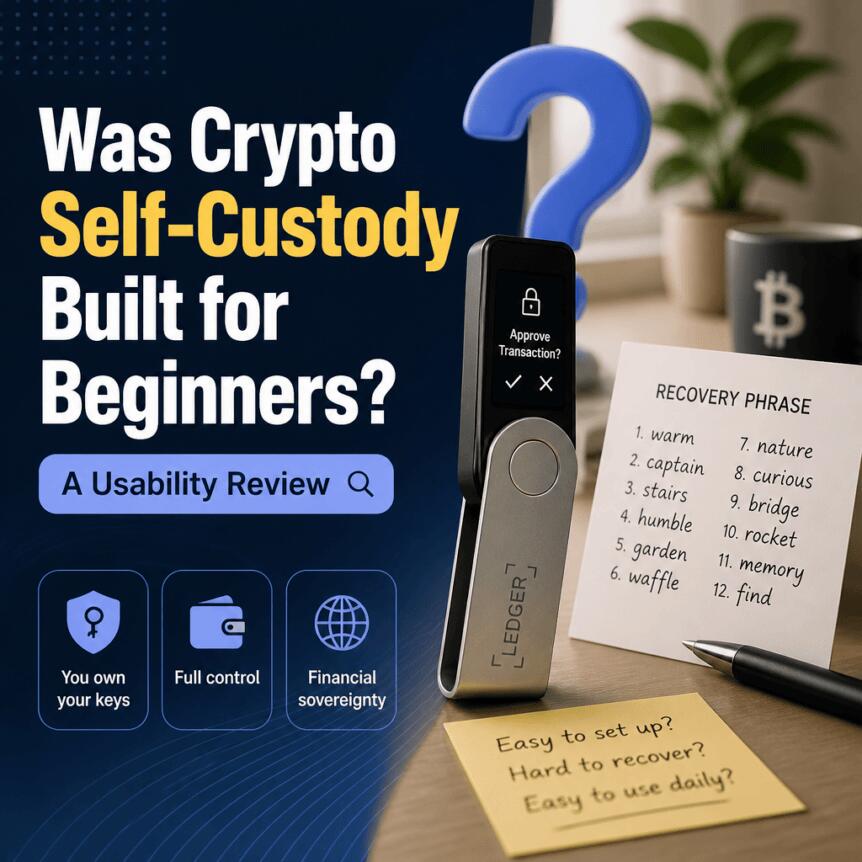
Crypto industry leaders are split on a fundamental question: was self-custody ever meant to be truly beginner-friendly? While advocates argue that easier controls and clearer user flows are essential for Bitcoin’s long-term growth, critics point to recent real-world wallet incidents and the inherent complexity of securing keys correctly.
In interviews with Cointelegraph, Safe Labs CEO Rahul Rumalla and Bitcoin custody executive Michael Tanguma both discussed what “self-custody for everyone” should mean—but they differ sharply on whether the responsibility model should change as users get broader access to Bitcoin.
Key takeaways
- Executives disagree on whether self-custody was designed for newcomers, with some saying it was never intended to be beginner-first.
- Hardware wallet security has been challenged by incidents involving recovery phrases and firmware flaws, keeping investor concerns about device trust front and center.
- Multisignature wallets can improve resilience, but they add coordination and recovery complexity—and may still fail if signers are socially engineered through the same compromised interface.
- Seedless wallet designs reduce reliance on recovery phrases, yet they shift risk to device safety and transaction confirmation UX.
Beginner access vs. security reality
Self-custody remains one of Bitcoin’s most defining narratives: users can “be their own bank.” Yet recent hardware wallet incidents have highlighted that “offline keys” do not automatically eliminate every threat to safe ownership.
Cointelegraph reported that some Ledger devices were targeted by implants that enabled attackers to steal recovery phrases, including through Ledger incidents detailed by Cointelegraph. Separately, a Coldcard firmware bug was linked to a scenario where attackers could recreate private keys and steal funds, as described in Cointelegraph’s Galaxy analysis coverage.
Against this backdrop, Michael Tanguma, CEO of Bitcoin custody provider Onramp, compared Bitcoin custody to personal computers in the 1970s—when users needed more technical skill to assemble and operate systems. He argued that self-custody “was never designed with newcomers in mind” and said simpler designs helped expand computer adoption. In his view, Bitcoin faces a similar adoption challenge.
Safe Labs CEO Rahul Rumalla pushed back, saying self-custody “does not mean doing everything yourself” and that being able to own and control assets is “the whole point of crypto.” For Rumalla, the path forward is not abandoning self-custody, but making it more usable without asking every holder to become a security expert.
Multisig: stronger by design, harder by practice
Multisignature (multisig) wallets distribute authorization across multiple keys. In theory, that reduces the odds that a single compromised key results in a total loss. In practice, the operational overhead can be a barrier—especially for inexperienced users or groups.
Justin Hutzler, chief technology officer of Synergy Network, told Cointelegraph that “traditional multisig implementations can introduce additional complexity involving signer coordination, key backups, recovery procedures, and transaction approvals.” Each of those steps creates additional points where users can misunderstand, misconfigure, or fail to follow the correct workflow.
There’s also a limit to what multisig can protect against. Rumalla said multiple signers cannot prevent every attack—particularly if all signers are deceived into signing the same malicious transaction through a shared compromised interface. That distinction matters for investors and users: multisig can improve resilience to certain key-loss scenarios, but it does not automatically solve human-targeting threats or compromised UX surfaces.
Seedless wallets cut one risk—then relocate others
Seedless wallet designs aim to remove the recovery phrase from the center of self-custody by using the wallet’s physical components as the access layer. Tangem described this approach as simplifying custody by eliminating the need to manage a recovery phrase; instead, users must safeguard the devices.
Cointelegraph reported that Tangem generates a private key on one card and creates backup copies stored on up to two additional devices. Tangem confirmed to Cointelegraph that losing every card would permanently lock users out of their funds, while also stating it had received no reports of users losing all their cards.
However, seedless does not automatically fix transaction authorization risk. Cointelegraph quoted Zach Herbert, CEO of Foundation, who said seedless backups can preserve self-custody—but criticized Tangem’s lack of a built-in screen. Without a dedicated display, users may rely on their smartphones to verify transaction details before approving.
Herbert’s concern was direct: “An attacker does not need to extract your private key if they can trick you into authorizing a transaction that empties your wallet.” That frames an important trade-off for buyers evaluating wallet designs: reducing recovery-phrase exposure does not eliminate the broader question of whether users can reliably confirm what they are signing.
Rumalla’s broader point—that self-custody shouldn’t require users to become security specialists—becomes especially relevant here. If the user experience relies too heavily on external devices or non-dedicated verification flows, it may shift the security model toward social engineering and interface deception rather than cryptographic safeguards alone.
What to watch as wallet makers compete
With hardware wallet supply-chain concerns still part of the public conversation and competing architectures emphasizing different trade-offs, the next phase of self-custody innovation may hinge less on claiming “offline equals safe,” and more on designing workflows that minimize user error and deception risk. For readers deciding how to hold crypto, the key question going forward is whether usability improvements reduce the need for specialized security knowledge while still enabling trustworthy transaction confirmation.
As new wallet features roll out, investors and users should watch for evidence around two areas: how products handle recovery and device-loss scenarios in practice, and how transaction verification is implemented—especially the extent to which user confirmation depends on potentially compromised screens or interfaces.
https://www.cryptobreaking.com/was-crypto-self-custody-built/?utm_source=blogger%20&utm_medium=social_auto&utm_campaign=Was%20Crypto%20Self-Custody%20Built%20for%20Beginners?%20A%20Usability%20Review%20
Comments
Post a Comment