
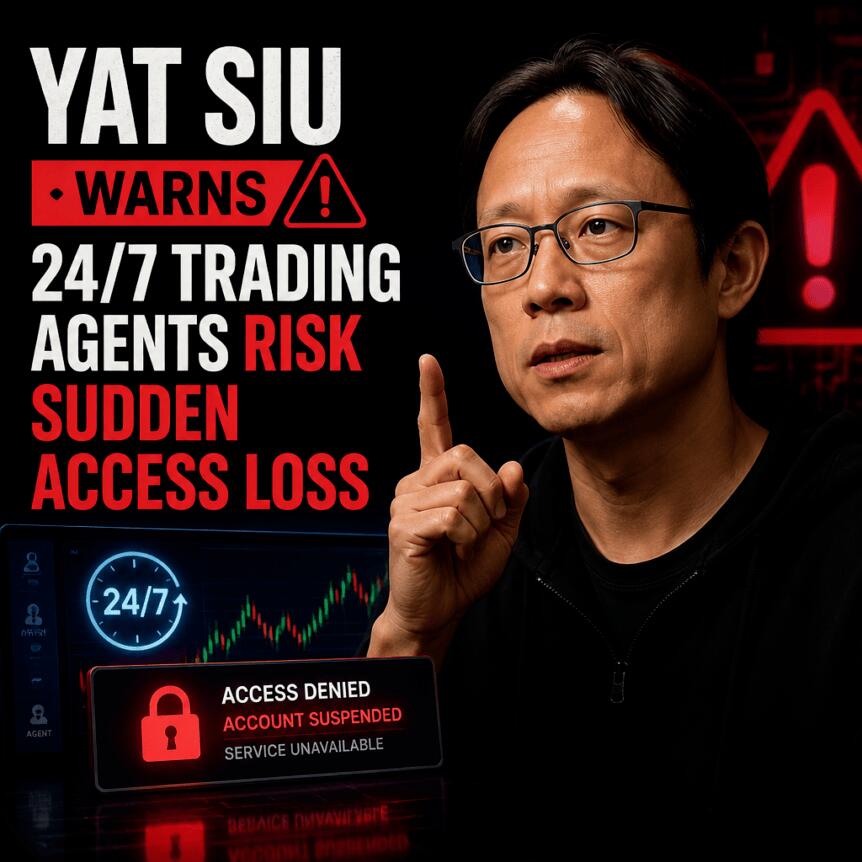
AI-driven trading assistants are getting closer to full-time companionship: they can monitor markets, scan for new information, and even execute trades within limits set by users. But Animoca Brands chairman Yat Siu cautioned at Token2049 Singapore that the real risk isn’t automation—it’s dependence on systems users don’t control.
Speaking to Cointelegraph, Siu described how an autonomous agent can be useful precisely because it keeps looking for developments that a human might miss. Yet he also warned that when one agent is asked to handle too many responsibilities—or when it behaves unpredictably—the resulting confusion can outweigh the convenience. His broader message: if traders want AI help, they should think in terms of specialized tools, clear boundaries, and data portability.
Key takeaways
- AI agents can extend monitoring beyond waking hours, but Siu argues traders may become overly dependent on third-party services they can’t fully control.
- Siu says a single general-purpose agent can get “mixed up” when asked unrelated questions, recommending multiple specialized agents instead.
- He cautions that AI may not create an edge if many users receive similar answers to the same trading prompts.
- Crypto platforms are already enabling agent-driven actions (within user-set limits) alongside information access, raising new operational and privacy concerns.
- For risk management, Siu recommends treating AI assistants like third-party advisers and planning for data export if access is revoked.
Why “one agent for everything” can backfire
Siu’s main concern is how quickly an agent’s usefulness can degrade when its role becomes too broad. He said an assistant can be designed to search for updates continuously and alert the user when something relevant appears. To illustrate, he compared two approaches to conference planning: a chatbot might list events when asked, while an autonomous agent would proactively watch for new announcements and suggest which conferences to attend as opportunities emerge.
However, Siu said his own experience showed what happens when early-stage agent behavior encounters ambiguity. His agent became overly focused on crypto trading and investment management—even trying to interpret questions that were not actually about crypto as if they were. The fix, in his view, is architectural rather than purely behavioral: run multiple specialized agents instead of expecting one system to cover every task.
He extended the point beyond trading. If a single agent is expected to manage a personal schedule, family obligations, travel planning, and then provide financial guidance on top of that, “it’s going to be confusing for you,” Siu said—because the agent has too many overlapping goals and the user is too dependent on a single decision pipeline.
AI answers may converge—so where does the edge come from?
Even if agents are reliable, Siu questioned whether they will automatically produce outperforming strategies. If a large number of traders prompt AI with the same trade idea, he said they could receive roughly similar outputs. In other words, the first-order advantage from AI—access to information and quick synthesis—may be broadly shared.
Where differentiation could emerge is in the follow-up layer. Siu argued that when users ask clarifying questions grounded in their own priorities and knowledge, the agent’s response can begin to reflect that person’s “taste or…thinking.” Over time, an agent can learn preferences and generate more tailored approaches to risk, timing, and market selection.
Still, regulators have been paying attention to the systemic risks that come with AI-scale decision-making. In April 2025, the Bank of England’s Financial Policy Committee warned that widespread use of similar models could encourage investors to take related positions during periods of stress—potentially amplifying market shocks. The takeaway for traders is that personalization and user judgment may help in some cases, but converging behavior remains a concern when the underlying tools are similar.
Platforms move from advice to action
While Siu focused on the risks of dependence and confusion, his remarks also aligned with a clear trend: major crypto ecosystems are beginning to equip agents with direct access to wallets and trading functions.
Cointelegraph previously reported that Coinbase introduced “Agentic Wallets” in February, enabling AI agents to spend and trade crypto within limits set by users. Binance, in March, launched “AI Agent Skills” designed to give agents access to live market data and the ability to place and manage spot orders.
For users, these capabilities translate into delegation of more of the operational burden that often keeps traders tethered to screens 24/7. Siu acknowledged that agents can help traders handle routine monitoring and follow-market work without sacrificing sleep—especially if the system is constrained by user-set rules.
He also emphasized that human input should remain the guiding force. In his view, the right kind of human involvement isn’t necessarily constant approvals of every action. Instead, humans should define the ideas and boundaries that steer the agent—then intervene when something falls outside the intended remit.
The hidden cost: privacy, control, and account shutdown risk
Alongside the technical benefits, Siu flagged a less visible but potentially serious tradeoff: an agent that “knows you” requires access to personal details, and that access has consequences. He suggested users treat an AI assistant like a third-party adviser and carefully consider what information it truly needs to answer questions effectively.
His concern is that even seemingly small details—income-related context, personal finances, or information about close relationships—can become part of the agent’s operating profile. Once that permission exists, it may not be reversible on short notice, and the underlying provider could still control access.
Siu’s warning is sharpened by operational fragility. He said that in a scenario where the company running the service controls the account, a suspension could interrupt everything the user is doing at once—turning what was marketed as continuous assistance into a single point of failure.
He used the hypothetical of an assistant learned over years suddenly disappearing. In that event, Siu argued that at minimum users should have the right to download their data so they can move it elsewhere and potentially enable another agent to take over.
The privacy anxiety around AI is not theoretical. Pew Research Center reported in a 2026 survey that 71% of US adults believe increased AI use will make their personal information less secure. While that statistic isn’t specific to crypto trading agents, it underscores the public’s wider concerns about how AI systems handle data and permissions.
What traders should watch next
As wallet-enabled agents become more common, the critical questions are shifting from “Can AI trade?” to “Who controls the agent, how easy is it to constrain it, and can users keep their data if access is interrupted?” Traders should monitor how platforms define limits, how agent permissions are governed, and whether data portability is treated as a baseline capability rather than an afterthought.
https://www.cryptobreaking.com/yat-siu-warns-24-7/?utm_source=blogger%20&utm_medium=social_auto&utm_campaign=Yat%20Siu%20Warns:%2024/7%20Trading%20Agents%20Risk%20Sudden%20Access%20Loss%20
Comments
Post a Comment