
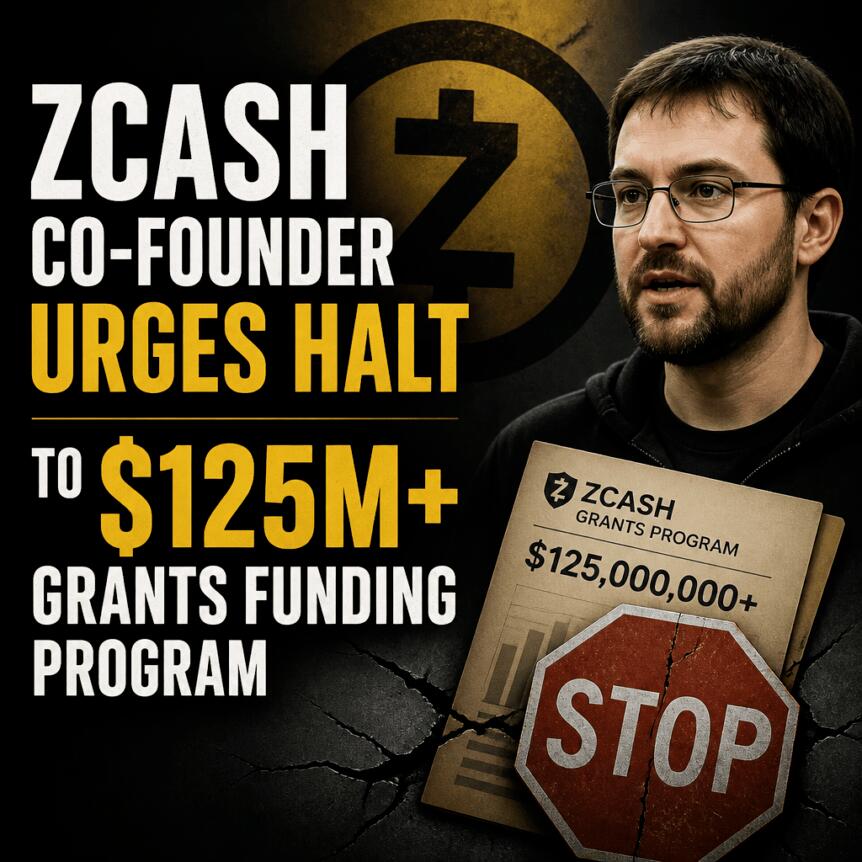
Zcash co-founder Sean Bowe has proposed ending the project’s automatic funding stream to the Zcash Community Grants (ZCG) program, arguing the grants treasury is already sufficiently resourced to continue supporting proposals without further automatic inflows.
On X Tuesday, Bowe said ZCG “has over $125M in funding” and “will receive millions more before the spigot is turned off,” adding that the program “was never designed to handle this amount of funding.” To support the idea, he shared a draft proposal on GitHub outlining how the funding could be redirected without touching ZCG’s existing balance.
Key takeaways
- Sean Bowe argues ZCG’s current treasury is large enough that automatic grant funding should be stopped.
- His draft suggests reallocating ZCG’s 8% share of the Zcash block subsidy to a “Network Sustainability Mechanism,” not withdrawing ZCG’s current funds.
- The redirected allocation would continue through the current funding period, which runs until 2028.
- ZCG reported 91,453 ZEC plus $8.8 million in cash as of Wednesday, alongside $2.4 million in outstanding commitments.
- Zcash’s separate development “lockbox” holds 72,351 ZEC, indicating the network already maintains other reserves alongside ZCG.
Why Bowe wants the ZCG automatic stream halted
At the center of Bowe’s argument is a mismatch between the original design and what the program has become over time. According to his post, ZCG has accumulated more than it was intended to manage, and that scale makes an ongoing automatic funding stream unnecessary.
Bowe’s proposal is aimed at changing the mechanics of future allocations—specifically the “automatic payments” that feed ZCG—while leaving the funds already held by the grants program in place.
The draft GitHub proposal: redirecting the 8% block subsidy share
Bowe shared a draft Zcash Improvement Proposal (ZIP) on GitHub titled around “end-zcg-stream.” The core proposal is to redirect ZCG’s 8% share of the Zcash block subsidy away from community grants and toward the network’s sustainability reserve.
Under the plan, the redirected funds would flow to the Network Sustainability Mechanism until the current funding period ends in 2028. The mechanism’s purpose, as described in the proposal text, is to keep ZEC out of circulation by holding the allocation and gradually reissuing it through future block rewards.
That distinction matters for readers tracking how Zcash manages token supply: the proposal is not framed as a reduction in total funding, but as a reassignment of where that funding goes—and how its token impact is handled—during the remainder of the program’s defined period.
Context: past calls to end Zcash dev funding at a specific threshold
Bowe’s move echoes a broader debate within Zcash’s funding ecosystem. In September, Haseeb Qureshi, managing partner at Dragonfly, proposed ending the Zcash developer fund when its current funding period expires, warning that the pool could become “politicized” as it approaches the scale of $100 million.
While Qureshi’s comments focused on the developer fund rather than ZCG specifically, the common thread is governance and concentration risk: when funding treasuries grow substantially, questions tend to shift from whether the funds are sufficient to how they should be structured and controlled.
Bowe’s draft similarly frames the issue as a structural one—arguing the grants program wasn’t meant to absorb funding at the level it has reached—rather than a judgment about whether grant recipients should be supported.
What the treasuries show right now
ZCG’s public dashboard lists 91,453 ZEC and $8.8 million in cash as of Wednesday. It also reports $2.4 million in outstanding grant commitments. Based on the ZEC balance alone, the holdings were valued at about $111 million at the time of press.
In addition to ZCG, Zcash’s separate development lockbox holds 72,351 ZEC, according to ZecStats. That balance was roughly $89 million, underscoring that Zcash already maintains multiple funding and reserve structures rather than relying on a single pool.
Together, these figures help explain why Bowe is making a “design limit” argument: with sizable assets already reserved for different roles—community grants and development—he contends that the automatic mechanism for funneling new block subsidy into ZCG is no longer necessary.
What to watch next
The immediate question is how Zcash community stakeholders respond to Bowe’s draft ZIP and whether the network will treat the proposal as a governance and supply-mechanics change for the remainder of the program through 2028. Investors and builders may also want to monitor how proposals like this balance treasury size, token circulation effects, and long-term sustainability goals as funding debates evolve.
https://www.cryptobreaking.com/zcash-co-founder-urges-halt-2/?utm_source=blogger%20&utm_medium=social_auto&utm_campaign=Zcash%20Co-Founder%20Urges%20Halt%20to%20$125M+%20Grants%20Funding%20Program%20
Comments
Post a Comment