
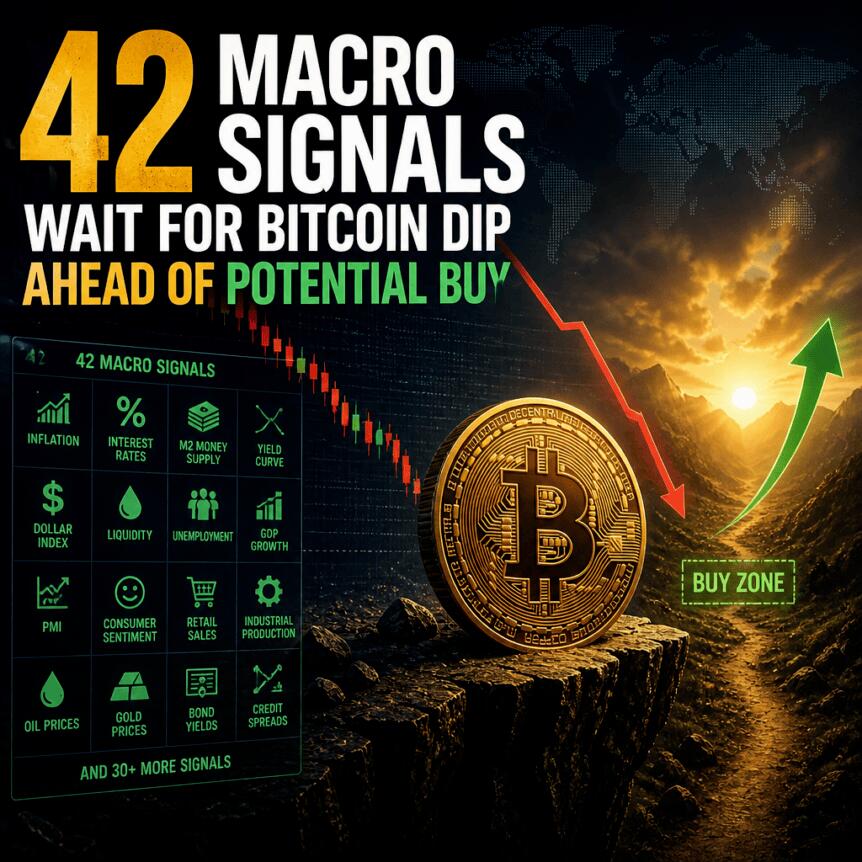
Bitcoin’s latest dip is renewing questions about whether the market has finally reached a durable bottom. This comes as Darius Dale, founder and CEO of 42 Macro, says his firm has already reduced its exposure to BTC and is waiting for clearer signs that the sell-off has run its course.
In an interview with Cointelegraph last week, Dale characterized 42 Macro’s posture as “de-risked,” adding that the firm is watching the transition from a risk-off environment to a more constructive “risk on” regime before considering fresh buying.
Key takeaways
- 42 Macro has already cut Bitcoin exposure, with Dale saying its “stress levels are low” and the firm is currently waiting rather than adding.
- Despite signs of stabilization, Dale warned that persistently high inflation could drive additional Federal Reserve tightening, which he argues can drain liquidity that Bitcoin relies on.
- He suggested Bitcoin could still fall 30%–40% from the interview’s timeframe if broader markets extend their decline, framing this as tied to equity weakness.
- 42 Macro says it will look for internal market signals—moving from bearish to neutral or bullish—before pivoting back toward BTC buying.
- Dale’s longer-range view is more optimistic: he expects improving macro conditions to support Bitcoin in 2027, linked to a likely Fed shift as inflation cools.
Why 42 Macro is staying on the sidelines
Dale’s message is straightforward: 42 Macro has de-risked out of Bitcoin already, and it plans to buy only after the market provides confirmation. “We’ve already de-risked out of Bitcoin,” Dale said, emphasizing that the firm is not trying to predict a bottom in advance.
He described the current approach as one of waiting for the “bottoming process” to conclude. In his view, the timing depends less on a single price level and more on whether conditions flip from a bearish setup to something more supportive—something he said the firm’s signals currently do not reflect.
That emphasis on regime change matters for investors because it frames the decision as macro-driven rather than purely technical. In other words, the catalyst is expected to be liquidity and risk appetite, not a one-off rebound.
Fed tightening risk and the liquidity argument
A major component of Dale’s caution is the role of monetary policy. He warned that if inflation remains stubborn, the Fed could keep tightening, further tightening financial conditions and reducing liquidity—an environment he argues is not friendly for assets like Bitcoin.
Cointelegraph reported that the US Federal Reserve is widely expected to increase rates by 25 basis points at its next meeting on Dec. 9. Dale connected that risk to Bitcoin’s sensitivity to liquidity conditions, stating: “Bitcoin doesn’t generate earnings. Bitcoin needs liquidity to go up.”
For traders and portfolio managers, this matters because it ties near-term price action to the path of rates and liquidity. Even if Bitcoin appears to be stabilizing, Dale’s stance implies that macro policy expectations can quickly overwhelm short-term improvements.
What Dale expects if equities weaken further
The interview came shortly before Bitcoin touched a “two-year low” around $55,100, according to Cointelegraph’s coverage referenced in the article. At the time of the interview, Bitcoin was trading around $64,000, Dale said.
Dale also floated a scenario in which Bitcoin could fall another 30% to 40% if US equities extend their decline. Specifically, he linked the potential drawdown to the S&P 500 moving further down from its Oct. 6 peak—an event described as a 20% drop by Christmas. At the time of the interview, the S&P 500 was down 7.4% from that peak.
In that scenario, Cointelegraph noted that the rough implication would place Bitcoin around $38,400. Dale’s framing suggests he sees the BTC sell-off as not isolated, but partially synchronized with broader risk assets, reinforcing his focus on a liquidity-driven market regime.
When 42 Macro would consider buying again
Rather than specifying a date, Dale said 42 Macro would base a potential pivot on its own market signals. He described the trigger as a shift toward a “risk on” regime, alongside the completion of Bitcoin’s “bottoming process,” and a change in the signals from bearish to neutral—or even back to bullish.
This approach underscores an important practical takeaway for readers: in Dale’s framework, attempting to front-run a bottom can be less valuable than waiting for confirmation that the macro and market environment has improved.
It also highlights the uncertainty that remains. While Bitcoin’s recent low raises the possibility that downside momentum has eased, Dale’s comments indicate that he still sees meaningful macro risks—especially tied to the inflation outlook and Fed policy expectations—that could prolong volatility.
From caution now to a more constructive 2027 view
Despite his near-term conservatism, Dale’s outlook is not purely defensive. He expects conditions to become more favorable around the middle of 2027, when easing inflation could give the Fed room to move away from tighter monetary policy.
“So we think 2027 will be a phenomenal year for stocks, gold, Bitcoin,” he said. However, he also suggested that the Fed may need to see second-quarter inflation data before changing course, implying the potential policy shift could occur in late June or during the first half of the third quarter.
For investors trying to connect macro narratives to crypto strategy, Dale’s timeline is notable because it doesn’t rely on immediate catalysts inside the Bitcoin ecosystem. Instead, it places Bitcoin’s medium-term prospects in the broader context of liquidity normalization—an argument that aligns with his earlier claim that Bitcoin requires liquidity to rise.
Going forward, readers should watch how rate expectations evolve into the Dec. 9 Fed meeting and whether equity markets stabilize or extend their decline, since Dale’s framework ties Bitcoin’s near-term direction to macro-driven liquidity conditions. The other key variable is whether 42 Macro’s internally tracked signals turn from bearish to neutral or bullish—an indicator that may help clarify when the market is actually transitioning rather than merely rebounding temporarily.
https://www.cryptobreaking.com/42-macro-signals-wait-for/?utm_source=blogger%20&utm_medium=social_auto&utm_campaign=42%20Macro%20Signals%20Wait%20for%20Bitcoin%20Dip%20Ahead%20of%20Potential%20Buy%20
Comments
Post a Comment