
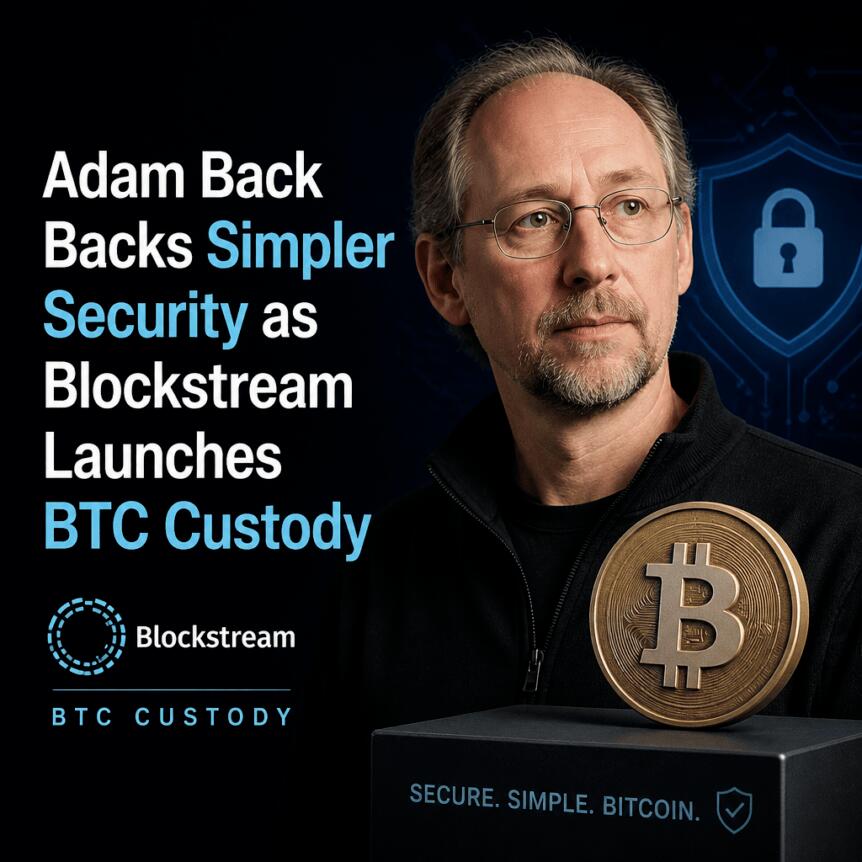
Blockstream, the Bitcoin infrastructure company led by cryptographer Adam Back, has unveiled an enterprise custody offering designed to keep the most sensitive parts of transaction authorization off the open network. The new solution is developed with French technology group Thales and is built to improve offline security for institutional users facing an environment of increasingly sophisticated cyberattacks.
Announced Friday, the custody system combines Thales hardware security modules (HSMs) with Blockstream’s Secure Multi-Party Computation (Secure-MPC) technology. According to Blockstream, the architecture allows institutions to authorize transactions while ensuring that the full signing protocol runs inside Thales’ protected security hardware—rather than splitting parts of the signing process across less controlled systems.
Key takeaways
- Blockstream and Thales are positioning the new custody solution around secure transaction signing executed entirely inside Thales HSMs.
- The offering uses Blockstream’s Secure-MPC approach, aiming to reduce the security risks associated with conventional MPC setups.
- Adam Back argues that conventional MPC protocols can be too interactive and complex to fit cleanly into fully offline cold storage.
- Back links growing custody risk to the realities of internet-connected infrastructure, highlighting examples of credential compromise.
- Both companies are effectively betting that “simpler, less exposed” signing flows will matter more as attackers adapt with new techniques, including AI.
Secure signing inside dedicated hardware
At the core of Blockstream’s announcement is a design choice aimed at limiting where cryptographic operations occur. Blockstream says the system pairs Thales HSMs—specialized hardware meant to protect keys and signing operations—with Secure-MPC to support institutional transaction authorization workflows.
The company contrasts its implementation with “conventional MPC implementations” that, in some designs, may perform parts of the signing process outside dedicated security hardware. Blockstream’s stated approach is to run the entire signing protocol within the protected environment of the HSM.
For institutions, the practical significance is straightforward: if the signing environment is constrained to hardened hardware, the custody system reduces the attack surface for any steps that would otherwise rely on broader computing environments. In custody, that distinction can be the difference between protecting a key operation and merely placing it behind layers that could still be reached through misconfiguration or compromised credentials.
Why Adam Back is pushing for offline-first custody
In comments provided to Cointelegraph, Adam Back—co-founder and CEO of Blockstream—spoke directly about the limitations he sees in current MPC-based approaches for fully offline custody.
Back said that MPC can become “esoteric” and “complicated,” and that these protocols often require significant interaction among devices to function. In his view, that level of complexity and communication makes it difficult to deploy MPC in a manner that truly matches the goals of cold storage.
He also argued that offline security is not just a theoretical ideal; it addresses a concrete risk: connecting signing equipment—even indirectly—can create paths for unauthorized access. Back pointed to the widely reported Binance hack case as an example of how attackers can compromise systems and then gain leverage over wallet-signing infrastructure.
According to Binance’s investigation, as described earlier by Cointelegraph, attackers compromised employee devices and obtained credentials that enabled access to signing infrastructure. The broader takeaway, reflected in Back’s remarks, is that credentials and connectivity can turn “internal” systems into reachable targets.
If you connect equipment to the internet, even if it’s via firewalls and so on, there is risk that you can get unauthorized access. You can get hackers into the network, get hackers with access to logins they shouldn’t have and so on.
AI may raise the stakes for custody design
Back also suggested that the rise of AI could intensify existing cybersecurity challenges. While AI is already widely discussed in the context of offensive tooling, Back’s focus was narrower: attackers may use AI to identify subtle implementation weaknesses that are difficult to spot in complex cryptographic systems.
He argued that attackers could leverage AI to find “small implementation errors” in sophisticated MPC deployments—issues that might not be obvious during routine review.
That framing matters because it highlights a tension in modern custody systems: increasing cryptographic complexity can improve functionality, but it can also make verification and hardening harder. In this context, Blockstream’s emphasis on executing the signing protocol inside secure hardware can be read as a move to reduce the number of moving parts that exist outside tightly controlled environments.
Back said he hopes that more of the custody industry will adapt toward offline-oriented models, urging institutions to “adapt to the environment” by moving assets into cold storage to reduce exposure. He summed up the philosophy as “complexity is the enemy of security,” adding that “going back to basics” can be the answer.
What institutions should watch next
Blockstream’s custody launch with Thales is a clear attempt to operationalize an offline-first security stance by constraining the signing protocol to dedicated hardware. For market participants, the immediate question is less about theory and more about execution: how the solution integrates with real-world institutional workflows and whether its architecture maintains the intended security boundaries in practice.
As attackers evolve—and as AI potentially changes both the speed and reach of cyber operations—custodians may increasingly be judged by how effectively they reduce reliance on complex, interactive processes outside secure environments. Readers should watch for further technical and deployment details from Blockstream and Thales, especially around how the system supports institutional authorization while keeping signing operations confined to protected hardware.
https://www.cryptobreaking.com/adam-back-backs-simpler-security/?utm_source=blogger%20&utm_medium=social_auto&utm_campaign=Adam%20Back%20Backs%20Simpler%20Security%20as%20Blockstream%20Launches%20BTC%20Custody%20
Comments
Post a Comment