
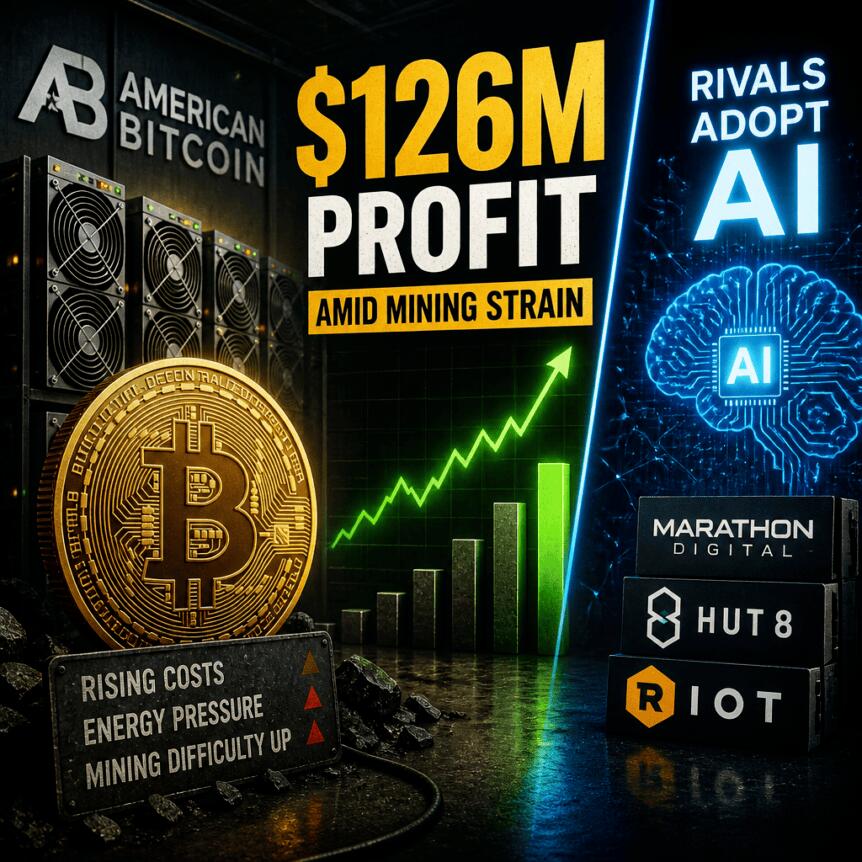
American Bitcoin reported quarterly net income of $126 million, but the numbers also underscored how quickly Bitcoin mining margins are tightening as electricity and operating costs rise. The company’s earnings were boosted by a large noncash gain tied to its Bitcoin holdings, while its mining results weakened compared with the prior quarter.
In Wednesday’s earnings announcement, American Bitcoin CEO Mike Ho said the firm continued mining “at a structural discount to spot” despite seasonal power cost pressures. Still, revenue from mining slipped and the cost to mine one Bitcoin climbed, adding pressure to the question investors are increasingly asking: how sustainable is the miner’s balance-sheet-driven strategy as rivals diversify into artificial intelligence?
Key takeaways
- American Bitcoin posted $126 million in quarterly net income, largely driven by a $197.3 million noncash gain on its Bitcoin holdings.
- Mining revenue fell 5.5% quarter-over-quarter to $63.4 million, while the cost to mine one BTC rose about 15% to $42,100.
- Excluding gains on Bitcoin holdings, the company would have recorded an operating loss of roughly $5.5 million, alongside a $64.3 million loss on derivatives.
- Gross mining profit decreased to $25.8 million and mining margin fell to 41% from 49% in the prior quarter.
- While American Bitcoin increased BTC reserves to 8,427 by the end of September, several large competitors have been expanding aggressively into AI data centers.
Profit hinged on Bitcoin holdings, not mining operations
The headline profit does not reflect strengthening core mining economics. According to the company’s financial statements, American Bitcoin generated $126 million in quarterly net income, but that figure was propelled by a $197.3 million noncash gain on its Bitcoin holdings.
When that gain is excluded, the picture changes materially: the filings indicate an operating loss of approximately $5.5 million. The company also recorded a separate $64.3 million loss on derivatives during the quarter, further complicating the underlying earnings quality.
On the mining side, results weakened. Mining revenue declined to $63.4 million from $67.0 million in the prior quarter. The cost to produce one Bitcoin rose by roughly 15%, reaching about $42,100, while the company’s gross mining profit dropped to $25.8 million from $33 million. That pushed its reported mining margin down to 41% from 49%.
American Bitcoin also mined 891 BTC during the quarter, down from 932 BTC previously. The company attributed the higher mining costs primarily to elevated electricity prices.
Costs rise while revenue misses expectations
The quarter wasn’t only a margin story—it also involved a revenue shortfall. The company reported $63.4 million in mining revenue, which was below analysts’ estimates of $74.35 million, according to Yahoo Finance data cited in the coverage. That gap amounted to nearly 15% against expectations.
Even compared with the same period last year, the pattern reflects limited improvement in operating revenue. Mining revenue was nearly unchanged year over year, sliding only slightly from $64.2 million to $63.4 million, while profit increased sharply from $3.5 million to $126 million—again largely due to gains on Bitcoin holdings rather than core mining income.
American Bitcoin’s CEO framed the business as continuing to mine at a discount to the market price, stating the company persisted with Bitcoin mining despite “seasonal power cost pressures.” However, the cost metrics and margin compression suggest the discount is getting harder to defend as operating inputs become more expensive and mining difficulty continues to evolve.
Investors are focused on long-term sustainability
David Gamble, founder of asset management firm Enigma Holdings—which focuses on Bitcoin mining and AI infrastructure—argued that reported profitability doesn’t automatically translate into shareholder value creation if mining economics remain structurally weak. In commentary provided to Cointelegraph, Gamble said mining below the market price does not necessarily mean value is being created for investors.
He also pointed to sustainability concerns tied to the competitive environment. Even if accumulation of Bitcoin is not inherently “flawed,” he suggested it raises questions over the long term—particularly as mining difficulty increases and miners must keep investing in newer, more efficient technology to stay competitive.
For readers, the key watch point is whether the company can convert its scale and operational positioning into more stable margins, or whether the earnings model increasingly relies on Bitcoin price-driven accounting gains. As mining costs rise, that distinction becomes central to evaluating whether reserves-building is a temporary buffer or a durable strategy.
BTC accumulation vs. an AI pivot across the sector
The quarter arrives during a broader shift in how public Bitcoin miners position themselves. The results highlight a growing split: American Bitcoin is continuing to accumulate and hold Bitcoin, while major competitors have been directing capital toward artificial intelligence.
According to the coverage, Riot Platforms is building large AI data centers, MARA Holdings is expanding into AI while continuing to mine Bitcoin, and Core Scientific has shifted much of its business toward AI data centers. Against that backdrop, American Bitcoin reported that it held 8,427 BTC at the end of September, up from 3,418 BTC a year earlier.
Gamble said the competitive advantage in the industry is moving toward energy infrastructure rather than purely hashrate deployment. He emphasized that Bitcoin miners and AI operators can compete for the same power supply, and in some cases AI data centers may generate more revenue than Bitcoin mining.
At the same time, he cautioned that the transition is not automatic. Moving from mining to AI requires accounting for depreciation, equipment replacement, financing costs, and the opportunity cost of deploying capital elsewhere. That means the AI pivot may benefit only some operators depending on their cost structures and ability to secure and monetize power efficiently.
For American Bitcoin, the next signal investors are likely to look for is whether mining margin pressure eases as electricity costs and operational efficiency fluctuate, or whether the company’s results continue to depend heavily on Bitcoin valuation effects. More broadly, the sector will watch how quickly miners can convert energy advantage into new revenue streams without undermining their ability to maintain cost competitiveness in Bitcoin itself.
https://www.cryptobreaking.com/american-bitcoins-126m-profit-amid/?utm_source=blogger%20&utm_medium=social_auto&utm_campaign=American%20Bitcoin’s%20$126M%20profit%20amid%20mining%20strain%20as%20rivals%20adopt%20AI%20
Comments
Post a Comment