
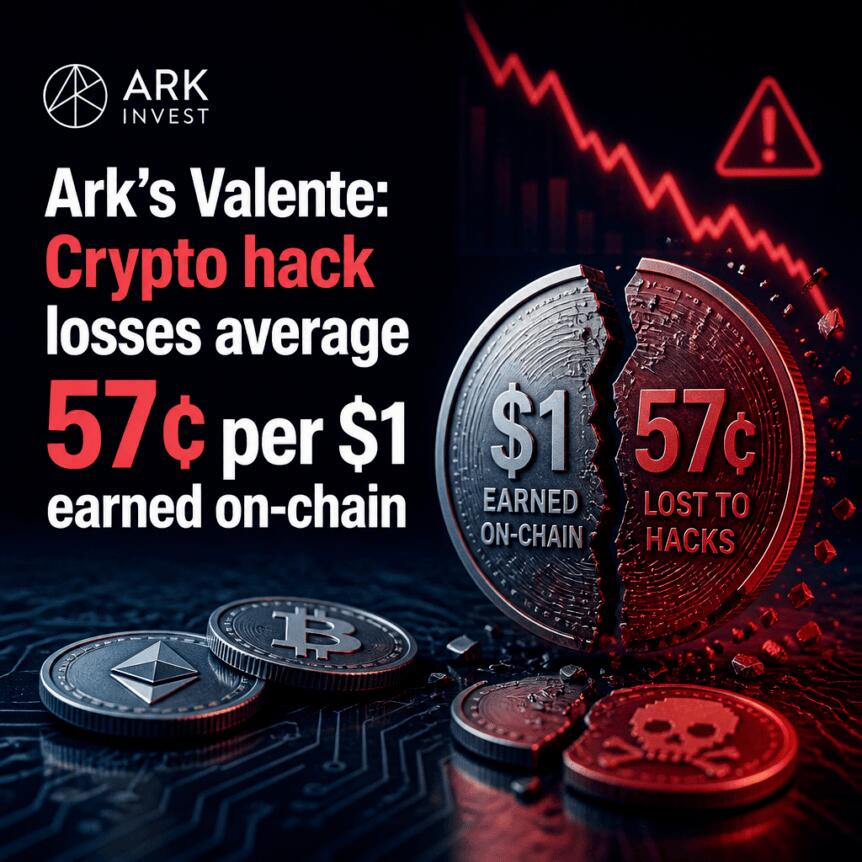
Crypto security losses are now outpacing the industry’s on-chain revenue, according to analysis shared by Lorenzo Valente, director of digital asset research at ARK Investment Management. Valente’s figures suggest that since 2017, hackers have taken far more value than protocols have generated in revenue terms—an imbalance that could further pressure institutional comfort with decentralized finance.
In an X post dated Thursday, Valente highlighted a chart showing that losses from crypto hacks already totaled $8.7 billion year to date. That figure, he said, has surpassed an estimated $5.6 billion in estimated annual on-chain revenue for 2026.
Key takeaways
- According to ARK Investment Management research director Lorenzo Valente, crypto hacks caused $8.7 billion in losses year to date—above projected 2026 estimated on-chain revenue of $5.6 billion.
- Valente estimates total losses of about $26.9 billion to hacks since 2017, compared with roughly $47 billion in total on-chain revenue over the same period.
- The Binance hack’s reported $6.3 billion stolen amount alone exceeded Valente’s full-year 2026 on-chain revenue estimate.
- DeFi activity, as measured by total value locked (TVL), has declined by nearly 10% since the Binance exploit, according to DefiLlama.
- Institutional attention remains focused on bridge security and other structural weaknesses, with JPMorgan analysts citing bridge risk as a persistent challenge.
Security losses now eclipse revenue projections
Valente’s central claim is straightforward: in aggregate terms, value stolen through hacks is catching up to—or overtaking—the revenue protocols earn from on-chain activity. His comparison draws a line between money lost to attacks and money generated by the ecosystem’s ongoing usage.
In the same analysis, Valente stated that about $26.9 billion has been lost to crypto hacks since 2017, while the sector has generated around $47 billion in total on-chain revenue across the period. That framing matters because it highlights not only the severity of individual incidents, but also whether today’s security trend is deteriorating relative to the industry’s earning power.
Valente also described a key inflection point: value lost to hacks is on track to exceed on-chain revenue by year-end for the first time since 2020.
High-profile 2026 hacks intensify pressure
This year’s hack profile includes multiple large incidents that, taken together, reinforce the “security bottleneck” argument Valente made in his post. He pointed to several widely reported exploits, including a $6.3 billion theft in the Binance hack that he said already exceeded his estimated full-year 2026 on-chain revenue.
Other notable incidents cited in the analysis included September’s reported $387 million Bitget hack, the $320 million Liquid Network exploit, and April’s $295 million Drift Protocol exploit. While each event differs in cause and affected components, the overall effect is similar: large-scale breaches have become frequent enough that they materially change how investors and institutions evaluate risk in crypto markets.
For traders and portfolio managers, this backdrop can alter expected returns in DeFi by increasing the tail risk attached to smart contract and infrastructure vulnerabilities—particularly when those vulnerabilities impact assets quickly and at scale.
DeFi TVL slides as confidence comes under strain
Beyond the direct financial impact of theft, Valente’s analysis also connects security events to institutional and market behavior. The mounting frequency of exploits, he argues, is weighing on the appetite for DeFi among professional investors.
That tension appears to show up in locked capital. Total value locked in DeFi has fallen nearly 10% since the Binance exploit, dropping from $85.9 billion on Oct. 29 to $77.4 billion as of Thursday, based on DefiLlama data.
Even though TVL can move for many reasons—market price swings, rotation among protocols, and changes in yield—rapid declines after major hacks tend to reflect a mix of reduced risk tolerance and capital moving toward safer venues. For builders, the implication is equally practical: security failures don’t just trigger incident response; they can depress usage and liquidity long after the immediate losses are known.
Bridge security remains a recurring problem
Valente’s concerns align with broader industry commentary about how vulnerabilities cluster in certain parts of the crypto infrastructure stack. In an April research note, JPMorgan analysts identified bridge security as a longstanding challenge for the sector. Bridges are often critical for moving assets between networks, but they also enlarge the attack surface by introducing complex trust assumptions, operational dependencies, and cross-chain interactions.
When institutional risk teams evaluate DeFi exposure, these structural points can matter as much as the performance of a given protocol. If bridge risk remains “sticky” over time—rather than improving sustainably—capital may continue to favor assets and strategies where the security model is simpler or more battle-tested.
Looking ahead, investors are likely to watch whether the industry can reduce the frequency and severity of high-value hacks fast enough to restore the relationship between protocol revenue and security losses. Valente’s data implies that, unless security improves meaningfully, 2026 could end with security losses continuing to outstrip the ecosystem’s on-chain revenue estimates.
Readers should monitor two things over the coming months: whether DeFi TVL stabilizes after recent drawdowns, and whether new disclosures or audits translate into fewer or smaller incidents—because the key question raised by Valente’s analysis is not whether hacks happen, but whether the sector can reach a security baseline that makes on-chain activity financially sustainable.
https://www.cryptobreaking.com/arks-valente-crypto-hack-losses/?utm_source=blogger%20&utm_medium=social_auto&utm_campaign=Ark’s%20Valente:%20Crypto%20hack%20losses%20average%2057¢%20per%20$1%20earned%20on-chain%20
Comments
Post a Comment