
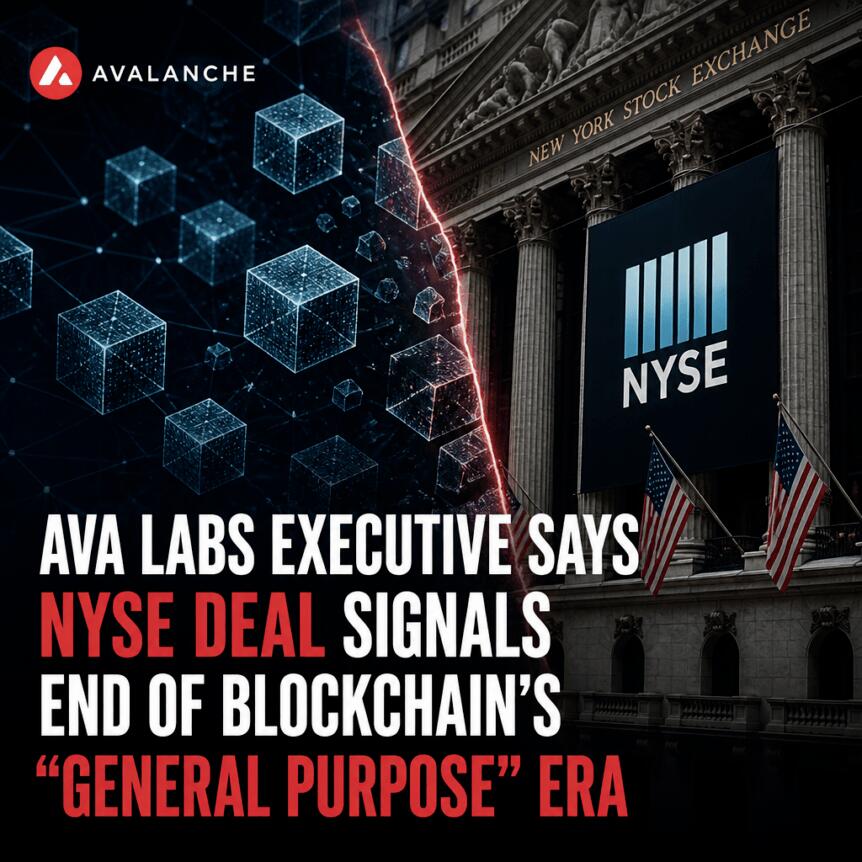
Institutional interest in crypto infrastructure is increasingly shifting toward blockchains built for specific regulatory and operational requirements, Ava Labs’ John Nahas said. Speaking to Cointelegraph, the chief business officer of the company behind the Avalanche network argued that the next wave of tokenization will depend less on “one-size-fits-all” platforms and more on systems that financial institutions can meaningfully control.
The point is reflected in the announced development of a NYSE-affiliated tokenized securities platform, which will use Avalanche technology for clearing and settlement. Nahas said the design goal is to deliver predictable settlement costs and clear governance over network participants—capabilities he believes general-purpose blockchains often struggle to provide.
Key takeaways
- NYSE-linked plans to tokenize securities use Avalanche for clearing and settlement, with an emphasis on controllable access and cost predictability.
- Ava Labs’ John Nahas argues that financial institutions need purpose-built blockchains rather than general-purpose networks.
- Nahas frames institutional pushback as partly rooted in a perception of crypto as a speculative “wild west.”
- The NYSE says it will select technology based on “each job,” and its team spent about a year testing Avalanche before tailoring the approach.
- Nahas links adoption urgency to evolving regulation, saying systems must be adaptable as rules take shape.
Why NYSE-linked tokenization is built differently
Nahas told Cointelegraph that capital markets require “reliable performance” and “predictable cost settlement,” along with certainty and control over the network and its participants. In his view, tokenized securities cannot rely on the same assumptions that often guide public, general-purpose blockchain usage.
His comments align with a broader industry debate: whether institutions can operate effectively on open networks where settlement fees fluctuate and access rules are limited. Nahas suggested the industry’s typical instincts—placing crypto infrastructure rather than institutional requirements at the center—have contributed to slower adoption.
In his framing, the traditional crypto preference for general-purpose chains is reaching its limit. “I look at this as the end of the general purpose era,” he said, describing a move toward blockchains engineered for particular use cases rather than broad experimentation.
From general-purpose networks to managed participation
The NYSE-affiliated platform, announced on Monday, will support equities issued across multiple blockchains, but its settlement ledger must enable the exchange to manage who participates while keeping costs predictable. Dennis Lee, NYSE’s head of digital issuance, said the exchange will be “picking the right technology for each job” as it develops the platform, and that Avalanche met key requirements related to access control and cost predictability.
Lee contrasted the platform’s approach with how public chains work today. For example, he noted that on public networks such as Ethereum, institutions may be able to restrict access to their own applications, but the underlying network remains open. Network congestion can also increase transaction fees—an operational risk when settlement needs to be dependable.
According to Nahas, the NYSE spent about a year testing Avalanche, giving Ava Labs time to tailor its approach to the exchange’s needs. He argued that general-purpose chains often “don’t want to or most of the time cannot adapt to the existing frameworks” that financial institutions already rely on.
Institutional objections and the “understanding gap”
The NYSE announcement arrives amid heightened scrutiny of tokenization efforts more broadly. The article notes that more companies have objected to third parties tokenizing their shares for trading on OKXICE, a separate venue proposed by crypto exchange OKX and NYSE parent Intercontinental Exchange (ICE). OKXICE reportedly listed 67 companies that had objected as of Nov. 5, including Apple, Amazon, Meta and Tesla.
Nahas attributed part of the resistance to limited understanding among incumbents, saying many view crypto as a speculative “wild west.” He suggested that if institutions see a wholesale shift in the underlying market infrastructure—one aligned with institutional needs—the efficiency benefits will become clearer and objections are likely to soften over time.
While the dispute around tokenization venues highlights friction between traditional public-company governance and crypto-native trading mechanics, Nahas’s position emphasizes that the technology stack itself may be the determining factor. Purpose-built infrastructure, he argues, can reduce operational uncertainty and make compliance requirements more workable.
Regulatory uncertainty and the case for adaptability
Beyond access control and settlement cost, Nahas focused on adaptability during a period when crypto regulation remains in flux. He said the ability to adjust matters most when rules are still forming, arguing that “nobody wants to be on the wrong side of a line that didn’t exist the day before.”
In his view, building around the compliance frameworks financial institutions already follow can help projects move forward even as regulators clarify how existing rules apply to crypto. That approach is intended to reduce the risk that tokenization infrastructure becomes obsolete when regulatory interpretations evolve.
Asked about potential political developments in the United States—referred to in the article as a possible “blue wave” in the House and Senate—Nahas said he remained optimistic. He described the change in the overall environment as evidence that “the train has left the station,” framing the momentum behind tokenization as difficult to reverse.
For readers, the key question is how quickly institutional-grade requirements will translate into repeatable technical designs. The NYSE’s year-long testing of Avalanche and its emphasis on controlling participation suggest a model that other tokenization efforts may try to copy—especially as regulators continue to refine what compliance means for on-chain settlement.
https://www.cryptobreaking.com/ava-labs-executive-says-nyse/?utm_source=blogger%20&utm_medium=social_auto&utm_campaign=Ava%20Labs%20Executive%20Says%20NYSE%20Deal%20Signals%20End%20of%20Blockchain’s%20“General%20Purpose”%20Era%20
Comments
Post a Comment