
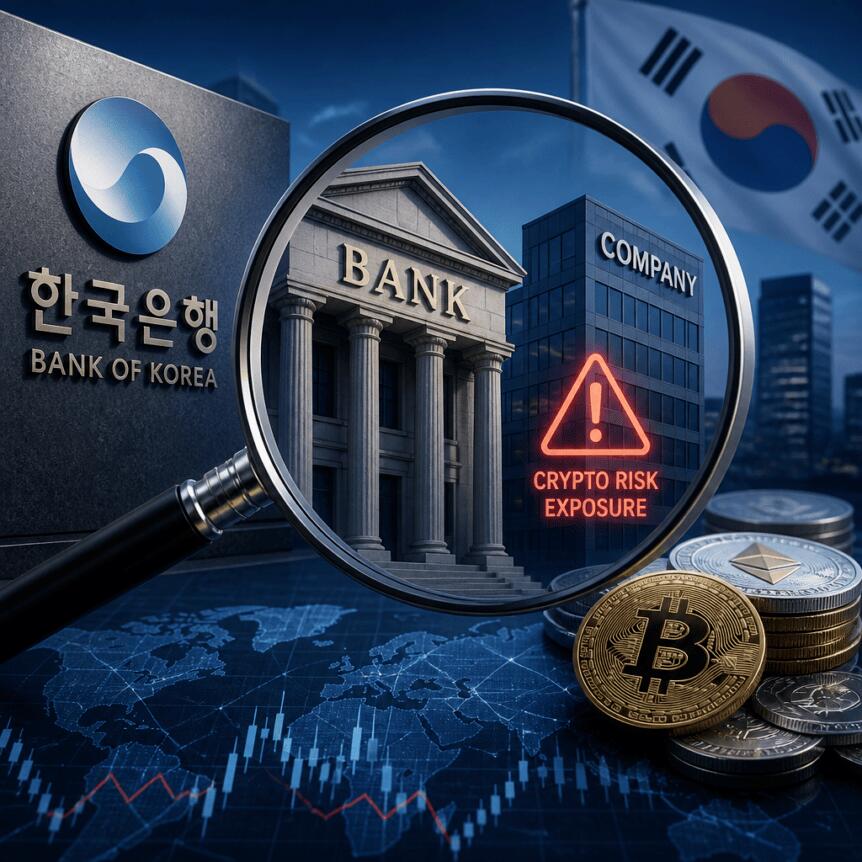
South Korea’s central bank has started a risk review of banks and brokerages that participate in the virtual-asset market, according to reporting by Business (The Herald) and Yonhap. The survey is designed to test how traditional financial firms would handle major crypto shocks—ranging from a large exchange hack to steep market drawdowns and spillover from losses at other institutions.
Financial industry sources cited by the outlets said the Bank of Korea began surveying 18 banks and 13 brokerages on Oct. 23. Responses were reportedly due on Wednesday. The review appears to be the central bank’s first reported look at how financial institutions are operationally and financially exposed to cryptocurrency-related activity.
Key takeaways
- The Bank of Korea is conducting its first reported risk survey of 18 banks and 13 brokerages involved with virtual assets.
- Scenario questions include how firms would be affected if South Korea’s largest crypto exchange temporarily halted operations after a major hack.
- The review also probes exposure to market crashes followed by prolonged trading inactivity, plus contagion from losses suffered by other financial institutions.
- The survey began before the widely reported $6.3 billion Binance hack, but the incident underscores the type of security and counterparty risk the central bank is examining.
- The push comes as South Korea’s banking sector continues stablecoin pilots even while broader digital-asset legislation—such as the proposed Digital Asset Basic Act—faces delays and institutional disagreements.
A central-bank stress test for crypto-linked fallout
While the details of the survey are not fully public, the reporting describes a structured set of questions aimed at mapping both preparedness and financial exposure. Institutions were asked about their crypto-related staffing and budgets, their current business activities, and the rationale for entering the market.
Beyond organizational readiness, the survey also reportedly seeks figures on how much each firm has invested in domestic and overseas crypto-related companies. This suggests the Bank of Korea is not only assessing operational risk—such as whether firms have the personnel and controls to respond to incidents—but also the balance-sheet sensitivity of traditional financial players to the digital-asset ecosystem.
The scenario set is framed around plausible, high-impact events. One question asks how institutions would be affected if the largest exchange in South Korea by market share temporarily suspended operations after a major hack or similar incident. Another scenario covers a sharp drop in cryptocurrency prices followed by a sustained period in which trading activity remains subdued. Finally, the review reportedly addresses what happens if another financial institution experiences heavy losses tied to a crypto-related incident—an explicit nod to contagion risk across the financial system.
Why the timing matters: survey begins before Binance hack
According to the report, the Bank of Korea launched the review before last week’s $6.3 billion Binance hack. Even so, the hack is now part of the backdrop for the risk assessment because it matches the kinds of threats central banks typically analyze: exchange security failures, liquidity shocks, and potential knock-on effects for counterparties.
Earlier coverage from Cointelegraph cited U.S. authorities’ attribution of the attack to North Korean hackers. The connection matters for Korean banks and brokerages because the survey’s hypothetical questions focus on how a large exchange’s temporary shutdown—and a severe crypto market slump—could ripple into broader financial stability concerns.
For investors and market participants, the practical implication is that crypto-related business activity by traditional firms may face tighter expectations around incident response, contingency planning, and concentration risk. Even if the survey is primarily informational, it can shape how regulators frame future supervision, particularly around custody, counterparty exposure, and security governance.
Stablecoin pilots proceed while legislation remains contested
The risk review comes at a time when South Korean financial institutions continue exploring stablecoin services. The banking sector’s experimentation highlights a key tension: crypto adoption efforts are moving forward on certain rails—such as payments infrastructure—while the legal framework for broader virtual asset activity appears to be evolving more slowly.
Cointelegraph reported that KB Financial Group completed a won-denominated stablecoin pilot in May. Separate reporting noted that Kakao Pay and KakaoBank partnered with Fireblocks in September to explore digital-asset infrastructure. These initiatives suggest that even as uncertainty remains around the regulatory timetable, institutions see enough commercial and operational value in stablecoins to run pilots.
The Bank of Korea has also reportedly pushed for bank-led stablecoin issuance. However, disagreements over which institutions should be allowed to issue stablecoins have complicated progress related to the proposed Digital Asset Basic Act. The result, as reflected in a quote attributed to a Bank of Korea official by The Korea Herald, is that financial institutions are preparing even while legislation is moving more slowly than the market expected.
This matters because the survey’s scenarios do not appear limited to trading losses—they also examine operational exposure and investment levels. If stablecoin issuance becomes more common, regulators will likely be watching whether bank-led structures reduce systemic risk or merely shift it to different parts of the value chain.
Cybersecurity scrutiny intensifies alongside market integration
Regulatory attention to cyber risk has been rising in South Korea. In October, the Financial Services Commission proposed tougher security requirements after identifying deficiencies at 130 out of 555 financial companies, as reported by Cointelegraph. The proposals included more frequent vulnerability assessments and greater executive accountability, following security incidents involving 16 companies, including crypto exchanges.
That regulatory posture aligns with the Bank of Korea’s survey focus on major hacks and the downstream effects of service interruptions at a key exchange. Even if the survey findings are not immediately public, the direction of travel is clear: financial institutions participating in crypto-related markets are being pushed to demonstrate that cybersecurity and incident response are not optional extras, but integral parts of governance.
For banks and brokerages, this creates a dual compliance challenge. They must manage crypto market risks—such as drawdowns and reduced liquidity—while also meeting heightened cyber expectations that can affect custody practices, infrastructure reliability, and overall operational resilience.
As responses to the survey roll in, market participants should watch for whether the Bank of Korea’s questions lead to new supervisory emphasis on exchange dependency, investment concentration, and cyber readiness. The immediate uncertainty is how widely the results will be shared and whether they translate into specific constraints on crypto-related activities or stablecoin experimentation.
https://www.cryptobreaking.com/bank-of-korea-examines-banks/?utm_source=blogger%20&utm_medium=social_auto&utm_campaign=Bank%20of%20Korea%20Examines%20Banks%20and%20Firms%20for%20Crypto%20Risk%20Exposure%20
Comments
Post a Comment