
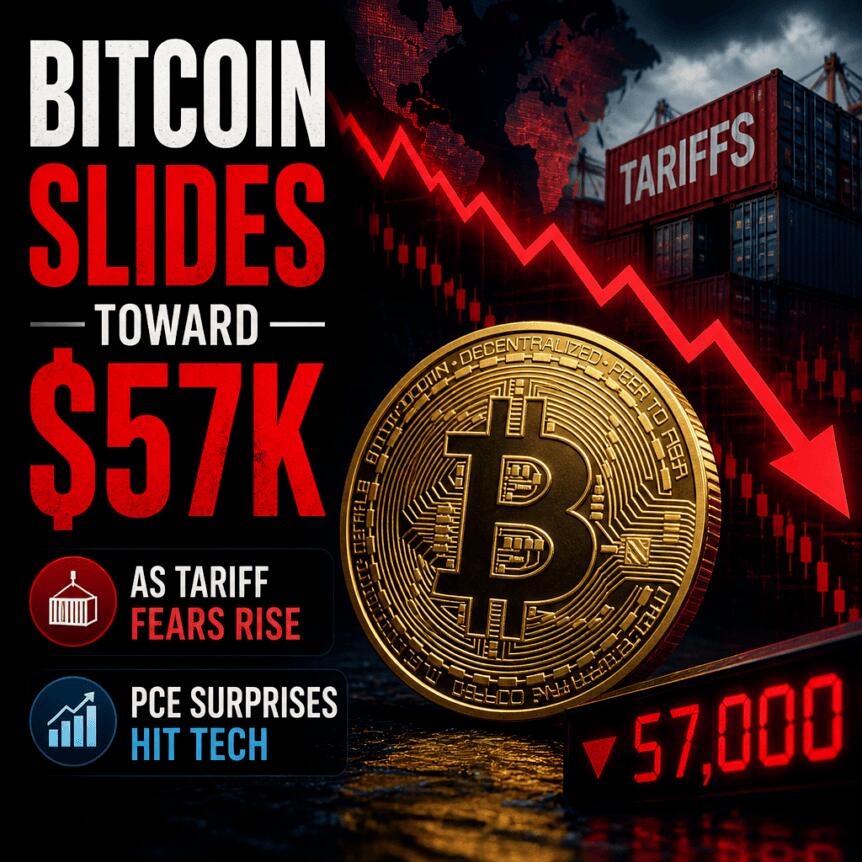
Bitcoin slid toward the $57,000 area on Wednesday as hotter-than-expected US inflation readings pushed broader risk markets lower and renewed concerns about tighter monetary conditions. The selloff accelerated after the October core Personal Consumption Expenditures (PCE) index came in above forecasts, reinforcing expectations that the Federal Reserve could still be inclined to move at its upcoming meetings.
Alongside the macro shock, crypto leveraged positioning was hit: over the prior 24 hours, $512 million in liquidations were recorded, according to CoinGlass data. BTC traded at its lowest level around $57,209 on Bitstamp during the session, down as much as 4.2% on the day, while the Nasdaq Composite dropped 4.2%.
Key takeaways
- Bitcoin briefly touched $57,209 on Bitstamp, with daily downside reaching about 4.2%.
- October core PCE rose to 3.3% year-on-year, above the 3.2% expected, supporting a more hawkish rate outlook.
- US inflation concerns weighed on risk assets, with the Nasdaq Composite down 4.2% during the same window.
- Crypto liquidations totaled $512 million in 24 hours, including $416 million in long liquidations, per CoinGlass.
Inflation data and trade-tariff anxiety hit stocks and Bitcoin
According to TradingView data cited in the report, BTC/USD reached $57,209 on Bitstamp, falling up to 4.2% intraday. The move aligned with broader market pressure: US equity futures opened weaker as traders reacted to both a “hot” inflation print and heightened uncertainty around proposed increases to international trade tariffs.
At the same time, the Nasdaq Composite Index fell sharply—down 4.2% to 22,632 points—while the S&P 500 was reported down 2.7% around 4:30 p.m. UTC. The synchronization between BTC’s decline and the tech-heavy index underscored how macro-driven correlations can resurface quickly when liquidity conditions tighten.
Speaking to CNBC about the tariff proposal, US Trade Representative Jamieson Greer characterized the increases as a “top up,” noting that—once fully netted—they would amount to only a few additional percentage points and would take months to take effect. Even so, the market reaction suggested investors were not waiting for implementation dates to adjust risk exposure.
Why the Fed narrative matters for crypto liquidity
The immediate catalyst was the October PCE report. The Federal Reserve’s preferred inflation measure showed price growth at 3.8% year-on-year, cited as the second-highest reading since April 2023. Core PCE—excluding food and energy—came in at 3.3%, above expectations of 3.2%, according to the Bureau of Economic Analysis.
Higher inflation readings typically matter to crypto because they can change expectations for the path of US interest rates. The report noted that a potential shift toward tighter policy would be a headwind for risk assets, potentially reducing liquidity and slowing the inflow of capital that often supports higher beta markets—including digital assets.
In prior coverage referenced by the report, markets were already pricing in the possibility of a 25-basis-point hike at the Fed’s December meeting. Economist Mohamed El-Erian also argued that the new macro data would leave markets feeling a rate hike on December 9 is “essentially a done deal.” In earlier comments highlighted in the same reporting, El-Erian warned that a larger increase would be “ill-advised for both economic and financial reasons.”
More hawkish signals had also been discussed from within the Fed. The report pointed to earlier remarks from Fed Governor Christopher Waller, who suggested he would support a 50-basis-point move next month.
Liquidations mount as risk assets sell off
Crypto-specific leverage stress compounded the macro-driven drop. Total liquidations over the last 24 hours reached $512 million, according to CoinGlass, with long liquidations accounting for $416 million of that amount. In practice, large long liquidation bursts can amplify price declines as forced selling meets additional stop-loss orders and margin constraints.
The report also framed the move as a continuation of elevated liquidation activity while Bitcoin traded lower. This matters for traders because it can affect how quickly markets recover: after periods of heavy liquidation, a rebound sometimes follows once forced sellers are cleared, but the timing depends on whether macro pressure eases.
Options expiry and Nasdaq correlation remain in focus
Beyond spot selling, the report highlighted a potential derivatives effect: trader and analyst Michaël Van de Poppe connected Bitcoin’s weakness to the Nasdaq, and suggested Friday’s options expiry could be adding additional pressure. While the precise mechanics of how expiry impacts price vary by strike distribution and positioning, large expiries can increase volatility—particularly when markets are already unstable due to macro catalysts.
Van de Poppe also outlined a “main scenario” expecting a relief rally toward $68,000–$72,000 over the coming one to three weeks, based on his market framework shared on X. That forecast is not a guarantee, but it provides a reference point for how some traders are balancing near-term downside with expectations of stabilization after macro-driven selling.
The report further noted that Bitcoin’s correlation with the Nasdaq Composite has remained positive since early September, measuring 0.73 on Wednesday. This is an important detail for investors because it implies BTC’s direction may continue to track broader equity risk until the macro picture changes—rather than trading purely on crypto-native fundamentals.
For now, the key question for the next sessions is whether inflation momentum cools and whether equity volatility persists. With core PCE above expectations and traders leaning toward a more hawkish Fed path, Bitcoin may remain vulnerable to further downside if risk assets continue to reprice interest-rate expectations—while options-related flows could determine how volatile rallies or retests become.
https://www.cryptobreaking.com/bitcoin-slides-toward-57k-as/?utm_source=blogger%20&utm_medium=social_auto&utm_campaign=Bitcoin%20Slides%20Toward%20$57K%20as%20Tariff%20Fears%20Rise,%20PCE%20Surprises%20Hit%20Tech%20
Comments
Post a Comment