
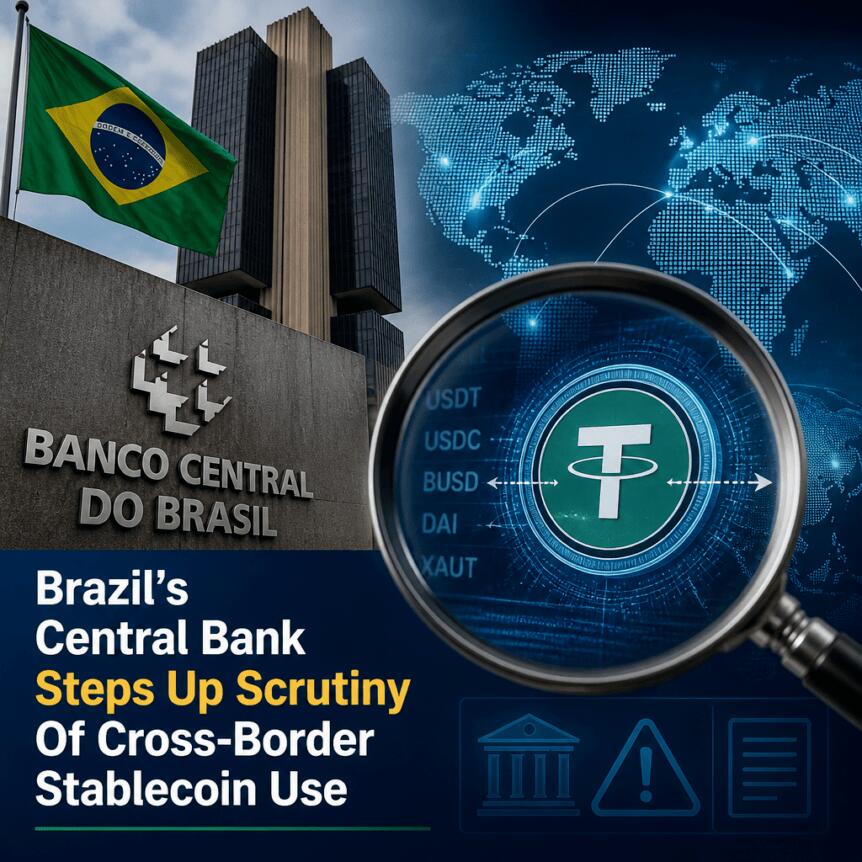
Cross-border payments through stablecoins face greater scrutiny in Brazil as the central bank examines how providers exchange and move funds. Livecoins reported on November 13 that a senior official raised money laundering concerns about certain arrangements at a private meeting. The comments come as Brazil restricts international payments and transfers to its market under new foreign exchange rules.
Brazil Central Bank Examines Two Stablecoin Transfer Models
Gerson Romantini, head of the central bank’s Exchange Division, addressed industry representatives about the treatment of funds during some conversions. According to Livecoins, he linked specific conversion arrangements to money laundering and described stablecoins as an evolution of dollar-cable transfers. For Brazilian fintechs and crypto companies, the issue centers on who owns the funds and who bears the foreign exchange obligations.
The stablecoin sandwich starts with a customer paying Brazilian reais to a financial service provider to make an international transfer. The provider exchanges those reais for a dollar-pegged or euro-pegged stablecoin, then sends the digital asset to a company overseas. That company converts the stablecoin into local currency, and the token serves as a bridge between the two currency conversions.
Under one model, the provider uses virtual assets to settle a foreign exchange transaction outside conventional payment networks like SWIFT. Under the other model, the provider sells stablecoins to customers, who send them overseas and convert them into foreign currency. Romantini said Brazilian institutions cannot offer the second service, where customers handle the overseas transfer and conversion after buying the tokens.
Resolution 561 Tightens Brazil’s eFX Rules
Brazil’s central bank approved Resolution 561/2026 on April 30, and the measure took effect on October 1 of that year. The measure amends Resolution 277/2022, which governs electronic international payment and transfer services under Brazil’s existing framework for providers of eFX. The revised framework limits participation in the eFX market to eligible institutions with authorization from the Central Bank of Brazil.
However, the resolution gives some existing providers extra time to apply for authorization and keep operating during the transition period. To qualify, providers must submit their applications by May 31, 2027, under the timetable the central bank set for existing businesses. The provision gives those businesses time to seek approval while continuing to process international payments and transfers for their customers.
The central bank says the changes aim to improve security and transparency and align Brazil’s rules with international financial crime standards. The authorization requirement therefore gives the central bank more oversight of the institutions that provide electronic cross-border payment and transfer services. The requirements could also increase compliance costs for smaller crypto businesses and fintechs that serve Brazilian customers making payments across borders.
IMF Finds Stablecoin Transfer Costs Vary By Route
An October 2026 International Monetary Fund working paper examined the cost of international stablecoin payments across 270 routes in 18 countries. The researchers found an average cost of 2.18% for a $200 transfer, but the rate varied across the routes they studied. That average amounts to $4.36 per transfer and gives payment providers a benchmark for comparing costs across specific routes and providers.
Traditional providers offered lower prices in roughly one-third of the corridors where researchers could compare their rates with stablecoin transfer costs. The price of a stablecoin transfer can reflect currency conversions at both ends of the payment as well as blockchain fees. As a result, providers can face different total costs even when they use the same type of digital asset for settlement.
Separately, Livecoins cited an unnamed source who said a November 19 meeting could cover further restrictions on cross-border stablecoin transfers. The outlet could not confirm the meeting, and its report gave no details about possible measures or their scope. Brazil’s central bank had yet to respond to questions from Livecoins about the matter when the outlet published its report.
https://www.cryptobreaking.com/brazils-central-bank-steps-up/?utm_source=blogger%20&utm_medium=social_auto&utm_campaign=Brazil’s%20Central%20Bank%20Steps%20Up%20Scrutiny%20Of%20Cross-Border%20Stablecoin%20Use%20
Comments
Post a Comment