
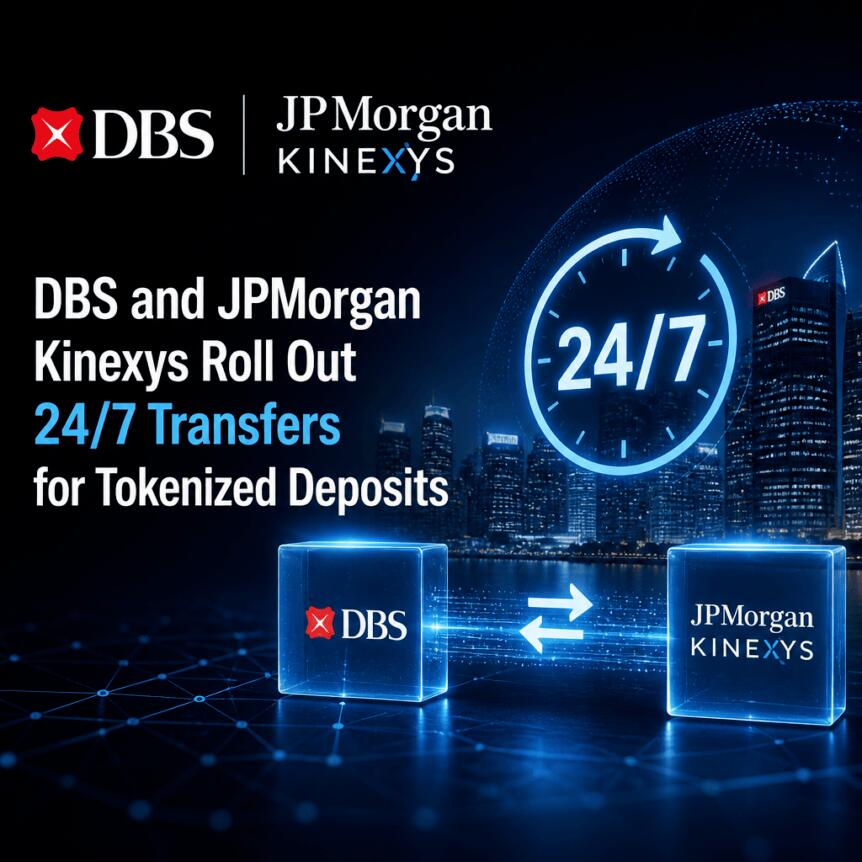
DBS and JPMorgan have rolled out a 24/7 service that enables customers to move tokenized U.S. dollar deposits between the two banks without being constrained by traditional banking hours. The offering is designed to connect DBS Token Services with JPMorgan’s Kinexys platform, supporting cross-border transfers between Singapore and the United States.
According to a DBS press release, Ant International is the first client to use the service, applying it to manage cash across markets. The launch also aligns with Singapore’s push to broaden practical use cases for tokenized deposits and regulated stablecoins through the Monetary Authority of Singapore’s Project BLOOM.
Key takeaways
- DBS and JPMorgan launched a real-time, around-the-clock transfer service for tokenized U.S. dollar deposits between Singapore and the U.S.
- The interoperability bridge links DBS Token Services with JPMorgan Kinexys for cross-border settlement.
- Ant International is reported as the first customer to run cash management through the system.
- The initiative supports MAS’s Project BLOOM, which seeks to improve how tokenized deposits and regulated stablecoins are used for payments.
- DBS says survey results show growing corporate interest in tokenized deposits across multiple markets.
A 24/7 bridge for tokenized deposits
Under the new service, tokenized deposits—bank deposits represented on a blockchain—can be transferred between DBS and JPMorgan outside of conventional operating windows. The banks position the move as a step toward more continuous settlement and smoother liquidity operations for institutions that need to coordinate funds across regions.
DBS said the service connects directly to JPMorgan’s Kinexys platform, targeting interoperability across the two systems. In practice, that means a transfer that originates with tokenized deposits in one bank’s ecosystem can be routed for settlement with the other bank, reducing friction that can arise when participants rely on separate platforms.
Project BLOOM and Singapore’s payments agenda
The launch also matters because it ties into MAS’s Project BLOOM. MAS initiated the program in October 2025, aiming to make it easier to use tokenized deposits and regulated stablecoins for payments both within Singapore and across borders.
DBS and JPMorgan co-lead a working group related to Project BLOOM that focuses on transfers between blockchain platforms. That matters for investors and market participants because it signals that the “plumbing” for regulated tokenized money is being treated as an infrastructure priority—one intended to improve settlement capabilities while staying within the contours of financial regulation.
From announced plans to operational service
DBS and JPMorgan had previously discussed building a blockchain-based tokenization framework for interbank deposits. In November 2025, the banks first revealed plans to develop such a framework for onchain transfers. Earlier focus on developing the tokenization approach is now translating into an operational cross-bank transfer mechanism, with a named corporate client already using the service.
For the broader market, the shift from framework-building to running customer transfers is an important milestone. It suggests interoperability work is moving beyond prototypes and into services that can support day-to-day cash management and liquidity workflows.
Corporate momentum around tokenized deposits
DBS is also pointing to demand signals from industry participants. In an Oct. 28 report, the bank said more than half of the 422 business leaders it surveyed across 11 markets indicated their companies either already use tokenized deposits or plan to do so.
While a survey cannot substitute for transaction volumes, it provides useful context: institutions are actively considering tokenized deposits as a component of treasury and payments strategy. That can influence how quickly interoperable infrastructure attracts customers—particularly when banks can offer clearer pathways to move funds across platforms.
Earlier coverage from Cointelegraph highlighted industry milestones in tokenized deposit transfers, including efforts involving major banks and messaging rails. The current DBS–JPMorgan service builds on the same theme—tokenized money becoming more interoperable and more operationally integrated—while specifically targeting cross-border movement between Singapore and the U.S.
Next, market participants will want to watch how widely DBS and JPMorgan expand access beyond the initial client, whether additional institutions join the interoperability network, and how the broader Project BLOOM work progresses toward more standardized transfer and payment capabilities across regulated tokenized assets.
https://www.cryptobreaking.com/dbs-and-jpmorgan-kinexys-roll/?utm_source=blogger%20&utm_medium=social_auto&utm_campaign=DBS%20and%20JPMorgan%20Kinexys%20Roll%20Out%2024/7%20Transfers%20for%20Tokenized%20Deposits%20
Comments
Post a Comment