
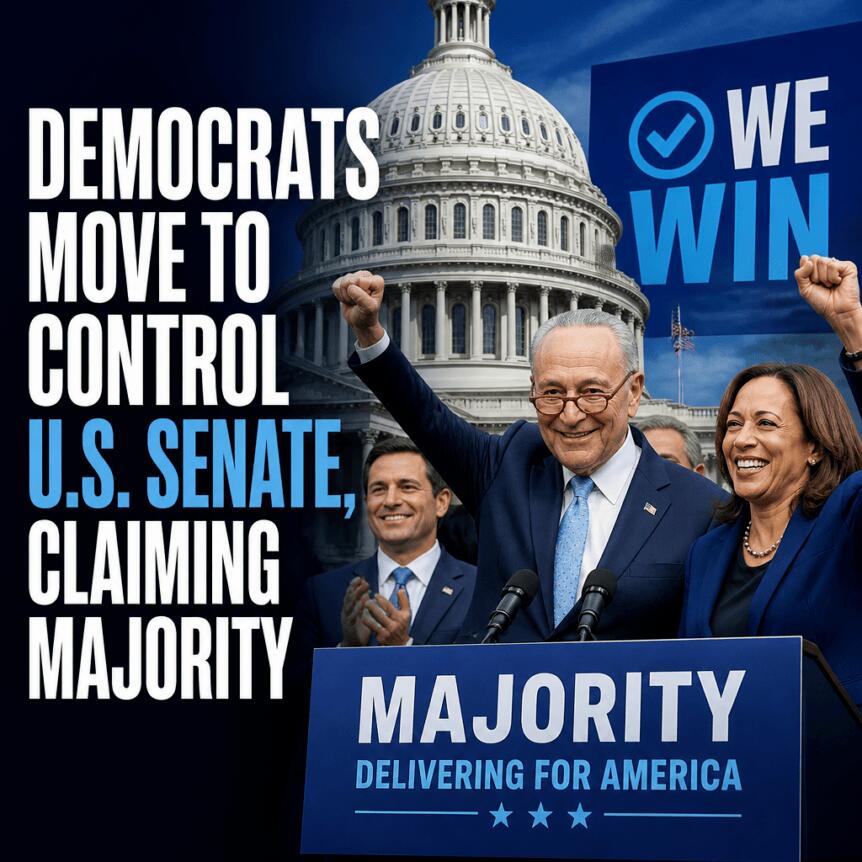
Democrats have secured control of the U.S. Senate after winning several seats previously held by Republicans, according to the Associated Press. The outcome includes flips in Texas, Ohio, North Carolina, South Carolina, Kansas and Iowa, and it sets the stage for how quickly major crypto legislation—particularly the stalled CLARITY Act—can move in the next legislative cycle.
In Iowa, Democratic Senator Josh Turek’s victory expands the caucus backing Democrats and independents to 51 seats. With that shift, attention turns to committee leadership and the broader level of scrutiny lawmakers may apply to crypto-related businesses and regulatory decisions.
Key takeaways
- Democrats’ Senate control is expected to influence whether crypto-focused legislation like the CLARITY Act can advance, especially given prior procedural setbacks.
- Committee leadership changes could affect how hearings and oversight are prioritized for the digital-asset sector.
- Industry advocates warn that new requirements—such as stronger conflict-of-interest rules and customer protections—are likely to be framed through a more stringent policy lens.
- Multiple commentators stress that durable U.S. crypto policy will still require cross-party agreement, not just one-party control.
- How closely crypto regulation becomes tied to party politics may determine whether reforms move steadily or stall.
Why Senate control matters for crypto policy
Control of the Senate can reshape the legislative environment in two practical ways: it affects which lawmakers lead committees and it can change the political incentives behind oversight and regulation. The article notes that this result could intensify congressional scrutiny of Trump-linked crypto businesses and also influence how senators view regulators’ decisions.
Beyond legislation itself, the Senate’s role in confirming nominees to regulatory posts means the new political balance could affect who steers agencies tasked with interpreting and enforcing crypto rules. For market participants, that matters because regulatory leadership can change enforcement priorities and the tone of rulemaking—even when the underlying statutory framework remains the same.
The CLARITY Act faces renewed pressure to clear procedural hurdles
A central thread in the current policy debate is the CLARITY Act. Industry participants cited in the article pointed to the bill’s recent procedural history: it failed a Senate procedural vote in September, with a 49–50 result.
As Jerome de Tychey—president of Ethereum France and co-founder of EthCC—told Cointelegraph, the timing is critical. He said that if the act is not passed by January, the next Congress would start over from scratch. That would force the industry to reengage lawmakers and make its case again, rather than building on momentum from the previous session.
This is likely to influence industry strategy. When legislation risks resetting, stakeholders often have incentives to repackage arguments, broaden coalition-building, and focus on provisions that can attract support across the political aisle.
Cross-partisan support remains the gating factor
Despite the political shift in the Senate, de Tychey cautioned that the industry should not assume one-party control will translate into immediate progress. In his view, the key requirement is cross-partisan support for any measure that can clear the Senate.
He framed the current moment as uncertain: “It’s too early to say exactly what this means for crypto,” he said, but he emphasized that “nothing will pass without cross-partisan support.” That logic reflects the procedural realities of U.S. legislating, where major bills often need enough votes from multiple political blocs to overcome procedural and final passage thresholds.
Fred Hsu, co-founder and CEO of D3 and a core contributor to Doma Protocol, echoed the same theme. In remarks provided ahead of the election, Hsu described the midterms as a reminder that the crypto industry cannot rely on a single party. His statement suggested the industry should be preparing to advocate with lawmakers on both sides of the aisle, rather than waiting for a particular party to deliver regulatory outcomes.
What new demands could look like: protections, conflicts, and the MiCA reference point
While the article notes uncertainty about the overall policy trajectory, it also highlights specific areas where Democratic demands could shape legislative language. De Tychey suggested that certain proposals—such as conflict-of-interest rules and customer protection obligations—could be seen as signs of regulatory maturity.
He referenced the European Union’s Markets in Crypto-Assets (MiCA) framework as an example of how such expectations are already embedded in a major regulatory environment. That comparison matters for U.S. participants because it implies a possible convergence path: U.S. lawmakers might pursue guardrails that resemble provisions already implemented elsewhere, potentially reducing ambiguity for businesses operating internationally.
However, de Tychey also warned against allowing crypto policy to harden along partisan lines. His concern was that turning crypto into a consistently political issue could delay progress and set the U.S. regulatory approach back “several years.” That warning is relevant for investors and builders because regulatory volatility—whether driven by shifting political priorities or enforcement changes—can raise compliance costs and increase uncertainty in long-term planning.
The tension described in the article is straightforward: lawmakers may push for stronger protections, but the durability of those protections depends on whether they can survive political transitions and avoid being framed as partisan concessions rather than stable market rules.
What to watch next
With Democrats controlling the Senate and CLARITY Act momentum constrained by its prior procedural defeat, the most immediate question is whether crypto stakeholders can secure the cross-party support de Tychey and Hsu say is necessary. Readers should watch how committee leadership priorities and early committee activity translate into concrete bill schedules—especially with the January deadline referenced in the discussion.
https://www.cryptobreaking.com/democrats-move-to-control-u/?utm_source=blogger%20&utm_medium=social_auto&utm_campaign=Democrats%20Move%20to%20Control%20U.S.%20Senate,%20Claiming%20Majority%20
Comments
Post a Comment