
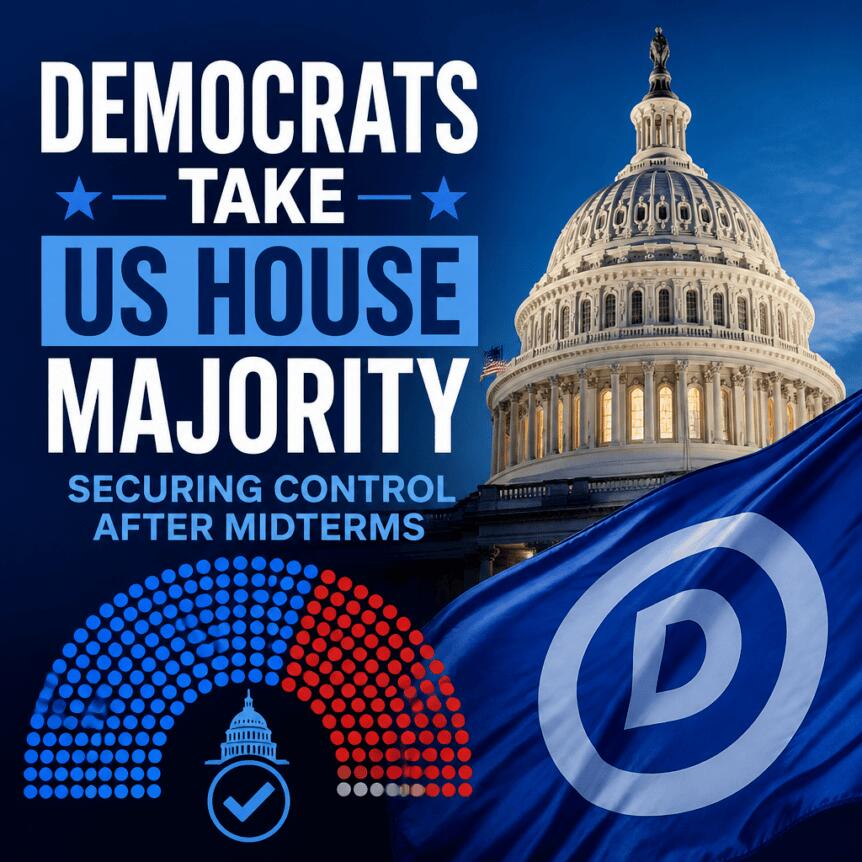
Democrats have secured control of both chambers of the US Congress following the 2026 midterm elections, a shift that could significantly alter the political trajectory for digital-asset regulation and oversight of President Donald Trump’s administration.
Multiple reports indicate Democrats won House seats in districts where Trump defeated Democratic challengers by margins as large as 18 percentage points in 2024, while the party also flipped at least seven Senate seats across a range of states, including Kansas, Iowa, Texas, Ohio, Maine, North Carolina, and South Carolina, according to the Associated Press.
Key takeaways
- Democrats taking both chambers increases the likelihood of faster committee action on crypto and related policy questions.
- Control of House committees from January 2027 gives Democrats stronger subpoena and investigation tools.
- Election results could bring heightened scrutiny of Trump-linked digital asset businesses and enforcement priorities.
- Prediction markets had leaned toward a Democratic sweep, with Kalshi and Polymarket pricing Democrats’ odds at about 75% before results were announced.
Congress changes hands as Democrats expand legislative leverage
The practical impact of Democrats winning control of the House and the Senate is straightforward: a new majority typically reshapes what legislation moves, what oversight becomes a priority, and which political narratives gain institutional backing. For crypto participants, the timing matters because committees drive much of the work—drafting, hearings, and the early stages of bill momentum—before proposals reach full votes.
In its live coverage, the Associated Press reported that Democrats flipped at least seven Senate seats, naming specific states including Kansas, Iowa, Texas, Ohio, Maine, North Carolina, and South Carolina. That geographic spread matters because it reflects a broad electoral swing rather than concentration in only a handful of regions.
Separate commentary from NBC News pointed to Democrats gaining House committee control starting in January 2027, opening the door to subpoenas and investigations involving the Trump administration, including matters tied to the president’s family and business interests, according to NBC News.
Why crypto policy could feel the difference soon
While crypto legislation has historically advanced through a combination of bill text and political negotiations, US oversight often becomes a catalyst—especially when new committee leadership takes office. According to the reporting cited above, Democrats’ committee leverage could translate into more frequent inquiries into digital-asset industry practices and the administration’s connections to related businesses.
That potential scrutiny is notable because it is not limited to whether Congress passes new crypto-focused laws. Even without immediate sweeping reforms, investigations can influence how regulators and lawmakers interpret existing rules, pressure companies to adjust compliance programs, and shape the policy agenda for the next legislative cycle.
The article’s framing also suggests a shift in accountability expectations. With Democrats positioned to control committee agendas, the set of hearings and requests for information could change quickly, particularly around allegations of conflicts, enforcement gaps, or political entanglements involving digital-asset firms.
Election narratives and market odds: what traders expected versus what happened
Alongside the policy implications, the election produced familiar debates about what drove voters and how parties position their messages. The Kobeissi Letter highlighted affordability as the defining election issue, citing high energy costs and renewed interest rate increase concerns.
On the political side, David Gokhshtein, founder of Gokhshtein Media, attributed the result to Republican candidates failing to connect with voters. He wrote on X that Republicans had “got their asses handed” to them and suggested expectations had been wrong on his part, as posted on X.
Meanwhile, election markets appeared to anticipate a Democratic sweep. The article notes that prediction markets on Kalshi and Polymarket had priced the probability of Democrats winning both chambers at roughly 75% on Tuesday, before the results were announced. That matters for readers because it indicates market participants weren’t treating the outcome as an outlier; they were already pricing it as more likely than not.
For crypto traders and portfolio managers, that can be relevant even if it doesn’t determine price directly. When political outcomes move from “unlikely scenario” into “base case,” it often changes how quickly traders adjust to prospective regulatory timelines—especially around committee leadership and potential oversight hearings.
What to watch next for digital assets
In the near term, investors and builders should focus less on broad promises and more on process signals—committee staffing, hearing scheduling, and the specific topics that leadership chooses to pursue once January 2027 begins. If Democrats use their subpoena and investigation capacity as NBC News described, that could quickly set the agenda for enforcement and legislative priorities affecting exchanges, custody services, stablecoin ecosystems, and other parts of the sector.
Another key area to monitor is how Congress balances legislative activity with oversight. Even when major laws take time, targeted inquiries can create momentum for rulemaking or accelerate negotiations among stakeholders. As a result, the coming months may reveal whether this political shift leads to visible policy outputs—or primarily to a more intense scrutiny environment.
The next signals to track are the first committee moves after the new Congress is seated and which crypto-adjacent issues become hearing priorities. Until those specifics emerge, the direction is clear—Democrats now have the institutional tools to shape both legislation and oversight, but the exact regulatory path for digital assets will depend on how committees translate political control into concrete action.
https://www.cryptobreaking.com/democrats-take-us-house-majority/?utm_source=blogger%20&utm_medium=social_auto&utm_campaign=Democrats%20Take%20US%20House%20Majority,%20Securing%20Control%20After%20Midterms%20
Comments
Post a Comment