
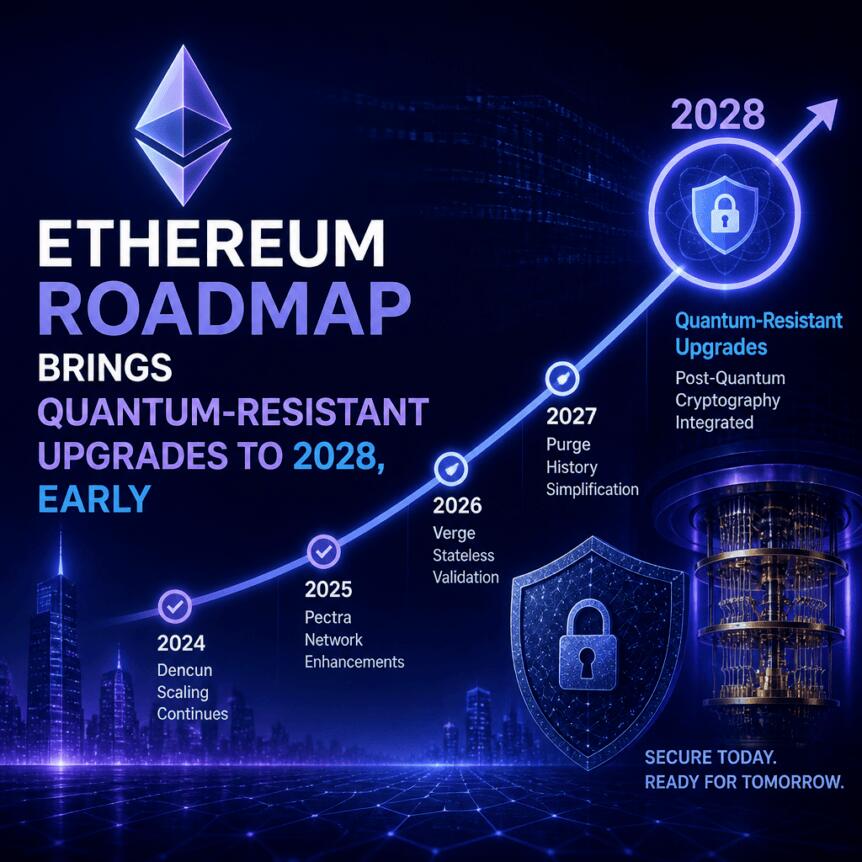
Ethereum Foundation researcher Justin Drake says the network’s post-quantum and “post-AI” transition should be largely wrapped up by December 2028—an accelerated target compared with the foundation’s previously published quantum-resistance deadline.
Speaking at Devcon 8 in Mumbai on Tuesday, Drake outlined a plan that hinges on developers delivering three additional network upgrades within roughly the next 24 months. The update is significant for Ethereum builders and risk managers because it narrows the window for implementing new cryptographic and systems changes that could otherwise take longer to ship, test, and deploy safely.
Key takeaways
- Justin Drake targets December 2028 to complete Ethereum’s post-quantum and post-AI transition.
- The earlier Ethereum Foundation roadmap set December 2029 as the goal for quantum resistance across execution, consensus, and data layers.
- Drake’s Devcon remarks point to three additional network upgrades being delivered within about 24 months.
- The foundation’s roadmap is still scheduled for reassessment in January 2027, suggesting this acceleration may evolve.
- Other projects have criticized the later deadline and are pursuing independent post-quantum research paths.
Accelerated target for Ethereum’s cryptographic shift
Drake’s remarks place timing at the center of Ethereum’s post-quantum effort. According to his Devcon 8 comments, the goal is to “wrap up the full post-quantum and post-AI transition” by December 2028. He added that developers would have about 24 months to deliver three additional network upgrades—an implied ramp that compresses the schedule from what the foundation previously described.
The distinction matters operationally. A shorter implementation timeline can change how teams prioritize engineering resources, auditing bandwidth, and testnet coverage. It also affects how applications and infrastructure providers plan for compatibility—particularly if cryptographic primitives or protocol assumptions shift across multiple layers rather than in a single event.
How the December 2028 goal compares with the published roadmap
Ethereum’s September roadmap established December 2029 as the target for quantum resistance spanning Ethereum’s execution layer, consensus layer, and data layer. Drake’s new, earlier date therefore represents a meaningful shift in ambition—at least from the perspective of when “full” transition work should be completed.
Even so, Drake’s comments do not appear to formally replace the foundation’s existing roadmap. The document is still set for reassessment in January 2027, meaning the foundation may adjust the plan after reviewing progress, implementation feasibility, and security considerations. For investors and developers, that reassessment checkpoint is likely the moment when the accelerated narrative either solidifies into an updated schedule or is moderated by engineering realities.
What Ethereum’s internal sequence has been aiming for
Drake has previously tied the broader schedule to specific technical milestones. In August, he outlined plans for production-ready “leanVM” technology in 2027. In the following year—2028—he described moving toward post-quantum deployments across Ethereum’s three layers.
That earlier outline now aligns with the updated timing logic: a set of upgrades delivered over a roughly two-year window, followed by deployment work that completes by late 2028. The underlying takeaway is that Ethereum’s post-quantum transition is being treated as a staged protocol change rather than a single upgrade, which is consistent with the roadmap approach that addresses multiple layers instead of only one.
Why other teams are pushing back on later deadlines
The Ethereum Foundation’s December 2029 quantum-resistance target has not gone unchallenged. StarkWare CEO Eli Ben-Sasson previously told Cointelegraph that the 2029 deadline was “too late,” warning that deadlines could slip.
Beyond critique, the broader ecosystem appears to be translating concerns into independent research directions. In October, Starknet’s community reportedly backed research into becoming an independent post-quantum layer-1 network—an approach that reflects a strategy of reducing dependence on Ethereum’s timeline while pursuing readiness for post-quantum cryptography.
These reactions matter because they highlight an asymmetry: Ethereum is coordinating a multi-layer transition with a roadmap and reassessment cycles, while other ecosystems hedge by exploring alternative deployment pathways. If Ethereum’s accelerated schedule advances smoothly, the divergence may narrow. If it encounters delays, the gap between “wait-and-implement” and “prepare-in-parallel” strategies could widen.
For readers tracking Ethereum’s post-quantum roadmap, the next signals to watch are the January 2027 reassessment of the foundation’s schedule and whether the “three additional network upgrades” framework solidifies in public development plans before the December 2028 target becomes definitive.
https://www.cryptobreaking.com/ethereum-roadmap-brings-quantum-resistant/?utm_source=blogger%20&utm_medium=social_auto&utm_campaign=Ethereum%20Roadmap%20Brings%20Quantum-Resistant%20Upgrades%20to%202028,%20Early%20
Comments
Post a Comment