
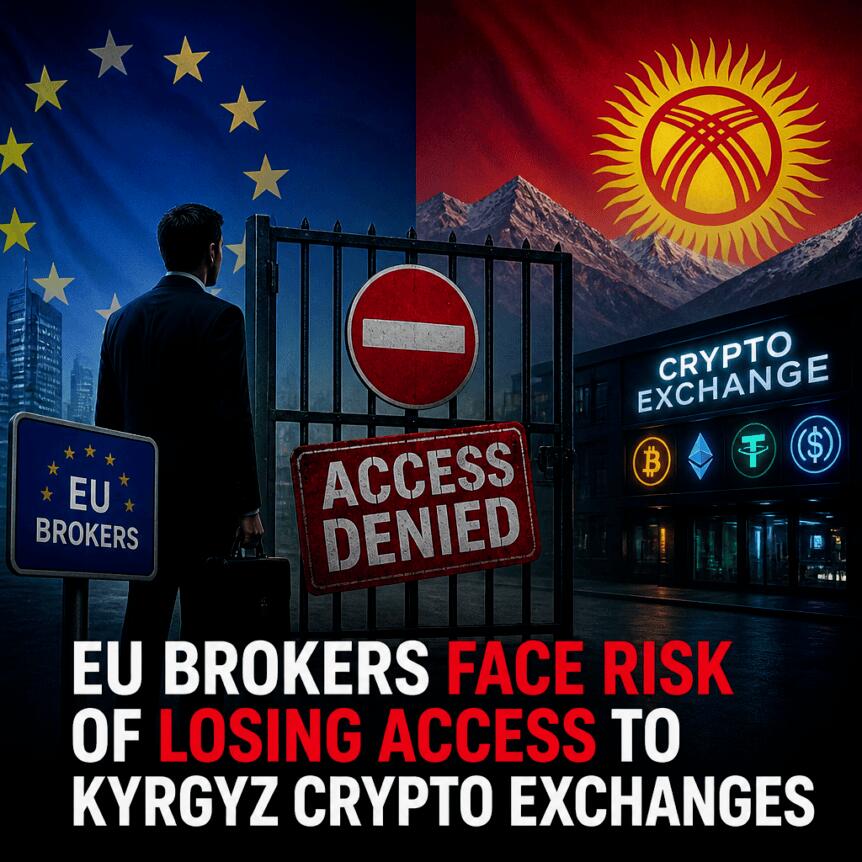
The European Union has opened the door to a new way of policing cryptocurrency-related sanctions: brokers in EU markets may soon be required to verify not only whether a crypto provider is sanctioned, but also where that provider is established. The change is tied to an EU sanctions list published in July, whose annex has been left blank—an annex that a report says could be used to target Kyrgyzstan first.
Why this matters for traders and exchanges is straightforward. If the policy advances and Kyrgyzstan is added, an EU-facing intermediary could clear a trade involving a firm that appears “unsanctioned” by name, only to be blocked because the firm is based in a jurisdiction the EU believes does not do enough to prevent sanctions evasion through crypto services. That shifts compliance from a simple blacklist check to a more location-driven assessment.
Key takeaways
- The EU’s July sanctions package left the relevant country annex empty, with Kyrgyzstan reportedly proposed as the first entry.
- The policy would give EU operators authority to block direct or indirect dealings with crypto providers established in a country viewed as persistently failing to stop sanctions evasion.
- Prior enforcement involving Kyrgyzstan-linked activity—according to the U.S. Treasury—suggests the EU may be building a case around exchange routing and asset movement.
- Even if a particular exchange is not listed by name, an EU broker could still be forced to route trades elsewhere if it is established in the targeted jurisdiction.
From sanctions lists to “where the exchange is based”
In July, the European Union published an updated sanctions list that includes an empty annex—Annex LVII—meant to designate countries for additional compliance scrutiny. According to reporting by the Kyiv Independent, Kyrgyzstan is the proposed first country in that annex.
The practical effect, if the proposal is adopted, is that EU brokers would have to look beyond whether a counterparty appears on an existing sanctions roster. The EU directive described in the underlying reporting would allow EU operators to bar dealings—directly or indirectly—with crypto providers established in a country that the EU characterizes as systematically and persistently failing to prevent sanctions evasion through crypto services.
That distinction is important. A firm could avoid being captured by a traditional name-based sanctions check and still become ineligible for EU trading relationships once its country-of-establishment is added to the annex.
How the Kyrgyzstan compliance theory took shape
The EU’s policy direction does not appear in a vacuum. The article’s timeline points to a specific enforcement story that involved Russia’s crypto exchange ecosystem.
According to the U.S. Treasury, when authorities disrupted the Russian crypto exchange Garantex in March 2025, Garantex employees created Grinex, an exchange registered in Kyrgyzstan, and moved customer deposits there. The U.S. Treasury also states that British sanctions officials later traced substantial transfers between Grinex and licensed international exchanges.
That sequence—disruption of one exchange, relocation to a different jurisdiction, and continued links to licensed counterparties—creates the compliance problem regulators often try to solve: sanctions can be bypassed by rerouting activity through providers that appear legitimate in isolation while still serving the same blocked network.
By shifting compliance attention to the country where a crypto provider is established, the EU is effectively trying to reduce the room for that kind of “jurisdiction hopping,” at least within the framework of the proposed annex.
What happens if Kyrgyzstan is added to the annex
As of Nov. 26, the proposal still required unanimous approval from all 27 EU member states, according to the reporting referenced in the article. That means the change was not yet certain at the time of publication.
If approval comes, EU brokers would face an additional gating step in their operational workflows. For example, a broker might confirm that a long-term settlement partner is not listed on a sanctions registry by name; however, if the provider is established in a targeted annex country, the broker could still be required to take the next trade elsewhere.
This could affect liquidity pathways, settlement choices, and counterparty management practices for platforms and market makers that rely on global routing. It also places pressure on exchanges to demonstrate not just legal compliance, but also their independence from jurisdictions the EU assesses as high-risk for sanctions evasion.
The larger compliance shift for EU crypto markets
The policy development signals a broader trend in sanctions compliance: regulators increasingly treat geography as a risk factor, not merely a background detail. In crypto markets—where funds can move quickly and where counterparties may be structurally complex—country-based compliance rules can become as operationally significant as traditional blacklists.
That also changes what market participants should watch for next. Even in scenarios where there is no explicit name-based designation, the addition of a jurisdiction to a compliance annex can rewire relationships across settlement partners, brokers, and custodial routes.
Investors and builders should focus on how EU-facing intermediaries respond: whether they introduce new screening steps based on “country of establishment,” how they handle existing contractual relationships, and how compliance teams document the basis for allowing or blocking specific counterparties.
For now, the key uncertainty is whether EU member states will reach unanimous agreement and ultimately populate Annex LVII with Kyrgyzstan. If they do, the immediate question will be how quickly EU brokers translate the policy into real trading and settlement restrictions—especially for providers that have not been sanctioned by name.
https://www.cryptobreaking.com/eu-brokers-face-risk-of/?utm_source=blogger%20&utm_medium=social_auto&utm_campaign=EU%20Brokers%20Face%20Risk%20of%20Losing%20Access%20to%20Kyrgyz%20Crypto%20Exchanges%20
Comments
Post a Comment