
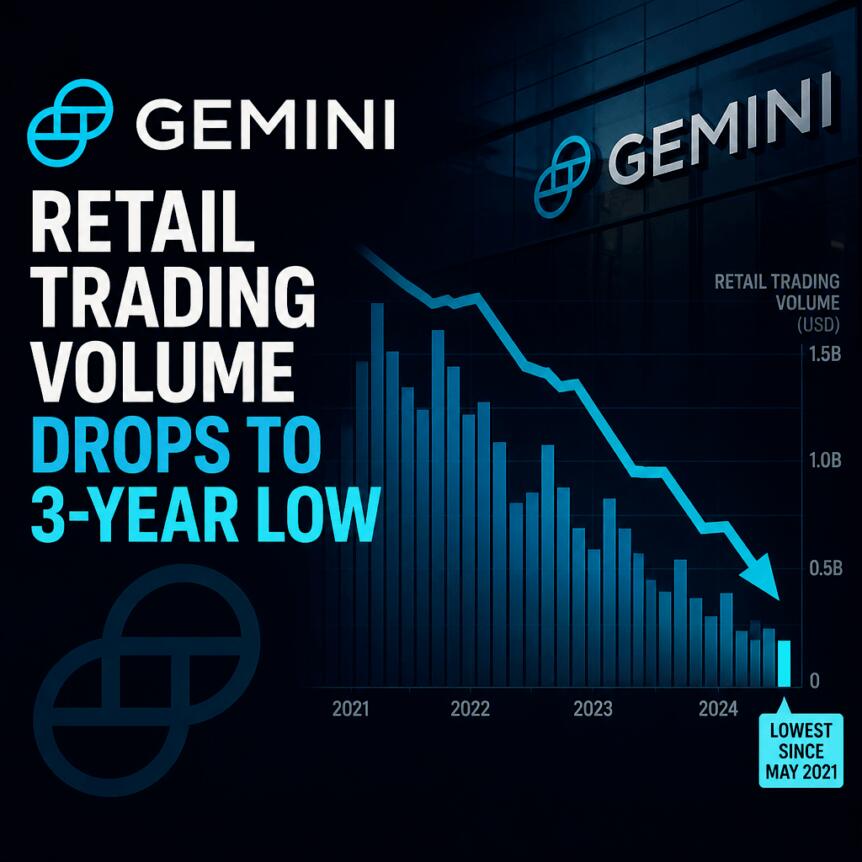
Gemini’s latest earnings update shows a market that is still trading actively overall, but with a clear shift away from retail participation. In its Q3 2026 results, the crypto exchange reported that spot trading volume climbed while retail volumes slid to a multi-quarter low—an unusual combination that suggests institutional activity is doing more of the heavy lifting.
At the same time, Gemini and other major platforms highlighted prediction markets as a potential stabilizer as traditional exchange volumes soften. For traders and investors, the key question is whether prediction venues can grow quickly enough to offset weakening retail engagement—and whether this pattern is spreading across the industry.
Key takeaways
- Gemini’s total spot trading volume rose 18% quarter-on-quarter to $4.5 billion, but retail spot volume fell 14% to $600 million.
- Retail volume on Gemini reached its lowest point since Q3 2023, even as institutional spot volume increased 26% to $3.9 billion.
- Gemini exchange revenue increased 7% to $13.4 million, with institutional revenue more than doubling—while retail still contributed nearly three-quarters of revenue.
- Other exchanges reported softer trading activity, while pointing to prediction-related products as partial compensation.
- Gemini is expanding prediction-market reach, citing stronger trader engagement in October and pursuing distribution partnerships.
Gemini’s retail volumes drop as institutions step in
According to Gemini’s Q3 earnings report, spot trading volume rose from the second quarter to $4.5 billion—an overall improvement that could suggest buoyant market demand. However, the breakdown tells a different story. Institutional spot trading volume increased 26% to $3.9 billion, while retail spot volume declined 14% to $600 million.
Gemini described the quarter’s higher spot volume as being supported by increased institutional Zcash activity and expanded affiliated market-making. What it did not provide was a specific explanation for the retail decline.
The retail drop matters because retail traders have traditionally been a major driver of exchange engagement and activity-based revenue. With retail volume falling to its lowest level since Q3 2023, Gemini’s latest results reflect a period when consumer trading interest is not keeping pace with broader market turnover.
Revenue holds up—partly through institutional strength
Despite the retail volume contraction, Gemini reported that its exchange revenue rose 7% quarter-on-quarter to $13.4 million. The company said the improvement was largely tied to institutional revenue, which more than doubled over the same period.
Retail traders remained Gemini’s largest source of exchange revenue, contributing nearly three-quarters of the total. That creates an important tension: even if retail volumes are sliding, revenue contribution from retail is still dominant, which could mean either (a) retail customers are trading in different ways that preserve revenue per user, or (b) the revenue effects lag behind volume trends.
Investors should watch whether future quarters show retail volume stabilization—because revenue can sustain declines longer than activity metrics, but it typically doesn’t escape them indefinitely if the participation trend worsens.
Prediction markets enter the conversation as exchange activity softens
Gemini’s retail slump is not an isolated development. The broader exchange landscape is showing softer trading activity in recent quarters, and multiple companies have pointed to prediction-market products as a compensating growth area.
Coinbase, for example, reported “softer retail and institutional activity,” with consumer spot trading volume down 9% quarter-over-quarter to $23.4 billion, according to coverage referencing Coinbase’s results. Coinbase chief financial officer Alesia Haas said continued growth in prediction markets helped offset the weakness in crypto trading activity.
Robinhood also underscored the same shift in product focus. Its crypto revenue fell 55% year-on-year to $120 million, but event-contract revenue rose sixfold to $173 million—suggesting that users may be allocating attention to newer betting-style formats even when spot trading cools.
Within Gemini’s own reporting, prediction-market momentum is evident but not yet large enough to fully offset softness elsewhere. Gemini said revenue from its prediction exchange, Gemini Predictions, increased 52% quarter-on-quarter to $796,000. While that is meaningful for the segment, it remains a relatively small line item compared with the overall exchange economics.
Gemini doubles down on prediction-market distribution
Gemini indicated that its prediction-market activity strengthened heading into Q4. The company reported average daily traders in October were about 50% above the Q3 average, and nearly a third of new prediction traders were new to Gemini—more than double the share seen in Q3. That matters because it implies prediction products are not merely shifting existing users between activities; they may also be bringing in incremental participants.
Beyond engagement, distribution expansion is another theme. Gemini said it is seeking to distribute its event contracts through other platforms. In August, it referenced a nonbinding agreement with Apex Fintech Solutions that would make Gemini Titan the exclusive venue for crypto event contracts distributed through Apex’s futures brokerage to brokerage customers—subject to definitive agreements.
In other words, the strategy is twofold: grow the prediction-market audience on Gemini’s own platform while also using partner channels to increase the reach of its event-contract infrastructure. If these partnerships convert into finalized agreements and translate into sustained user growth, Gemini could reduce its reliance on retail spot trading volumes—an important hedge given the recent retail decline.
Gemini is scheduled to host a Q3 earnings call on Friday. Going forward, traders should focus on whether Gemini can convert its stronger prediction-market traction—especially the growth in new-to-Gemini prediction traders—into a larger share of overall revenue, and whether retail spot volumes stabilize or continue trending down into the next quarter.
https://www.cryptobreaking.com/gemini-retail-trading-volume-drops/?utm_source=blogger%20&utm_medium=social_auto&utm_campaign=Gemini%20Retail%20Trading%20Volume%20Drops%20to%203-Year%20Low%20
Comments
Post a Comment