
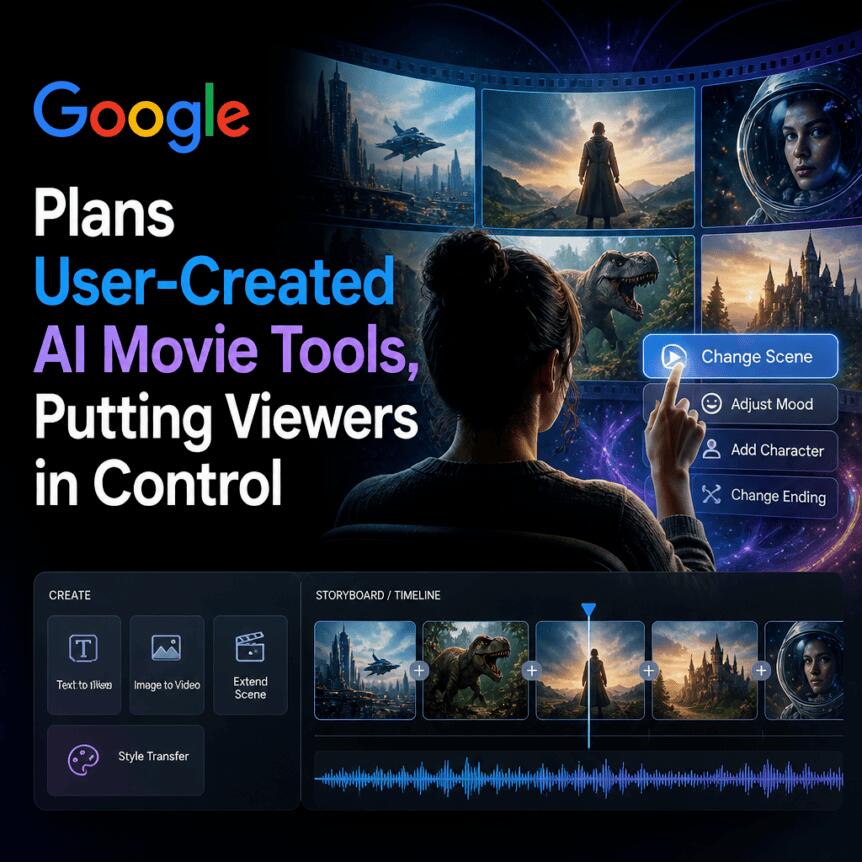
Google has filed a US patent application for a system it calls “My Channel,” which would generate an AI-produced TV channel tailored to an individual viewer. The proposal envisions content that not only reflects a user’s viewing habits and preferences, but could also cast the viewer as the protagonist—potentially using a user’s photos or video to create a digital likeness and generating a synthetic voice for dialogue.
The filing, submitted May 13, 2025, and published by the US Patent and Trademark Office this week, describes how the system could use a combination of watch history and demographic information to choose genres and style, then generate new narrative content based on those inputs. Google’s examples emphasize that the output would be customized both in presentation and storytelling structure.
Key takeaways
- Google’s patent describes an AI “My Channel” that generates tailored video content based on a user’s profile and viewing behavior.
- The system could use user-provided images or video to create a digital likeness and a synthetic voice for character dialogue.
- Google’s draft includes the ability to adapt narrative themes to a user’s recent interests (such as sports-related content) and preferred genres.
- The proposal also outlines an ad workflow where ads are inserted and then streamed as part of the generated viewing experience.
What Google’s “My Channel” patent proposes
According to the patent text, “My Channel” would be built around a customized video generation model. In one example prompt shown in the filing, Google describes generating a customized video where the user is the protagonist. The generated video would incorporate characteristics drawn from a user profile and would follow the style and format of the user’s top watched content, while aligning the narrative with the viewer’s stated or inferred genre preferences.
The filing also suggests that personalization goes beyond surface-level recommendations. In the example centered on cricket, Google describes a scenario in which a user recently watched content about a Cricket World Cup event and a specific player. The AI would then incorporate elements from the competition and the player’s recent performance—potentially positioning the user in the stands or as an interactive participant tied to the player’s story arc.
Digital likeness, synthetic voices, and the “you are the star” approach
A notable element of the patent is its emphasis on turning viewer data into a cast member. Google describes the possibility of using photos or videos of the viewer to create a digital likeness and using a synthetic voice so the viewer’s character can speak within the generated programming.
This is a direct attempt to move personalization from “what you watch” to “who appears on screen,” making the experience resemble interactive entertainment where the viewer’s identity becomes part of the content. That shift matters for adoption because it would require more sophisticated identity handling than standard recommender systems—along with user consent mechanisms strong enough to satisfy privacy and rights expectations.
How the system could deliver ads inside AI-generated programming
Google’s application also addresses monetization. In one described version, the patent envisions an ad server that retrieves the generated video choice, inserts advertisements, and streams the resulting version to the viewer’s TV.
While the patent does not detail the exact advertising targeting methods, it does lay out a workflow conceptually similar to conventional linear/streaming ad placement—adapted to the reality that the main content would be generated on demand rather than pre-produced as a fixed asset.
From an investor and industry perspective, that framing is significant: if AI-generated channels become widespread, advertisers and platforms will need a reliable way to ensure brand-safe placements and measurable delivery even when the underlying program is created dynamically.
From patent concept to signals of early market experimentation
Google’s proposal may sound futuristic, but the underlying mechanics—AI-driven content generation and user-facing customization—are already being tested in different forms. The filing is not the first time the concept of personalized AI storytelling has appeared in public platforms.
In China, for example, AI tools have been used to generate large numbers of very short “duanju” microdramas daily, according to reporting by NBC News. Separately, Shortical—a streaming service described as available in the US—produces fully AI-generated microdramas alongside more traditional titles. The service reportedly allows users to “audition” their face to potentially appear in future AI-generated characters.
Those examples illustrate that parts of Google’s vision—such as rapid generation of scripted-like content and some level of user identity input—have real-world precedents. What remains uncertain is whether “My Channel” would achieve the same scale, quality, and user trust requirements implied by the patent: consistent narrative coherence across episodes, effective moderation of synthetic likeness and voice, and a monetization pipeline that works reliably with dynamically generated output.
Who is behind the filing
The patent application lists Aravind Reddy Ayuluri (a software engineer) and Prameela Kavya Thummuru (a machine learning engineer) as inventors. Google did not provide additional public commentary in the information available here, though Cointelegraph reported that it reached out to Google for comment.
For readers watching this space, the key question is not whether AI can generate video that looks tailored—it’s how companies will govern identity inputs, voice synthesis, and ad insertion at scale. Until there’s clarity on those practical safeguards and product timelines, Google’s “My Channel” remains a blueprint for a future that increasingly blends personalization, synthetic media, and mainstream distribution.
https://www.cryptobreaking.com/google-plans-user-created-ai/?utm_source=blogger%20&utm_medium=social_auto&utm_campaign=Google%20Plans%20User-Created%20AI%20Movie%20Tools,%20Putting%20Viewers%20in%20Control%20
Comments
Post a Comment