
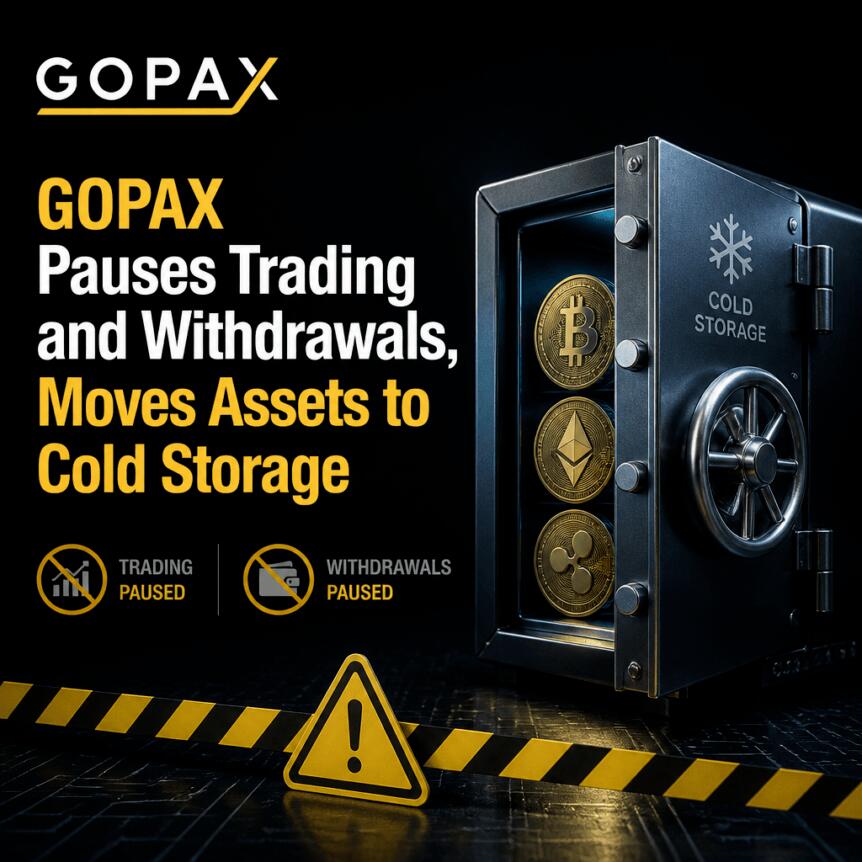
South Korean crypto exchange GOPAX has suspended trading, deposits, and “standard” withdrawals after receiving notice via email that it could be targeted by a hack, according to Kyunghyang Shinmun. The exchange says it had not observed a hack or attempted theft at the time it made its announcement.
In an effort to protect customer holdings, GOPAX also indicated it intends to move assets to offline storage, while citing regulator guidance and pointing to a wider push in South Korea toward stronger cyber safeguards after major exchange incidents.
Key takeaways
- GOPAX paused deposits and standard withdrawals at 5:55 am UTC, and halted trading at 6:53 UTC, canceling all unfilled orders.
- The suspension followed an email threat; GOPAX said no hack or attempted theft had occurred as of its communications.
- GOPAX plans to transfer crypto assets to offline wallets, referencing regulator recommendations and recent security concerns.
- Customers can still request withdrawals via GOPAX’s support center, though manual checks may slow processing.
- The move comes shortly after South Korea’s Financial Services Commission urged exchanges to hold at least 80% of customer crypto assets in cold storage.
GOPAX suspends services after a hack threat
Local reporting from Kyunghyang Shinmun said GOPAX suspended trading, deposits, and standard withdrawals on Friday after it received an email threatening a hack. A GOPAX representative told the newspaper that, at the time, there had been no confirmed hack or attempted theft.
GOPAX’s own notices set out the timeline for customers. It said deposits and standard withdrawals stopped at 5:55 am UTC, while trading ended at 6:53 UTC. The exchange also stated that it canceled all unfilled orders during the shutdown.
Manual withdrawals remain possible, but verification could take time
Even with deposits and standard withdrawals paused, GOPAX indicated that users can still submit withdrawal requests through its support center. The exchange cautioned, however, that manual verification and approvals may delay withdrawal processing compared with normal automated flows.
This distinction matters for traders and liquidity-sensitive users: while the exchange is effectively offline for new inflows and routine transfers, customer access to funds may continue through an exception process—potentially affecting withdrawal turnaround times during the suspension window.
Offline storage shift tied to regulator guidance
GOPAX said it intends to move customer crypto assets to offline wallets as a protective measure. Its notices referenced financial regulators’ recommendations and pointed to broader concerns arising from leaks and hacking incidents that have affected financial institutions.
The exchange’s rationale aligns with South Korea’s increasing focus on cold storage practices. Earlier coverage noted that the Financial Services Commission (FSC) urged domestic exchanges to increase cold-wallet holdings following the widely reported Binance hack worth $6.3 billion. Under South Korean rules, exchanges are required to keep at least 80% of customer crypto assets in cold storage.
Financial Supervisory Service data cited in the article previously showed GOPAX held 80.54% of user assets offline at the end of September—just above the regulatory floor. The close margin highlights why the exchange’s current suspension and planned offline storage transfer could be viewed by users as an attempt to strengthen compliance and reduce operational risk.
Recent security scrutiny across South Korea’s crypto sector
This latest disruption comes against a backdrop of heightened cybersecurity enforcement and industry-wide scrutiny in South Korea.
In October, the FSC reported cybersecurity deficiencies at 130 of 555 financial companies it reviewed nationwide. The regulator also identified GOPAX operator Streami and crypto exchange Prabang among 16 companies linked to earlier security incidents, signaling that compliance oversight would tighten.
Those concerns were not theoretical. In late October, South Korean exchange Prabang suspended services after it detected abnormal withdrawals from its hot wallet on Oct. 24. According to Yonhap News Agency, the incident resulted in losses of about 100 million won (roughly $70,000). Prabang said it would reimburse affected customers using company funds.
Taken together, these events illustrate a persistent tension in crypto infrastructure: exchanges need hot wallets for operational speed, but regulators and market participants increasingly demand larger cold-storage buffers and stronger controls around withdrawal processes and monitoring.
What to watch next for GOPAX users
For customers, the immediate priority is timing—how quickly GOPAX completes asset transfers to offline storage, when it resumes deposits and standard withdrawals, and whether manual withdrawal requests proceed within expected windows. More broadly, the episode is another test of South Korea’s enforcement direction as exchanges work to demonstrate cold-storage readiness and improve withdrawal security under closer regulatory attention.
https://www.cryptobreaking.com/gopax-pauses-trading-and-withdrawals/?utm_source=blogger%20&utm_medium=social_auto&utm_campaign=GOPAX%20Pauses%20Trading%20and%20Withdrawals,%20Moves%20Assets%20to%20Cold%20Storage%20
Comments
Post a Comment