
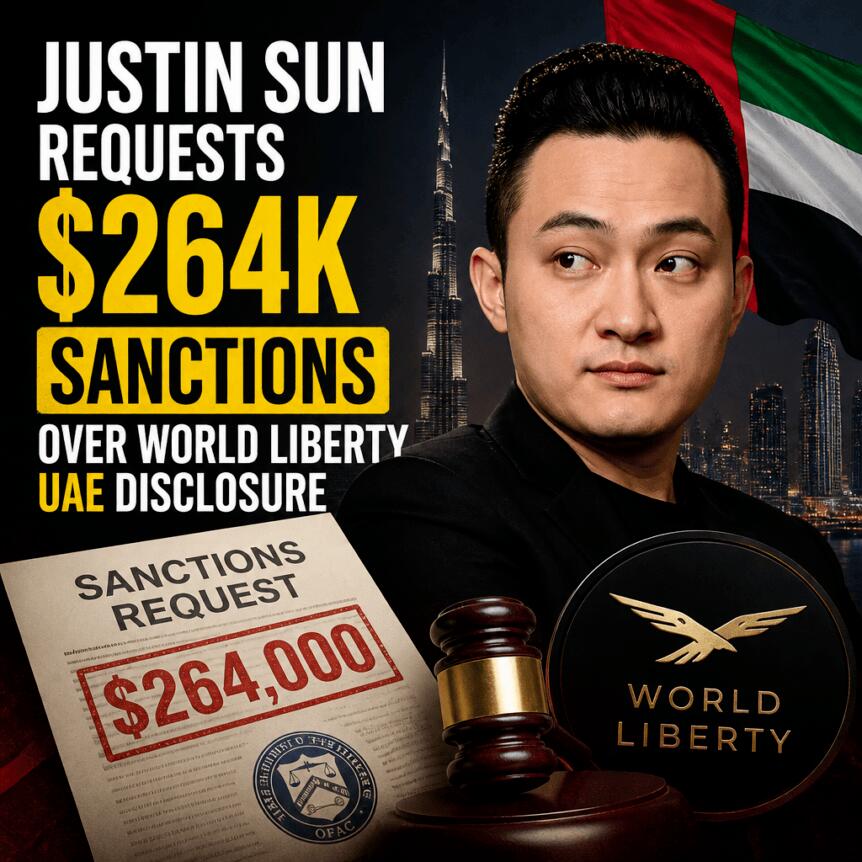
Tron founder Justin Sun is asking a federal court to impose $263,821.20 in sanctions on World Liberty Financial and its lawyers, arguing the company misled the court about who ultimately owns it during an ongoing dispute tied to Sun’s $45 million investment in WLFI tokens.
In a filing submitted in the U.S. District Court for the Northern District of California, Sun and two co-plaintiffs claim World Liberty first disclosed Florida as its sole citizenship and then amended its disclosure nearly three months later—adding a chain of 22 individuals and entities, including parties associated with the United Arab Emirates.
Key takeaways
- Justin Sun seeks $263,821.20 in sanctions, tied to what he says was an initially misleading ownership/citizenship disclosure by World Liberty Financial.
- Sun alleges World Liberty’s citizenship disclosure changed nearly three months after the original filing, expanding an ownership chain to 22 parties and entities, including those connected to the UAE.
- The dispute has also included arguments over whether the case belongs in federal court or should be moved to arbitration.
- Sun says he intends to refile in California state court after the sanctions motion is resolved; a hearing is scheduled for Dec. 10.
Sanctions request centers on alleged ownership disclosure changes
Sun’s sanctions bid points to how World Liberty reported its citizenship for jurisdictional purposes. According to the court filing, World Liberty initially listed Florida as its only citizenship and later revised that position to reflect a more complex ownership structure.
The amended disclosure, Sun’s team alleges, came close to a procedural milestone: six days after a federal judge questioned World Liberty’s effort to move Sun’s claims into arbitration. World Liberty’s lawyers then argued that because foreign parties were allegedly included in the company’s ownership chain—via UAE citizenship—the federal court lacked jurisdiction.
Sun said in a public post that World Liberty “presumably always knew who its owners were,” adding that when asked about how the disclosure changed, the company declined to explain.
World Liberty Financial did not immediately respond to Cointelegraph’s request for comment.
Why the UAE connection matters for jurisdiction and procedure
At the heart of Sun’s complaint is the procedural impact of World Liberty’s amended disclosure. In the exhibits submitted with the case, World Liberty’s lawyer Sam Cleveland stated in an Aug. 26 email that his team had “recently” learned of additional citizenship information.
Sun’s attorneys dispute that narrative. They argue World Liberty already had UAE citizenship when the lawsuit was filed in April and contend that World Liberty’s legal team provided limited documentation about its ownership structure while declining to explain why the original court disclosure omitted the UAE-linked information.
Sun’s court filing seeks to scrutinize not only what World Liberty disclosed, but when it learned the information and how that change aligns with the company’s attempt to steer the dispute toward arbitration.
How the sanctions figure was calculated
The amended disclosure dispute quickly evolved into a sanctions fight. Sun’s side says the request for $263,821.20 reflects attorney fees for work aimed at opposing arbitration—specifically tied to four attorneys.
Sun’s representatives also state that the amount sought does not include other legal fees and costs related to jurisdictional discovery and the sanctions motion itself.
Sun’s attorneys are effectively arguing that the alleged disclosure issue forced additional legal work, including efforts to preserve the case in federal court and resist arbitration, and that the court should compensate for those expenses through sanctions.
Timeline of the wider legal conflict around WLFI tokens
The sanctions request sits within a broader pattern of litigation involving Sun and World Liberty Financial.
Sun sued World Liberty in April, alleging fraud and the unlawful freezing of his tokens. World Liberty responded by filing a defamation lawsuit against Sun in May, alleging false statements and violations of token-sale terms; Sun denied those allegations.
The legal wrangling follows a deal described in earlier reporting involving an Abu Dhabi-backed investment vehicle that agreed to purchase a 49% stake in World Liberty for $500 million. Sun previously backed the Trump family’s crypto ventures—both by investing in World Liberty and by buying President Donald Trump’s TRUMP memecoin.
According to the dispute filings described in earlier coverage, Sun’s involvement and the way the ownership of World Liberty was structured have become central issues not only on the merits but also on where the case should be heard.
What happens next
A hearing on the sanctions motion is scheduled for Dec. 10. Sun has also said he plans to refile in California state court once the sanctions process is resolved, meaning the next steps could determine not only whether sanctions are imposed, but also where the underlying claims are litigated and how jurisdictional arguments will shape the case.
https://www.cryptobreaking.com/justin-sun-requests-264k-sanctions/?utm_source=blogger%20&utm_medium=social_auto&utm_campaign=Justin%20Sun%20Requests%20$264K%20Sanctions%20Over%20World%20Liberty%20UAE%20Disclosure%20
Comments
Post a Comment