
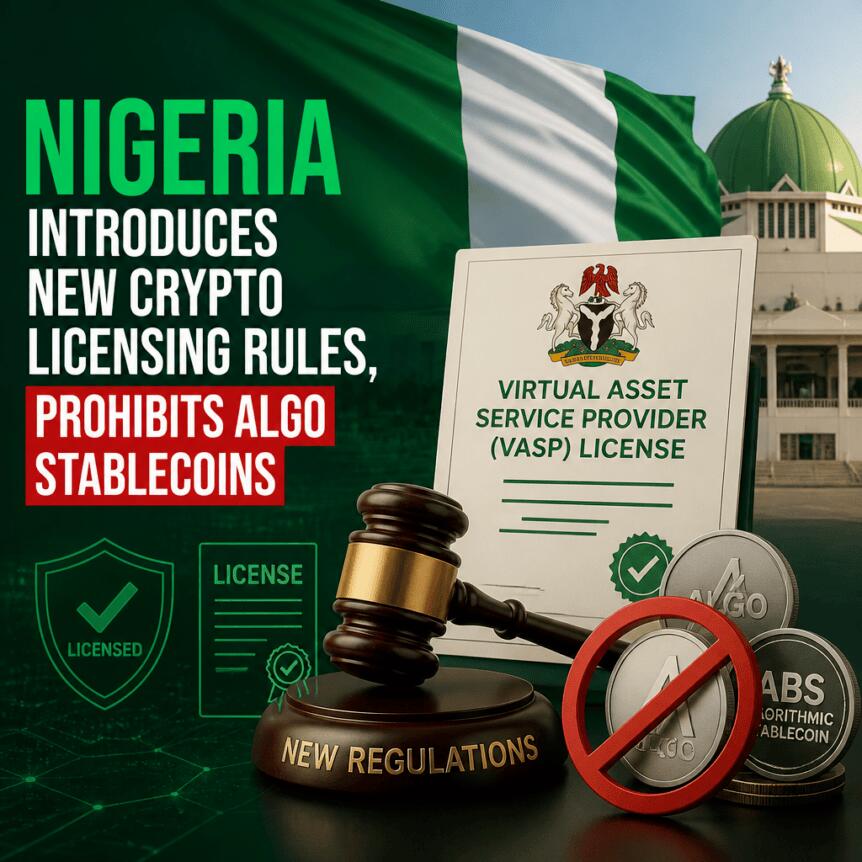
Nigeria’s central bank has moved to tighten oversight of stablecoins and crypto-related payments by issuing new licensing and reserve requirements for a broad range of non-security digital asset service providers. The Central Bank of Nigeria (CBN) released the Regulations for the Operations of Non-Security Virtual Assets on Thursday, and while the rules took effect immediately, existing firms have 180 days to apply for the required licenses or authorizations.
The CBN says the framework is designed to encourage “responsible innovation” without exposing consumers and the financial system to avoidable risks. The policy also builds on earlier steps aimed at coordinating crypto regulation across Nigerian authorities, including President Bola Tinubu’s July executive order.
Key takeaways
- Stablecoin issuers must keep reserves that fully back their tokens, plus an additional buffer of at least 2%.
- Reserve composition matters: at least 40% of stablecoin reserves must be cash or “highly liquid” qualifying assets.
- Algorithmic or weakly redeemable designs are barred: tokens relying primarily on algorithms are prohibited, as are stablecoins without enforceable redemption rights.
- Capital requirements are tiered, with higher paid-up capital for naira-backed versus foreign-currency-backed stablecoin issuers.
- Crypto payment providers and custodians face minimum paid-up capital rules, signaling tighter compliance expectations beyond trading.
Reserve-backed stablecoins face stricter constraints
The most significant changes apply to stablecoin issuers. Under the new CBN regulations, issuers must ensure their tokens are fully backed by reserve assets and maintain an additional buffer of 2% or more of the stablecoin’s value.
The central bank further specifies reserve quality. At least 40% of stablecoin reserves must be cash or other qualifying highly liquid assets. This emphasis on liquidity is notable: it targets the practical ability to meet redemptions during periods of market stress, rather than relying solely on reserve assets that may be harder to liquidate quickly.
Capital requirements add a second layer of conservatism. The regulations set minimum paid-up capital of 10 billion naira (about $7.4 million) for issuers backing stablecoins with the naira, and 15 billion naira (about $11.1 million) for stablecoins backed by foreign currencies.
Prohibitions signal a move away from weaker stablecoin models
Beyond capital and reserves, the regulations also directly restrict certain stablecoin structures. The CBN prohibits stablecoins that maintain their value primarily through algorithmic mechanisms rather than eligible reserve backing. It also bars stablecoins that do not come with enforceable redemption rights.
For market participants, the message is clear: in Nigeria, stablecoin viability appears tied not just to “claims” of backing, but to enforceable redemption pathways and reserves that meet the CBN’s liquidity criteria. Firms currently operating without structures that match these requirements may struggle to become licensed within the 180-day window.
Payments, custody, and exchange services now face capital minimums
The CBN’s regulatory scope is broader than stablecoin issuance. The rules cover a range of non-security virtual asset service providers, including entities involved in crypto exchange and custody and other payment-related digital asset services.
For these covered activities, the regulations set minimum paid-up capital of 1 billion naira (about $742,000). While smaller than the thresholds for stablecoin issuers, this requirement still raises the compliance bar for operators that previously focused on trading access or informal market activity.
Investors and operators should pay attention to how these capital rules interact with Nigeria’s broader regulatory direction. Capital thresholds can influence which companies can continue operating as licensed entities, potentially reshaping the competitive landscape in the domestic market over time.
Nigeria’s crackdown continues—now with formal stablecoin oversight
Nigeria has been tightening its approach to crypto for more than a year, particularly around fiat on-ramps and the ability to trade using local currency. Earlier restrictions included limiting banking access for exchanges and efforts to curb peer-to-peer trading.
International attention surged during Nigeria’s dispute involving Binance, the largest crypto exchange by trading volume. According to earlier reporting, Binance discontinued its Nigerian naira services in March 2024 amid government scrutiny and allegations involving currency manipulation. In the same broader period, Nigerian authorities detained Binance executive Tigran Gambaryan for nearly eight months before dropping money laundering charges in October 2024.
More recently, Nigeria’s revenue agency introduced crypto tax collection rules for digital asset platforms and peer-to-peer marketplaces in August 2026. Taken together, the new CBN regulations suggest a shift from enforcement through access limitations toward a more structured licensing model that explicitly addresses stablecoins and payment-related services.
That evolution matters for anyone building in or investing in Nigeria’s crypto ecosystem. Instead of operating in a partially constrained environment where banking access and market rails are the main battleground, firms now have a clearer regulatory checklist—reserves, liquidity, redemption rights, and capital—that they must satisfy to remain active.
What to watch over the next 180 days
With the regulations already in force and a 180-day window for existing operators to apply, the next key development will be how many companies can meet the CBN’s reserve, liquidity, and capital requirements without redesigning their products. Market participants should also monitor how the CBN’s licensing decisions—especially for stablecoin issuers and custody/payment providers—reshape service availability and compliance standards across Nigeria’s crypto market.
https://www.cryptobreaking.com/nigeria-introduces-new-crypto-licensing/?utm_source=blogger%20&utm_medium=social_auto&utm_campaign=Nigeria%20Introduces%20New%20Crypto%20Licensing%20Rules,%20Prohibits%20Algo%20Stablecoins%20
Comments
Post a Comment