
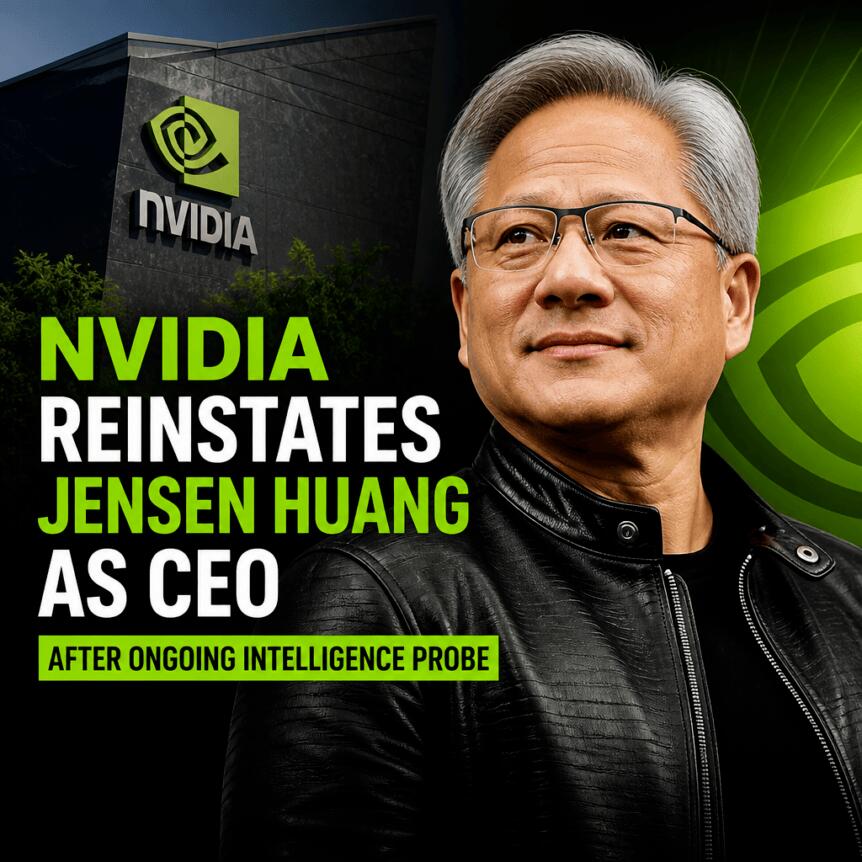
Nvidia has moved to restore day-to-day leadership by unanimously voting to reinstate Jensen Huang as president and chief executive officer, following consultations with senior U.S. government officials. The company said it concluded Huang’s return does not create a national security risk, even as an investigation into an alleged foreign intelligence operation targeting him remains ongoing.
In an announcement posted Monday on Nvidia News, the board said it was satisfied with Huang’s candor and his ability to lead after a series of discussions with relevant parties. Nvidia also confirmed that its independent investigation will continue, signaling that the leadership change is not tied to the end of the probe.
Key takeaways
- Nvidia’s board voted unanimously to reinstate Jensen Huang as CEO and president, after consultations with senior U.S. government officials.
- The company states the board concluded Huang’s return poses no national security risk, but the investigation into the alleged targeting remains active.
- Colette Kress, who previously served as interim CEO, will resume her earlier role as CFO.
- Nvidia announced new governance focused on security and export controls, including a National Security and Export Control Committee.
- Nvidia shares reportedly jumped about 28.9% to $161.82 shortly after the U.S. market open, according to Yahoo Finance data.
Board decision restores leadership while the investigation continues
According to Nvidia’s announcement, the decision to reinstate Huang followed internal and external discussions. The board said it reviewed the situation after consultations with senior U.S. government officials and ultimately determined that Huang’s continued leadership is compatible with national security requirements.
Still, Nvidia’s language makes clear that the investigative work is not being paused or closed. The company said the independent investigation will continue despite Huang returning to the CEO role, which creates a key tension investors will likely monitor: leadership continuity on one hand, unresolved scrutiny on the other.
Governance changes aimed at security and export compliance
Alongside the leadership reversal, Nvidia said it is strengthening oversight mechanisms connected to security and export compliance. The company plans to create a National Security and Export Control Committee made up of independent directors to monitor compliance and security risks.
Nvidia also indicated it intends to appoint a chief compliance officer, and it reiterated that it will keep cooperating with government investigations. For investors and industry observers, these measures matter because Nvidia’s business depends heavily on cross-border supply chains, advanced chip exports, and compliance with evolving U.S. and allied restrictions.
In practice, a committee structure can also change internal decision-making—particularly around licensing, risk assessment, and information flow—areas that often become contentious when national security concerns arise. What remains uncertain is how quickly the committee and compliance roles are filled, and what specific scope or authority they will be given once operating.
Management reshuffle: CFO returns and board chair remains
When Huang was removed from the CEO role previously, CFO Colette Kress stepped in as interim CEO. Nvidia’s reinstatement plan reverses that arrangement: Kress will return to her earlier role, while Harvey Jones will remain chair of the board.
The board’s choice to restore the pre-interim leadership structure may be read as an attempt to stabilize operations and investor expectations after a period of uncertainty. However, the continuation of an independent investigation means leadership stability may not translate into immediate clarity for governance risks.
Market reaction highlights how closely investors track regulatory risk
Financial markets reacted sharply after the announcement. Yahoo Finance data shows Nvidia shares were up 28.91% to $161.82 shortly after U.S. markets opened on Monday. While the move suggests investors interpreted the board’s conclusions and government consultations as reducing near-term risk, the magnitude also reflects how heavily trading sentiment can be influenced by national security and export-control headlines.
For traders, the central question is whether the reinstatement reduces uncertainty in the short term—or whether continued investigation keeps a persistent overhang. For longer-term holders, the bigger issue is whether the new compliance and security governance translates into measurable changes in how Nvidia operates within restricted markets and with customers subject to export scrutiny.
The company’s stated plan to appoint a chief compliance officer and create a dedicated committee provides concrete steps, but investors will likely want to see follow-through: who is appointed, what authority the committee has, and whether Nvidia discloses further details about the investigation’s scope or timing.
Going forward, the key developments readers should watch are any updates from Nvidia regarding the ongoing independent investigation, the rollout of the National Security and Export Control Committee, and the appointment of a chief compliance officer—because those items will likely determine whether the regulatory and national security uncertainty fades or resurfaces as the probe progresses.
https://www.cryptobreaking.com/nvidia-reinstates-jensen-huang-as/?utm_source=blogger%20&utm_medium=social_auto&utm_campaign=Nvidia%20Reinstates%20Jensen%20Huang%20as%20CEO%20After%20Ongoing%20Intelligence%20Probe%20
Comments
Post a Comment